

SFO Landing Restrictions Cut Arrivals Through October 2
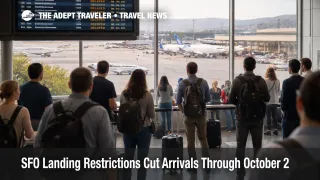
SFO landing restrictions became a larger traveler problem on March 31, 2026, after the Federal Aviation Administration cut San Francisco International Airport's maximum arrival rate from 54 to 36 flights per hour while Runway 1R remains closed for rehabilitation through October 2, 2026. That pushes the story beyond a normal runway works advisory and into a sustained arrival bottleneck at one of the country's biggest hubs. Reuters reported the airport now expects delays on about 25 percent of arriving flights, with many of those delays reaching 30 minutes or more. Travelers with tight same day connections, airport pickups, meetings, and onward ground plans should start treating SFO as a lower margin airport for the next six months.
SFO Landing Restrictions: What Changed
The runway closure itself was already known. SFO announced on December 30, 2025, that Runway 1R would close from March 30, 2026, through October 2, 2026, for repaving and taxiway improvements. At that point, the public message was that some delays were likely during the six month project. The March 31 shift is that the FAA has now imposed stricter landing procedures, including a ban on side by side landings on the airport's parallel runways in clear weather, which permanently lowers the airport's maximum arrival rate to 36 flights per hour. Reuters reported that this revised operating limit forced SFO to raise its expected arrival delay share to about 25 percent, above earlier airport assumptions.
That changes the operational picture. A runway project can create delays mainly at peak banks. A lower FAA arrival ceiling changes the system more fundamentally, because it constrains how quickly the airport can recover even when weather is good. The result is a steadier drag on inbound reliability, especially during the busiest parts of the day, not just an occasional construction slowdown.
Which Travelers Face the Most SFO Delay Risk
United Airlines and Alaska Airlines are the most exposed carriers in this story because Reuters says the two airlines account for about 60 percent of SFO passenger traffic. United is the larger risk point simply because SFO is one of its major hubs, which means more connecting passengers, more tightly banked arrivals, and more downstream disruption when inbound aircraft start arriving late. Alaska is also exposed because SFO remains an important West Coast station, and shorter haul schedules give travelers less buffer when the arrival stream slows.
The travelers most at risk are not only those flying to San Francisco, California. The more fragile itineraries are same day domestic to long haul connections, late afternoon and evening arrivals, and any trip that depends on an exact handoff to a rental car, hotel check in, cruise positioning night, or a meeting shortly after landing. First order, aircraft arrive late. Second order, gates turn later, crews and aircraft rotate later, and the next wave of departures can start slipping even if those flights were not originally part of the arrival queue problem.
What Travelers Should Do Now
Travelers flying into SFO through October 2 should add more buffer than they would normally use at a major West Coast hub. For local arrivals, that means protecting airport pickups, dinner reservations, and time sensitive appointments. For connecting passengers, it means avoiding short legal connections that look acceptable on paper but leave little room for a 30 minute or longer arrival delay. The safer move is to buy time before the trip rather than rely on a same day recovery at the airport.
For United and Alaska passengers, the decision threshold is straightforward. If the trip depends on an on time arrival, a tight onward connection, or a hard event start, pick the roomier connection, an earlier flight, or even a different Bay Area airport when that is practical. If the trip is more flexible, keep the booking but monitor schedule changes and day of travel conditions closely. Travelers meeting someone at SFO should also build in extra waiting time, because an arrival delay quickly becomes a curbside timing problem.
The next useful signal is whether SFO and the FAA can find a safe way to improve arrival throughput during the runway closure. Reuters reported the airport and FAA are working together on options, but the lower arrival cap is the live operating condition now. Until that changes, travelers should plan as though SFO's arrival side has less recovery capacity than usual for the rest of spring, summer, and early fall.
Why The Delay Story Got Bigger
The mechanism is simple, but the consequence is large. SFO's runway rehabilitation already reduced flexibility by taking Runway 1R out of service for months. The FAA restriction then tightened the remaining arrival process further by ending side by side landings on the parallel runways even in clear weather. When an airport loses both infrastructure flexibility and procedural capacity at the same time, delays stop being only a construction inconvenience and start acting like a network constraint.
That is why this became a stronger second angle than the original runway closure story. Earlier coverage could reasonably frame the project as a six month maintenance burden with some manageable delay risk. The March 31 FAA action materially changed the traveler consequence. It raised the share of affected arrivals, extended the pressure window, and made SFO more likely to feed delays into carrier networks that depend on it as a hub or focus city. What happens next depends on whether operating procedures improve, whether airlines retime flights, and how much summer demand presses on the reduced arrival ceiling. For now, the main risk is not airport closure, it is a lower margin arrival system that can punish tight plans.