

Philippines Holy Week Immigration Queues Build
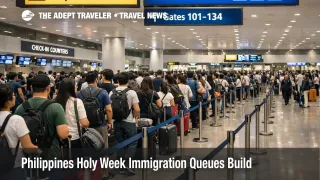
Philippines Holy Week immigration queues are becoming a live airport planning issue as the Bureau of Immigration moved to full deployment on April 1 and said daily departing international passengers could reach 45,000 across the country's major airports. The immediate pressure point is not runway capacity, it is document and border processing inside the terminal. For travelers leaving the country over the next several days, the practical response is to arrive earlier than usual, complete eTravel before leaving for the airport, and treat short landside to airside timing as fragile.
Philippines Holy Week Immigration Queues: What Changed
The Bureau of Immigration said on April 1 that it had placed all personnel on full force for the Holy Week exodus, added frontline staff, and mobilized support units as international departures climb toward an estimated 45,000 passengers a day. The agency repeated its advice for travelers to arrive at least three hours before scheduled flights and warned that queues are likely because of sheer passenger volume, even with extra staffing in place.
That changes the traveler calculation because the main risk now sits at the immigration counters and the surrounding pre departure flow. A long airport day does not begin only at the gate. It starts at curbside traffic, then check in, then document review, then immigration, then final security. When each layer adds even a modest delay, the total time loss becomes meaningful.
The clearest current stress signal is in Manila. Local reporting on April 1 showed long check in lines at Ninoy Aquino International Airport (MNL) Terminal 3, and GMA reported NAIA handled about 142,000 passengers amid the Holy Week rush. That does not prove a system wide breakdown, but it does show that the country's biggest gateway is already operating in a tighter margin environment than on a normal travel week.
Which Travelers Face the Most Exposure
International departures face the sharpest pressure because they stack more process points into the same pre flight window. A traveler with checked bags, a family group, or a booking that still requires manual document review will feel the queue problem sooner than a solo traveler who is already checked in and moving with only hand luggage.
Manila is the airport to watch first because it is the country's largest international gateway and because visible queue pressure is already being reported there. The Bureau's advisory, though, was written for the country's major airports more broadly, so travelers departing from other international gateways should not assume they are insulated if they are flying during the peak holiday banks. The difference is that Manila has the clearest published evidence of active strain right now.
The second layer of risk hits itineraries built on tight timing. Terminal changes, late curbside arrival, and same day domestic connections after an international arrival all become less forgiving when immigration and check in time expand. This is also why airport pickup timing matters. When flights push back late because passengers are still clearing formalities, landside meeting plans and onward road transfers start slipping as well.
What Travelers Should Do Before Departure
The minimum move is to finish eTravel before heading to the airport and save the QR code on the phone, plus a screenshot in case connectivity is weak. The Bureau of Immigration said registration is free and warned travelers not to use fake eTravel websites that charge money. The only official web address is etravel.gov.ph, and travelers can also complete the declaration through the government's eGovPH app.
For timing, the Bureau's floor is three hours before flight time. That is a baseline, not a universal safe margin. Travelers on international flights from Manila, anyone checking bags, and anyone traveling with children or elderly relatives should think closer to the four hour approach that Cebu Pacific has been pushing for international departures during the Holy Week rush. Domestic flyers without checked bags can usually work with less, but mixed itineraries and holiday traffic argue against cutting it close.
The decision threshold is simple. If the trip depends on a tight same airport connection, a complicated pickup, or a fixed onward booking, build more buffer now rather than hoping airport flow improves on arrival. If the itinerary is point to point and flexible, the extra time is mostly a comfort cost. If it involves a missed international departure penalty, a nonrefundable hotel, or a domestic link after arrival, the cost of underbuffering is much higher.
Why the Pressure Is Building, and What Happens Next
Holy Week is one of the Philippines' biggest annual travel surges, and the immigration layer tends to tighten when leisure demand, family travel, and holiday departure banks all pile into the same limited processing windows. Immigration is the border control step where outbound international passengers are checked before they can move deeper into the departure zone. When volume rises faster than processing speed, queues lengthen even if staffing has been reinforced.
That is why this story matters more as a terminal operations issue than as an air traffic story. First order, longer lines form at check in and immigration. Second order, terminal access, departure punctuality, airport pickups, and same day onward segments all become more fragile. Those second order effects are where travelers usually lose time and money.
Over the next 24 to 72 hours, the signals to watch are straightforward. If airport operators and local media keep reporting early morning curbside buildup, terminal crowding, and longer check in lines at Manila, the immigration layer is unlikely to ease much before the main Holy Week rush passes. If you are flying internationally from the Philippines during this window, treat eTravel completion, terminal verification, and early airport arrival as required pre departure work, not optional cleanup tasks.
Sources
- BI on full force for Holy Week exodus; warns vs. fake eTravel sites
- BI reminds Holy Week travelers to arrive early, secure documents ahead of travel
- Philippine Travel Information System
- Passenger volume at NAIA hits 142,000 amid Holy Week rush
- Long lines, fully booked trips greet travelers on Holy Wednesday
- Holy Week 2026: Cebu Pacific reminds passengers to arrive 4 hours before departure