

Brussels Airport EES Delays Threaten Easter Trips
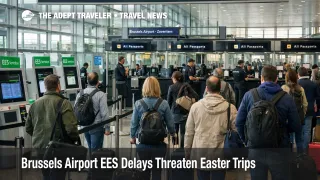
Brussels Airport EES delays have moved from abstract rollout risk to a concrete Easter planning problem at Brussels Airport (BRU). On March 30, the airport publicly asked for more flexibility in the rollout of the EU Entry/Exit System, after reporting waits of up to two hours at departures and up to 3.5 hours at arrivals for non European passengers, with nearly 600 passengers missing flights over four days. The timing is bad for holiday travel, because the airport then said on April 1 that it expects more than 1.25 million passengers from April 3 through April 19, with April 6 and April 13 among the busiest days.
The pressure point is not the whole airport equally. It is the handoff between security, outbound border control, and inbound passport processing for travelers who fall under EES rules. Brussels Airport said all passengers were required to be registered in EES from March 30, and that some nationals from the United States, the United Kingdom, Canada, and Singapore were no longer allowed to use departure e gates, pushing more people to staffed counters. That turns a border control issue into a broader airport timing issue, because one slow queue can break a short connection, a same day rail transfer, or even a nonstop if bag drop, security, and exit control stack too tightly.
Brussels Airport EES Delays: What Changed
The immediate change is that Brussels Airport itself is now warning that the rollout needs more flexibility before peak traffic deepens. Its March 30 statement said the system was already producing longer waits even without full biometric capture, and argued that the system should work smoothly in practice before it is fully rolled out. The European Commission, meanwhile, said on March 30 that EES started operations on October 12, 2025, with a progressive rollout in 29 European countries, and becomes fully operational on April 10, 2026.
That gap is the story. Brussels is not arguing that EES is optional. It is warning that a fixed legal deadline and real terminal throughput do not automatically line up. At BRU, the airport said border delays had already caused 21 hours of cumulative delay effects over four days, even while only 60 percent of passengers had been registered with partial biometrics. Once Easter demand hits and EES moves toward full scale, the operational margin gets thinner, not thicker.
Which Travelers Are Most Exposed at Brussels Airport
The most exposed travelers are non EU short stay visitors on their first EES affected Schengen entry, because first time enrollment requires passport data plus facial image and fingerprint capture, while later crossings are typically faster once that record already exists. Official EU material says EES applies to non EU nationals traveling for a short stay, and official guidance for Western Balkans travelers says first trips after EES starts require travel document data, a facial image, and four fingerprints, while subsequent crossings are usually faster.
At Brussels, that means the highest risk profiles are long haul arrivals making onward self connections, outbound non Schengen passengers who used to rely on quick e gate processing, families or groups whose slowest member sets the pace, and anyone landing or departing on the airport's peak Easter days. The airport expects about 74,000 passengers on April 3, and around 80,000 on both April 6 and April 13. Travelers trying to step straight from BRU into a timed train, a tour departure, or a short intra Europe connection are carrying the least slack.
EU and Belgian travelers are less exposed to this specific failure point. Brussels Airport said in October 2025 that EES does not apply to Belgian, EU, or Schengen travelers, and that their border process remains unchanged. The new friction sits mainly with third country nationals moving through external border control, which is why this is a segmented queue problem rather than an all passenger airport meltdown.
What Travelers Should Do Now
For Easter travel through Brussels, the practical move is to treat BRU like a border volatility airport, not a standard European transfer point. If your trip includes first entry into Schengen under EES, avoid tight onward rail bookings, same day nonrefundable tours, and short self connections. Brussels Airport's own Easter guidance says to allow at least two hours for Schengen flights and at least three hours for flights outside Schengen, including the United Kingdom, Ireland, and Turkey. For non EU travelers exposed to EES, that should be read as a minimum floor, not an ambitious target, especially on April 3, April 6, and April 13.
The rebook versus wait threshold is pretty simple. Wait if BRU is your final destination, your carrier shows the flight on time, and you have no tight timed commitments after landing. Change plans earlier if the itinerary depends on a short onward flight, a separate ticket, a rail connection from the airport station, or an evening arrival with little recovery room. Border queues do not just delay you at passport control, they shift failure downstream into missed trains, missed bag drop cutoffs, and forced hotel changes.
Monitor three things over the next several days. First, whether Brussels or Belgian authorities restore broader e gate use for some third country nationals. Second, whether staffing at federal police border posts improves enough to keep waits inside a usable range. Third, whether the airport changes its public guidance as April 10 approaches and the system reaches full operation across the 29 participating countries. Those are the signals that would show Brussels Airport EES delays stabilizing, rather than deepening into a bigger Easter and early summer connection problem.
Why Easter Volume Makes This More Serious
The bigger issue is throughput. EES is designed to replace passport stamps with digital records, biometric checks, and shared data on entries and exits for non EU short stay travelers. That can improve border enforcement and identity verification over time, and the Commission says the system has already logged more than 45 million crossings and helped detect refused entries and identity fraud cases. But systems that add time per passenger can still fail operationally at peak banks if staffing, terminal layout, and queue segregation are not ready.
Brussels Airport has been warning about that exact mechanism for months. In October 2025 it said sufficient border control staffing would be essential, noted the installation of 61 self service registration kiosks and 36 new e gates, and argued that allowing certain third country nationals to keep using e gates would reduce waiting times. Its March 30 statement shows that the concern was not theoretical. The airport is now asking for more flexible rollout precisely because Easter volumes are rising, summer is next, and the terminal has already shown what happens when border processing expands faster than flow can absorb it.
Sources
- Brussels Airport calls for further flexibility in implementation of the new European border registration system
- More than 1.25 million passengers at Brussels Airport during the Easter holidays
- The Entry/Exit System will become fully operational on 10 April 2026
- Entry/Exit System (EES), Migration and Home Affairs
- Entry - Exit System (EES): what Western Balkans travellers need to know