

Egypt Nile Cruise Capacity Grows With Viking Ships
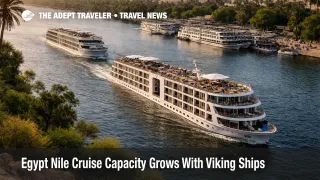
Egypt Nile cruise capacity is set to expand in fall 2026 as Viking prepares to add two more 82 guest ships to its Nile program. The company said the Viking Ptah and Viking Sekhmet completed float out ceremonies in Cairo and are scheduled to debut in September and November 2026 on the 12 day Pharaohs & Pyramids itinerary. That is a real availability signal for travelers looking at Egypt for late 2026 and 2027, but it also raises a second question, where the pressure lands once more cabins feed the same Luxor to Aswan corridor, the same docks, and many of the same marquee sites.
Egypt Nile Cruise Capacity, What Changed
Viking's announcement matters because it is part of a much larger fleet build on the Nile, not a one off ship delivery. The line already says these two vessels will join Viking Osiris, Viking Aton, Viking Sobek, Viking Hathor, Viking Amun, and Viking Thoth in Egypt, and earlier company statements said its Nile fleet is on track to reach 12 vessels by 2027. Egypt is also entering this expansion after a record tourism year, with official figures showing nearly 19 million visitors in 2025. More ships on the river should improve the odds of finding space in peak periods, and over time that can help travelers who were priced out or pushed into less convenient sailing dates.
The traveler benefit is straightforward. More purpose built capacity can mean more departure dates, more room in the premium segment, and better recovery options if one sailing fills or a supplier needs to reshuffle guests. That is especially relevant in Egypt, where the classic river portion is only one layer of a broader trip that often also includes Cairo, internal flights, transfers, and tightly timed temple visits. In an earlier Adept Traveler article, Egypt Nile Cruises Restart With Viking on March 12, the operational story was whether departures would run at all. The story now is different. Assuming regional conditions stay stable enough for normal operations, more supply shifts the traveler problem from outright access to how smoothly that added volume moves through the Nile corridor.
Who Benefits Most, and Where Friction Could Rise
The biggest winners are travelers who want a high end Egypt trip but need more date flexibility, especially for fall and winter departures when demand is usually strongest. Advisors and independent travelers both gain from a wider set of cabins and sailings, because that creates more ways to match Cairo stays, domestic flights, and post cruise extensions without forcing an awkward schedule. Travelers who are booking farther out for 2027 should also see a larger pool of Viking inventory than the market had just a few years ago.
The tradeoff is that Nile growth concentrates pressure in a narrow geography. Most mainstream Nile cruise itineraries still revolve around the same Upper Egypt sequence between Luxor and Aswan, with the same docking zones, the same early morning excursion rhythms, and many of the same archaeological draws. As a result, extra ship capacity does not spread evenly across Egypt. It tends to stack at embarkation points, coach loading areas, and headline sites during the busiest touring windows. That can mean longer waits to board, more boats rafted together at docks, more crowded transfers, and a less forgiving schedule for travelers who assume a river cruise will automatically feel low friction on shore as well as on board. UNESCO's long running site management guidance also notes that visitor flows at major heritage sites need active distribution rather than simple volume growth.
There is a positive side for destinations as well. More sailings support hotel nights, guides, drivers, museums, restaurants, and ancillary touring demand in Cairo, Luxor, and Aswan. But the operational downside is real when more ships compete for finite docking and touring windows. That is where travelers can feel crowding first, not necessarily in the onboard product, but in the handoffs around it.
What Travelers Should Do Before Booking
Travelers considering a Nile trip should treat the river cruise itself as only one booking decision. The more important question is whether the rest of the itinerary can absorb friction at the dock and on shore. If a trip depends on a same day handoff from a flight to embarkation, or from disembarkation to a long transfer or fixed flight, more buffer makes sense. A river product can feel premium while still becoming brittle if the transfer chain is too tight.
The next threshold is trip style. Travelers who care most about a calmer shore experience should look closely at sailing dates, shoulder season departures, and how much coach based sightseeing is bundled into the itinerary. Those who care most about securing a specific brand or cabin type may benefit from booking earlier, because more ships do not automatically mean low crowding at the exact dates everyone wants. Travelers still working through entry logistics should also review Egypt Tourist Entry Requirements For 2026 before they lock flights and cruise dates.
Over the next 24 to 72 hours, there is no disruption signal to monitor here. This is a structural growth story. The main watchpoints are whether more operators keep adding Nile inventory, whether Egypt continues pushing toward higher visitor totals, and whether the traveler experience at Luxor and Aswan stays manageable as more cabins enter service. For late 2026 and 2027 planners, the best use of this announcement is not assuming unlimited ease. It is using the added Egypt Nile cruise capacity to secure a better date, then building enough flexibility around the ship to protect the rest of the trip.
Why Nile Growth Helps and Hurts at the Same Time
River cruise growth is usually read as a confidence signal, and that reading is fair here. Viking is still investing in Egypt after several years of expanding its purpose built Nile fleet, and the company is doing it in a destination that just posted record visitor numbers. For travelers, that points to sustained supplier confidence in Egypt demand, and to a product that is moving deeper into the mainstream premium market rather than staying niche.
But river cruising is not like adding hotel rooms in a large city where demand can disperse across neighborhoods and activities. On the Nile, capacity tends to flow through a tighter operational funnel. More ships can improve access and traveler choice while also making the corridor feel busier at exactly the moments that shape the experience most, embarkation, disembarkation, temple touring, and dockside transfers. That does not make growth bad for travelers. It means the next phase of the Egypt story is less about whether the Nile is back, and more about whether operators and local infrastructure can keep the on shore experience from feeling compressed as Egypt Nile cruise capacity keeps rising.
Sources
- Viking Announces Float Out of Newest Nile River Ships
- Viking Announces Float Out of Newest Nile River Ships, Investor Relations
- Viking Floats Out Newest Egypt Ship
- Egypt Tourism Records Historic Growth in 2025 Receiving 19 Million Tourists
- Managing Tourism at World Heritage Sites
- Egypt Nile Cruises Restart With Viking on March 12
- Egypt Tourist Entry Requirements For 2026