

Uniworld S.S. Emilie Launch Adds River Capacity
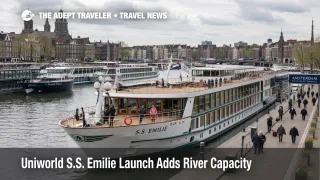
Uniworld's new S.S. Emilie is more than a ship christening story. The 154 guest vessel entered service in late March 2026 on a 10 day Tulips & Windmills sailing, giving Uniworld its first new build since 2020 and adding fresh premium capacity into a European river system that is still seeing strong demand, tighter berth management, and growing debate over how much cruise traffic historic cities want to absorb. For travelers, the immediate effect is positive, more choice, newer hardware, and potentially better onboard efficiency. The longer term effect is more complicated, because European river cruise expansion can also mean busier docks, more crowded call times in popular towns, and more pressure on destinations already trying to spread visitors more evenly.
European River Cruise Expansion: What Changed
S.S. Emilie officially began service in late March, after a christening ceremony led by Uniworld president and chief executive officer Ellen Bettridge. The ship is named for Emilie Flöge, the longtime partner and muse of Gustav Klimt, and Uniworld positions it as a design forward vessel with more modern and efficient technology than older ships in its fleet. Uniworld's own ship and itinerary pages show Emilie tied not only to the spring Netherlands and Belgium season, but also to longer 2026 European programs that connect it to Rhine, Main, and Danube linked sailings later in the year.
That is the core travel intelligence angle. A single 154 guest ship does not transform Europe's rivers on its own. But it adds capacity to a market already expanding. A recent market study reported European river cruise passenger numbers up 8 percent in 2024 to roughly 1.49 million travelers, while another industry market observation described 2024 passenger growth in Europe at double digit pace from 2023. The ship launch therefore fits a broader pattern, operators are still investing because bookings and traveler interest remain strong enough to support more berths.
Who Benefits Most, and Where Pressure Can Build
The clear winners are travelers who want the river cruise product itself. More new tonnage usually means newer cabins, better energy systems, and more chances to book popular spring and shoulder season itineraries without running into the same sellout pressure that has defined parts of the post pandemic river market. It also helps destinations that benefit from steady, high spending visitors arriving outside the peak summer crush associated with larger ocean cruise volumes.
The tradeoff is that destination and dock pressure can rise even when each individual ship is relatively small. River cruising is built around direct access to city and town centers, which is part of the appeal, but that also concentrates arrivals at the same piers, on the same walking routes, and during the same excursion windows. Amsterdam is a live example. The city's tourism policy explicitly calls for restricting river cruises, and its water policy says cargo vessels, ferries, and cruise ships already jostle for space on the River IJ. Travel industry reporting says Amsterdam has started reducing river cruise calls as part of a wider overtourism strategy, even as ocean cruise limits also tighten.
That does not mean travelers should treat every new ship as a crowding problem. It means the traveler experience now depends more on where capacity is being added. A new vessel helps when it spreads demand into shoulder seasons, longer itineraries, or less saturated ports. It hurts the experience when multiple lines stack arrivals into the same marquee stops, and the destination responds with berth caps, coach substitutions, or limits on where ships can actually tie up.
What Travelers Should Do Before Booking
Travelers looking at S.S. Emilie or similar new builds should book with their eyes open. The upside is straightforward, newer ship design, fresh inventory, and a product category that still delivers easy access to multiple cities without repeated unpacking. The more serious planning question is not whether the ship is attractive, it is whether the itinerary relies heavily on ports and cities already moving to control tourism volumes or berth access.
For spring tulip itineraries and core Rhine corridor voyages, travelers should ask exactly where embarkation and disembarkation occur, whether the line is using central berths or outlying coach transfer points, and how often excursions move in large groups at the same hour. That matters more now because dock competition can change the convenience equation that river cruise marketing often takes for granted. A ship may still visit Amsterdam or another headline city while using a less central mooring, which changes transfer time and the feel of the trip even if the brochure itinerary stays intact.
The booking threshold is simple. Choose the new ship if onboard quality and itinerary design are your priority, and if you are comfortable with the possibility that some busiest ports may require more bus time or more structured touring. Wait, or compare alternatives, if your main goal is maximum independent time in city centers and minimal group movement friction. Over the next 6 to 12 months, the most useful signal to watch is not another christening, it is whether major river cities add more berth restrictions, reroute cruise docking, or push even harder to spread visitor flows away from the most saturated zones.
Why the Next River Cruise Story Is About Capacity, Not Just Launches
The bigger story is that river cruise growth now has two headlines running at once. One is confidence. Lines are adding ships because demand is holding, travelers are still booking, and premium operators believe the market can absorb more product. The other is constraint. Historic cities and riverfront infrastructure do not scale infinitely, so every added vessel increases the importance of berth management, excursion timing, local transport, and political tolerance for tourism volumes.
That can cut both ways for destinations. Positively, more ships can support hotels, guides, restaurants, museums, coach operators, and shoulder season tourism spend in places that benefit from steady, high value arrivals. Negatively, they can intensify crowding at dockside, compress tour timing, and sharpen backlash in cities that already believe tourism has outgrown local infrastructure. Amsterdam's current posture shows where this can lead, not an end to river cruising, but tighter management of who gets in, where they berth, and how many visitors arrive by water.
For Adept Traveler purposes, that is the better way to read S.S. Emilie. It is not just a luxury product launch. It is another data point showing that European river cruise expansion is continuing, while the destinations receiving those ships are becoming more selective about how that growth lands. Travelers should expect the category to keep improving onboard, while becoming more operationally complex ashore.
Sources
- S.S. Emilie | Ships, Uniworld
- Tulips & Windmills 2026, Uniworld
- 2026 Port Locations & Boarding Times, Uniworld
- Uniworld Boutique River Cruises Celebrates Launch of New Ship S.S. Emilie, TravelPulse
- European river cruises grow with overseas demand, Seatrade Cruise News
- Passenger Transport, CCNR Inland Navigation Market Observation
- Policy: Tourism, City of Amsterdam
- Policy: Water and boating, City of Amsterdam
- Amsterdam has a 100 cruise cap on ocean ships taking effect this year, and cuts to river cruise calls begin this year, Travel Weekly