

Celebration Key Adds Sensory Support for Cruises
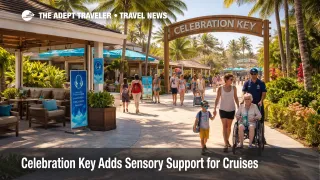
Celebration Key sensory support has become a real trip-planning feature, not just a shipboard accommodation talking point. Carnival Cruise Line said on April 2, 2026, that its private destination on Grand Bahama is now the first cruise destination certified by KultureCity for sensory inclusion, extending support beyond the ship and into the beach day itself. That gives families traveling with autism, PTSD, dementia, ADHD, and other sensory or cognitive needs a clearer signal about what resources may be available once they go ashore. The change is not a disruption story, but it is operationally useful for travelers deciding whether a private-island stop will feel manageable or overwhelming.
Celebration Key Sensory Support Changes the Destination Day
The main change is that Carnival has moved its accessibility partnership with KultureCity into Celebration Key itself, rather than limiting the practical benefit to the onboard environment. Carnival said more than 400 guest-facing team members at Celebration Key have been trained to help guests with sensory needs navigate the destination, and the line is offering complimentary sensory bags with noise-reducing headphones, fidget tools, filtered glasses, a VIP lanyard, and a visual feelings thermometer for nonverbal communication. Carnival also said a sensory room pop-up was scheduled at Celebration Key for April 3, 2026, as part of the certification announcement.
That matters because private cruise destinations are usually high-stimulation environments. They are built around loud music, bright sun, water attractions, queueing, crowd movement, and frequent transitions between ship, pier, tram, beach, dining, and excursion areas. A family that can manage the ship may still struggle once the shore day becomes less predictable. Carnival's move does not remove those stressors, but it adds staff training and a visible support system at the point where many families need it most.
Who Benefits Most at Celebration Key
The clearest benefit is for families who already cruise Carnival and have been weighing whether a private-destination stop is worth the stress. Carnival's broader KultureCity partnership already covers its ships, where the line says guest-facing crew are trained and sensory bags can be checked out for the duration of the cruise on a complimentary, first-come, first-served basis. Bringing a similar support model to Celebration Key makes the overall itinerary feel more continuous from ship to shore.
This also helps travelers who do not always appear in cruise marketing around accessibility. KultureCity's certification program is not limited to autism. The nonprofit says sensory inclusion can also apply to guests with PTSD, dementia, Parkinson's disease, stroke effects, and other conditions that make noise, light, crowds, or abrupt environmental shifts harder to process. For multigenerational cruise groups, that widens the practical value beyond families traveling with children.
The seriousness here is moderate, but meaningful. It is not the kind of change that reshapes cruise fares or routing. It does make one part of the cruise experience more usable for a specific traveler segment, and that can be the difference between booking confidently and avoiding a private-island itinerary altogether. The main limitation is that certification does not guarantee a low-stimulation destination. It means the venue has training, tools, and procedures in place to support guests when the environment becomes too much.
How Travelers Should Plan Around It
Travelers considering Celebration Key should treat this as one planning advantage, not as a reason to assume the destination will automatically feel calm. The beach club, lagoon, dining, and family activity areas that Carnival promotes are still built for high guest volume, and Celebration Key was designed to handle millions of visitors per year. Families who benefit from predictability should still think through timing, sun exposure, crowd patterns, walking distances, and whether the most stimulating parts of the destination are necessary for a good day ashore.
Before sailing, the practical move is to use Carnival's accessibility process early, especially if a guest may need a sensory bag or other accommodation support onboard. Carnival says guests with sensory or cognitive needs, or their travel companions, should meet with Guest Services once onboard to discuss accommodations, and the line directs travelers to its pre-cruise forms for disability-related needs. The next decision point is whether your family needs a structured shore plan, with built-in breaks and a fallback option to return to the ship, rather than an open-ended beach day.
Travel advisors also have a more concrete accessibility feature to discuss now when comparing Caribbean itineraries. For travelers choosing between similar private-destination cruises, Celebration Key's certification may become a tiebreaker, especially for families who have avoided sensory-heavy resort settings in the past. What travelers should watch next is whether Carnival expands the same shore-side model to other destinations, and whether competitors respond with their own verified sensory inclusion programs instead of looser accessibility claims.
Why Carnival Is Pushing This, and What Happens Next
Carnival's announcement fits a longer accessibility partnership, not a one-off April campaign. KultureCity says Carnival was the first cruise line to become Sensory Inclusive Certified, and Carnival's public accessibility materials describe trained guest-facing crew, onboard sensory bags, and other support resources already in place across the fleet. Celebration Key extends that framework to a destination Carnival opened on July 19, 2025, after a $600 million investment on Grand Bahama.
The broader mechanism is straightforward. Cruise lines increasingly sell private destinations as controlled, high-margin extensions of the onboard experience. Once the destination becomes part of the branded product, accessibility gaps ashore are harder to dismiss as someone else's problem. Carnival appears to be treating sensory inclusion as part of the destination design and staffing model, which is more significant than a temporary activation or awareness-month message. If that approach proves commercially useful, the next likely step is deeper integration into booking guidance, shore-day planning materials, and competitive positioning across the private-destination market.
Sources
- Carnival Cruise Line Marks World Autism Acceptance Month With First Sensory Inclusive Cruise Destination Certification
- KultureCity "Sensory Certified" | Special Needs | Carnival Cruise Line
- Carnival Cruise Line | KultureCity
- Sensory Inclusive(R) Certification | KultureCity
- Carnival Cruise Line Opens $600M Celebration Key, Its Spectacular New Exclusive Destination