

South Tyrol Rail Buses Replace Bruneck, Innichen Trains
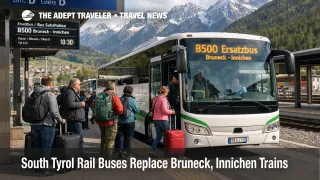
South Tyrol rail replacement buses are now the practical reality on the upper Puster Valley corridor after trains between Bruneck/Brunico and Innichen/San Candido were suspended from 400 a.m. on March 30, 2026, to 400 a.m. on April 29, 2026. Trains are canceled through April 28 and replaced by buses, with official notices warning that bus times can vary with road traffic. For travelers using eastern South Tyrol for Dolomites stays, same day hotel arrivals, or onward cross border links, this is a meaningful itinerary problem rather than a minor timetable tweak. The safest move is to treat the rail leg as a bus transfer, add buffer, and avoid building tight same day connections around the affected stretch.
South Tyrol Rail Replacement Buses: What Changed
The disruption is not a short weekend works window. RFI, Italy's rail infrastructure manager, says the Bruneck to San Candido section is suspended for infrastructure upgrade work from March 30 to April 29, 2026, and that replacement buses are standing in for the trains until April 28. South Tyrol's mobility authority gives the same closure window and ties the works to preparation for ETCS, the European Train Control System, along with additional maintenance on the line.
Operationally, the biggest change is that the replacement service does not behave like a one for one station stop train. The B500 bus runs every 30 minutes by day and hourly in the evening between Bruneck and Innichen, but it does not serve every railway stop. Instead, the official FAQ says the buses use a mix of rail stations and central town bus stops: Bruneck station platform D, Paul Tschurtschenthaler Platz in Bruneck, Percha town hall, Olang Anholz station, Welsberg Platzbäck, Niederdorf Von Kurz Platz, Toblach bus station platform B, Innichen Außerkirchl, and Innichen station. The journey time between Bruneck and Innichen is about 55 minutes.
Which Dolomites Itineraries Face the Most Friction
The travelers most exposed are those who were using the railway as a clean last mile into the eastern Dolomites, especially for stays around Innichen, Toblach, Niederdorf, Welsberg, Olang, and nearby resort areas where a rail arrival normally gives a more predictable handoff to hotels, local buses, or pickups. Anyone carrying ski gear, hiking gear, or bulky luggage is more exposed because the rail to bus shift adds a physical transfer and pushes more volume onto roads. Travelers with reduced mobility also need to plan ahead, because the mobility authority says assistance can be arranged, but requests should be made in advance.
The second tier is travelers chaining this corridor into longer regional trips. Innichen is also the interchange point for the replacement service toward Sillian in Austria on part of April, and South Tyrol's published notices make clear that the upper Puster Valley closure is part of a broader modernization program. That means a delay on the bus segment is not only a local inconvenience. It can compress onward train, coach, airport, or hotel timing across a wider Alpine itinerary. Even when the B500 runs frequently, road traffic is a variable the train did not have, and both RFI and South Tyrol's mobility authority explicitly warn that bus timings can shift with traffic conditions.
What Travelers Should Do Now
For most leisure travelers who are already committed to the corridor, the right play is not necessarily to scrap the trip. It is to rebuild the middle of the day more conservatively. Treat Bruneck as the key transfer point, assume the bus leg will be slower and less exact than the train it replaces, and avoid counting on a tight same day connection at Innichen. If your hotel check in, guided activity, or airport transfer has a hard cutoff, warn the supplier now and build extra arrival margin on both ends of the affected segment.
A car rental starts making more sense when your trip involves multiple stops off the rail corridor, bulky gear, or fixed time commitments that a delayed replacement bus could break. Sticking with public transport still works best when your origin and destination line up closely with the published B500 stop pattern and you have enough slack in the day to absorb road delay. Regional bus line 402 is also listed by South Tyrol's mobility authority as a fallback option in some cases, though it is not a simple substitute for every traveler because it serves a different stopping pattern.
Bike travelers need to be especially careful. South Tyrol's mobility authority says normal bicycles are not allowed on the replacement buses, although folding bikes and folded e scooters can travel as luggage. That is a trip breaking detail for anyone planning a rail based cycling itinerary through the valley.
Why the Disruption Spreads Beyond One Rail Segment
The underlying cause is infrastructure work, not a one off operating failure. RFI says the closure is tied to infrastructure upgrades, while South Tyrol's mobility authority says the corridor is being prepared for ETCS and other maintenance work as part of the larger Puster Valley rail modernization. In plain language, the line is being taken out of normal use so it can be made more capable and more standardized later, but the near term cost is a less reliable surface transfer during the closure window.
What happens next is straightforward, but not friction free. The published plan is bus replacement until April 28, with rail service expected to resume from 4:00 a.m. on April 29, 2026, if the works stay on schedule. Until then, the corridor's weak point is the road based substitution itself. Travelers should monitor the südtirolmobil journey planner and live updates page before departure, because the official warning about traffic dependent bus timing means conditions can shift on the day even when the closure itself is long scheduled.