

Southern Italy Rail Works Cut Salerno Taranto Trips
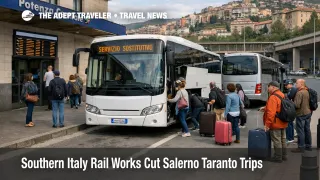
Salerno Taranto rail works are still disrupting southern Italy train travel after Trenitalia confirmed that traffic is suspended between Battipaglia and Potenza, and between Metaponto and Potenza Centrale, from March 1 through June 13, 2026, while the works themselves continue through June 30. The pressure point is not one train class or one weekend. Regional trains, Intercity services, and named Frecciarossa links all face cancellations, truncations, or replacement buses, which keeps this corridor risky for travelers heading between Campania, Basilicata, and Puglia in spring and early summer. Travelers with same day ferries, timed hotel arrivals, tours, or onward regional transfers should treat the rail plan as conditional, not automatic.
Salerno Taranto Rail Works: What Changed
The disruption sits on the Battipaglia, Potenza, Metaponto axis that feeds both local journeys and longer north south travel. Trenitalia says regional trains on the Taranto, Potenza Centrale, Salerno relation are canceled and replaced by buses, while regional services on the Naples, Salerno, Buccino San Gregorio Magno side are either cut back to Battipaglia or canceled on the Battipaglia, Potenza section. That means some itineraries still show rail on one side of the journey, but not on the other, which is where travelers can get caught if they assume a through trip is intact.
The longer distance impacts are more serious than a normal regional worksite advisory. Intercity 700 and 701 are replaced by bus on the Taranto, Battipaglia section, while Intercity 702 and 707 are replaced by bus on the Taranto, Napoli Centrale section. Trenitalia also says Frecciarossa 9514, Taranto to Torino Porta Nuova, is canceled from Taranto to Salerno from March 1 through June 30, and Frecciarossa 9547, Milano Centrale to Taranto, is canceled from Salerno to Taranto from February 28 through June 29. RFI's project notice ties the work to infrastructure and technology upgrades intended to improve reliability, accessibility, and running speeds on regional and interregional lines, but for travelers the near term reality is slower, more fragile journeys.
Which Travelers Face the Most Disruption
The most exposed travelers are not only people riding the full Salerno to Taranto corridor. Anyone trying to cross southern Italy without a car, especially between Salerno, Battipaglia, Potenza, Ferrandina, Metaponto, and Taranto, is dealing with a broken chain where train, bus, and station forecourt transfers now matter as much as the rail ticket itself. Travelers headed to Matera via Ferrandina Scalo Matera, to Basilicata hill towns via Potenza, or to Ionian coast connections through Metaponto and Taranto should expect longer elapsed travel times and less recovery room if one leg runs late.
The practical difficulty is that the substitute buses do not always stop exactly where rail passengers expect. Trenitalia says most buses stop in the station forecourts, but regional exceptions include Buccino San Gregorio Magno at the Bv. FS stop, Sicignano degli Alburni at the Rist. Il Camionista bus terminal, Contursi Terme at Contursi Scalo, and Battipaglia on the right side of the station square along Prolungamento via Ferrovia. Intercity exceptions matter too, with Potenza at viale Guglielmo Marconi, Napoli Centrale at the Corso Arnaldo Lucci bus terminal, and Sicignano degli Alburni on SP 36 near contrada San Licandro II. That adds real transfer risk for anyone arriving with luggage, limited mobility needs, or a tight onward booking.
What Travelers Should Do Now
Keep the rail plan if the train is only one part of a flexible day, you have no hard same day connection at the far end, and the itinerary already shows the replacement bus in Trenitalia's booking flow. Break the trip, or switch modes, when you are protecting a ferry departure, a nonrefundable hotel check in window, a tour start, or a regional last train later the same day. On this corridor, the main risk is not only cancellation. It is the cumulative loss of buffer once bus travel, road traffic, and station transfer friction are layered on top of each other.
High speed passengers should be especially skeptical of any plan that depends on the Taranto end of the Frecciarossa link remaining seamless. Trenitalia is not running the affected Taranto, Salerno sections of FR 9514 and FR 9547, and the replacement PZ114 and PZ147 buses are there to feed the surviving Frecciarossa connection, not to preserve high speed timing in the way travelers normally expect. If the goal is reliability rather than the cheapest through fare, an overnight break in Salerno, Naples, or another hub can make more sense than trying to force a same day long corridor journey across multiple substituted legs.
Regional passengers should also note the bus restrictions before travel day. Trenitalia says bus times can vary with road traffic, bicycles are not allowed onboard, and large animals are not permitted, though assistance dogs are allowed. That matters for spring cycling itineraries, hiking trips, and rural stays where a bike or pet was part of the transport plan, because the fallback is not equivalent to rail.
Why the Disruption Lasts, and What Happens Next
This is a structural works story, not a one off operational wobble. RFI says the line is in a new phase of infrastructure and technology upgrades on the Battipaglia, Potenza, Taranto axis, aimed at improving infrastructure performance, accessibility, and service regularity. That helps explain why the disruption window is long, why multiple service classes are affected, and why travelers should not expect the corridor to behave like a normal spring timetable until the work phases are cleared.
The next planning point is not just June 13. The broad suspension window on the affected sections runs through June 13, but Trenitalia and RFI both show work continuing to June 30, and the named Frecciarossa cancellations and many bus programs also run to the end of June. For travelers, that means the safe assumption is continued friction for most of June, even if some operating patterns evolve before then. The best move is to recheck Trenitalia shortly before ticketing and again before departure, because the operator says its sales channels are updated, and the exact bus timing and train handling can shift within the wider work period.
Sources
- Linee: Napoli C.le - Nocera Inferiore - Salerno - Buccino S.G.M.; Napoli C.le - Eboli; Taranto - Metaponto - Potenza C.le; Roma T.ni - Taranto | Trenitalia
- LINEE NAPOLI C.LE - NOCERA INFERIORE - SALERNO - BUCCINO S.G.M.; NAPOLI C.LE - EBOLI; TARANTO - METAPONTO - POTENZA C.LE; ROMA TERMINI - TARANTO | RFI Infomobilità
- RFI - Basilicata: Al via una nuova fase dei lavori di potenziamento infrastrutturale e tecnologico sulla linea Battipaglia-Potenza-Taranto