

Fiji Princess Grounding Raises Fiji Cruise Risk
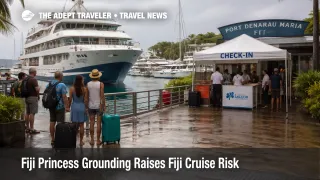
Blue Lagoon Cruises passengers with near term Fiji sailings now face a more practical problem than the grounding itself. The MV Fiji Princess ran aground near Monuriki Island on April 4, 2026, all 30 passengers were evacuated without injury, and salvage work is still tied to weather and sea conditions. For travelers booked in April, the immediate question is whether the next departure runs as sold, shifts to another vessel, changes stops, or slides to a later date. The operator's website still lists current itineraries and fares, but as of publication it does not appear to have posted a public travel alert or schedule update for upcoming departures.
Fiji Princess Grounding: What Changed
The verified change is straightforward. The Fiji Princess grounded near Monuriki Island, passengers were taken off the ship and moved to Denarau Island, fuel and onboard oils were later removed to reduce pollution risk, and Fiji authorities say further salvage work will begin when conditions improve. That means this is no longer just a one night marine incident. It is an active operational disruption involving the same vessel Blue Lagoon Cruises uses for small ship sailings in Fiji's Mamanuca and Yasawa islands.
Blue Lagoon Cruises continues to market April 2026 departures and still sells the Fiji Princess experience as a small ship product built around bays, reefs, and island stops that larger vessels cannot easily reach. Its 7 night Escape To Paradise cruise also explicitly markets a stop at Modriki Island, the Cast Away filming location that overlaps with the same kind of itinerary value travelers are buying here. That matters because even if the next sailing operates, passengers may not receive the original vessel, sequence, or signature stop pattern they expected when they booked.
Which April Fiji Cruises Face the Most Uncertainty
The most exposed travelers are those booked on departures that would normally rely on the Fiji Princess before the operator's second ship settles into its late April 2026 role. Blue Lagoon's itinerary page still shows Explorer and Escape to Paradise departures valid through April 17, 2026, and Wanderer departures valid through April 20, 2026. Its current ship pages and terms also say the Yasawa Princess II operates from late April 2026, while from April 27 the company plans a two ship setup in which Fiji Princess predominantly handles the 3 night and 7 night Friday departures and Yasawa Princess II predominantly handles the 4 night Monday departures.
That creates two different traveler risk bands. The first is the immediate window, where passengers booked in the next days or weeks face the highest uncertainty because the grounded ship is still in recovery mode and no public sailing update is visible on the operator's site. The second is the late April and onward window, where Blue Lagoon's own terms give it wide room to substitute vessels, combine sailings, amend itineraries, or change schedules for operational and safety reasons. That reduces outright trip loss risk, but it does not preserve the original ship, stop mix, or timing in the way many small ship passengers assume.
Families should pay especially close attention. Blue Lagoon's family departure page lists April 2026 family dates on both the 3 night and 7 night products, including Friday, April 10, 2026. When a disruption hits a small ship product with limited weekly departures, the second order effect is not just one missed cruise. It can also push pressure into Denarau hotel nights, airport transfer timing, and prebooked resort stays that were built around a fixed Friday or Monday sailing rhythm.
What Travelers Should Do Before Departure
Passengers sailing within the next 7 to 14 days should not assume silence means normal operations. Contact Blue Lagoon Cruises directly and ask four specific questions in writing, whether your departure is still operating, whether the vessel has changed, whether any island stops have been removed or substituted, and what ground arrangements apply if the departure date changes. The company's contact page lists a Fiji phone number, WhatsApp contact, and the cruisecentre email, and its check in point remains Port Denarau with check in one hour before departure.
The decision threshold is tighter than on a large ship line. If your cruise is the anchor product for a broader Fiji trip, meaning flights, resorts, or timed transfers depend on it, it is smarter to force clarity now rather than wait until arrival in Denarau. Blue Lagoon's terms say vessel substitutions, schedule changes, itinerary changes, and cancellations can happen for operational, weather, maintenance, or safety reasons, and standard cancellation penalties become steep inside 60 days. Travelers with comprehensive insurance should review interruption and operator change coverage now, not after they reach Fiji.
For later April and May travelers, the main question is not whether Fiji cruising stops. It is whether your sailing becomes a different product than the one advertised. The operator says guests may travel on either ship and that the company can substitute or combine sailings. If you booked mainly for the intimate Fiji Princess layout, a specific cabin type, or a Cast Away linked island stop, ask whether those features remain realistic for your date. If the answer is vague, build more flexibility into your pre and post cruise plans around Port Denarau and Nadi.
Why the Disruption Could Spread Beyond One Sailing
Small ship Fiji itineraries are inherently less buffered than big ship cruise operations. The same qualities that make Blue Lagoon attractive, shallow access, close shore approaches, reef heavy itineraries, and a low guest count, also mean there is less spare capacity when one ship goes offline. Blue Lagoon itself highlights that the Fiji Princess can reach bays and islands larger ships cannot, and its own "flexible cruising" language says itineraries may change for weather or local conditions. That operational flexibility is a selling point in normal weeks, but after a grounding it becomes the mechanism that can reshape multiple departures without a formal season wide suspension.
What happens next depends on salvage progress and sea state more than on marketing schedules. Fiji authorities said on April 7 that about 23,000 litres of fuel had been removed and that further salvage work would wait for improved weather and sea conditions. Until the Fiji Princess is either recovered, cleared for service, or replaced in practice by another vessel, the Fiji Princess grounding remains an active itinerary risk for booked passengers rather than a closed incident. Travelers should watch for a direct operator update first, then any revised embarkation instructions at Port Denarau, vessel swap notices, or rewritten itinerary language for April departures.
Sources
- Cruise ship runs aground in Fiji, 30 passengers evacuated safely, AP News
- Fuel cleared from grounded MV Fiji Princess, FBC News
- Fiji Princess Ship, Blue Lagoon Cruises
- Itineraries, Blue Lagoon Cruises
- Escape To Paradise, Blue Lagoon Cruises
- Explorer Cruise, Blue Lagoon Cruises
- Terms & Conditions, Blue Lagoon Cruises
- Contact Us, Blue Lagoon Cruises