

South Rim Water Restrictions Tighten Grand Canyon Stays
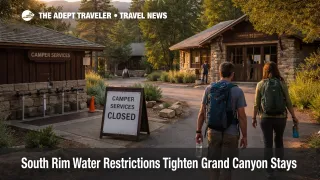
Grand Canyon's South Rim is open, but overnight planning changed on April 1, 2026, when Stage 3 water restrictions took effect after a pipeline break along the North Kaibab Trail. For travelers with lodge bookings, campground plans, or same day hiking tied to a South Rim overnight, the park is now operating with tighter service conditions rather than normal comfort assumptions. The immediate effect is not a full shutdown. It is a reduced service environment that affects showers, campground routines, food service behavior, and backcountry water planning. Travelers who still want the shortest sunrise, sunset, or trailhead access can keep in-park stays, but they should expect conservation rules and build more self-sufficiency into the trip.
South Rim Water Restrictions: What Changed
The National Park Service said on March 31 that Stage 3 water restrictions would begin on April 1 because of a break in the water pipeline, and the park will remain in conservation mode until the line is repaired and storage tanks return to sustainable levels. Under Stage 3 on the South Rim, Camper Services at Mather Campground is closed, water spigots at Mather Campground are turned off, and open fires in the campground are prohibited, while restrooms remain open and the RV dump and water station remain available. The park is also asking visitors, residents, and staff to limit showers to five minutes or less, shut off faucets while brushing teeth or shaving, wash only full loads of laundry and dishes, and reduce toilet flushing.
That makes this a real lodging and routine issue, not just a technical utility notice. A South Rim stay still works for travelers who mainly want rim access, shuttle access, and early trail starts. It works less well for travelers expecting a normal campground support setup, long showers after hiking, or a more relaxed lodge routine. The pressure point is strongest at Mather Campground, where the closure of camper services and shutoff of spigots changes how campers handle water, cleanup, and meal preparation.
Which Grand Canyon Stays Are Most Exposed
Campers are the most exposed group because the restrictions remove some of the on-site convenience that makes a South Rim campground stay easy. The Visit Grand Canyon operational update also says Mather Camp Store is closed, which weakens the fallback option for basic supplies inside that campground area. Backcountry hikers are another high exposure group because the park says they should plan to carry all their water or carry methods to treat water, and the current hiking updates show some inner canyon water points remain off because of the pipeline break. Bright Angel Campground water, Phantom Delta Restroom water, and Phantom Boat Beach water are all listed as off, even though several South Rim trailhead and corridor points remain on.
Lodge guests face a softer version of the same problem. The South Rim remains open for overnight guests, and regular park operations remain in place, but the conservation measures still change the stay experience. The park previously said concession operations under conservation measures may alter menus to use less water, use lower-water room cleaning, and serve restaurant drinking water only by request, which is the kind of operational trimming travelers notice in a tightly timed one or two night national park stop.
What Travelers Should Do Now
Travelers staying inside the park should keep those bookings if proximity is the priority and the trip depends on being near rim overlooks, shuttle routes, or dawn trail access. They should arrive with refillable water containers, assume shorter showers, and avoid treating campground services as normal. Campers should prepare as if the site is more self-service than usual, especially around water handling and food cleanup. Backcountry hikers should verify same day water status before committing to a descent, because the park says corridor water conditions can change suddenly with additional breaks in the waterline.
Travelers who care more about comfort than location should think harder about sleeping outside the park, especially if the trip is built around a drive-through visit, scenic overlooks, and light hiking rather than a predawn start. The main tradeoff is simple. In-park lodging still gives the best access. Off-park lodging reduces the chance that a conservation-minded stay feels like a bad value. That matters most for families, travelers with mobility limits, people stacking the canyon into a broader Arizona road trip, and anyone expecting a shower-forward recovery night after hiking. The park has not closed South Rim overnight stays, so there is no automatic reason to rebook, but there is now a clearer comfort penalty for staying inside if service normality is the deciding factor.
The threshold for changing plans rises sharply if the park moves to Stage 4. NPS says that under Stage 4, lodging for overnight guests could close, Trailer Village could become unavailable, and additional fire restrictions would be implemented. Travelers with upcoming April bookings should monitor the restrictions page and park alerts closely, because the next meaningful change is not whether the park is open today, but whether water storage improves enough to hold Stage 3 or slips into tighter measures.
Why This Is Happening, and What Comes Next
The mechanism is old and familiar at Grand Canyon. South Rim visitor services depend on a vulnerable water delivery system, and when the pipeline breaks, the park shifts into conservation mode to protect remaining storage and preserve core operations. This time, the break is along the North Kaibab Trail, but the operational impact lands on South Rim visitors because that is where the park must ration use while repairs are made and tanks recover.
What happens next depends on repair progress and storage levels, not on a fixed calendar. NPS has not published an end date for Stage 3. Until that changes, the likely path is continued pressure on campground convenience, lighter service standards in some visitor-facing operations, and a need for hikers to treat water availability as a live operational variable rather than a settled assumption. The important distinction for planners is that the South Rim is still functioning, but it is functioning in conservation mode. That is workable for access-driven trips, and less attractive for travelers who chose in-park lodging mainly for comfort and ease.