

U.S. Hotel Staffing Shortage Could Raise 2026 Rates
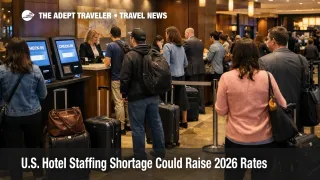
The U.S. hotel staffing shortage is becoming a more practical traveler problem for 2026, not just a labor market story. New U.S. Census Bureau data shows net international migration fell sharply between July 2024 and June 2025, while hotel owners say labor costs and understaffing are still pressing problems heading into another busy travel year. For travelers, the likely result is not an immediate collapse in hotel capacity. It is a slower squeeze, higher room rates in tight markets, thinner housekeeping and food service, and less margin for properties to absorb peak demand or operational disruptions.
U.S. Hotel Staffing Shortage: What Changed
The newest Census figures show the main labor supply story has shifted. On January 27, 2026, the Census Bureau said U.S. population growth slowed to 0.5 percent and attributed that slowdown largely to a steep drop in net international migration, which fell from 2.7 million to 1.3 million between July 2024 and June 2025. On March 26, the bureau added that every state and 90 percent of counties saw a decline in net international migration between 2024 and 2025. The White House has separately framed 2025 as a year of negative net migration nationally and across every metro area, but travelers should note that this broader characterization comes from White House messaging, while the Census releases themselves are the firmer statistical base for this story.
Hotels are already signaling that labor remains tight. AHLA said its late February 2026 survey of 246 hoteliers found 65 percent cited labor costs as a top concern, 42 percent flagged workforce shortages, and more than half said their properties were somewhat or severely understaffed. That matters because hotels are entering 2026 with demand expected to hold steady and with major event pressure, including the 2026 FIFA World Cup, already on the horizon.
The broader travel economy is large enough that even a modest labor squeeze can spread quickly. U.S. Travel says travel supported 15 million American workers in 2024 and directly employed 8 million. Reuters reported in 2025 that about one third of those travel jobs were held by immigrants, underscoring why a weaker immigration pipeline can hit lodging and food service harder than many travelers expect.
Which Travelers Will Feel It First
This is most likely to show up first in markets where hotels have the least slack. Think large event cities, major gateway metros, and seasonal destinations where staffing is already hard to maintain and replacement labor is expensive. In those places, the first order effect is usually not sold out inventory. It is premium pricing for rooms that may deliver a thinner service package than travelers associate with that rate.
Travelers booking full service and upper upscale hotels should pay particular attention to what is included, and what is only assumed. A property can still be open, charging peak rates, and yet be running with reduced housekeeping frequency, shorter restaurant hours, slower maintenance response, or thinner front desk coverage during arrival surges. Those are the kinds of frictions that appear when labor costs are rising faster than operators can rebuild staffing depth. For background on how that plays out on property, see Hospitality Labor Shortage in the United States: What Travelers Need to Know.
There is also a second order effect. Hotels with leaner staffing have less resilience when something else goes wrong. A flight disruption that pushes check in waves later into the evening, a convention that overruns expected demand, or a weather event that forces stranded travelers into last minute bookings can create a mess faster when there is less labor cushion behind the scenes. That does not just affect room readiness. It can slow baggage handling, guest messaging, shuttle operations, and food availability in the hours when travelers most need flexibility.
What Travelers Should Do Before Booking
Travelers planning U.S. trips in high demand periods should book earlier than they otherwise would in gateway and event markets, then read the service details more closely than usual. Room rate alone is a weaker signal than it used to be. Confirm housekeeping frequency, lounge access, restaurant hours, parking, shuttle timing, and any staffing dependent amenity that matters to your trip. A hotel can be expensive and still operate on a constrained service model.
For trips built around fixed timing, weddings, cruises, sports events, conferences, and complex same day arrivals, the decision threshold is simple. Pay more attention to reliability than to the last small savings on nightly rate. A slightly more expensive property with stronger staffing and more robust front desk coverage can save more value than a cheaper booking that struggles under peak arrival pressure. Business travelers and families arriving late should be especially careful with properties that have thin evening staffing or limited food service.
Over the next few months, watch for three signals. First, whether hotel operators keep highlighting labor costs and understaffing in 2026 surveys. Second, whether immigration and work authorization policies reduce legal labor availability further. Third, whether major event markets begin showing stronger rate growth without matching service improvement. If those indicators move together, the U.S. hotel staffing shortage becomes less of an industry warning and more of a visible traveler cost problem.
Why This Is Happening, and What Comes Next
The mechanism here is straightforward. Hotels are labor intensive businesses, and many key roles are hard to automate cleanly at scale. Even when technology helps at check in or with guest messaging, rooms still need to be cleaned, kitchens staffed, maintenance handled, and surges absorbed in real time. That is why hospitality groups have long pushed for immigration reforms and stronger seasonal worker pathways, including H,2B and J,1 visas.
Unite Here argues the contraction is already visible. Its February report said there were 98,000 fewer leisure and hospitality workers in December 2025 than a year earlier and warned that the work authorization of more than 2 million immigrant workers was in deep uncertainty. The union is not a neutral source, but the numbers are directionally important because they line up with what hotel owners are also saying about labor pressure, even if the groups differ sharply on cause and policy response.
That is why this story should be treated as a structural change, not a one week disruption. The next likely phase is gradual, uneven pressure rather than a clean national break. Some properties will respond with rate increases, some with automation, and some by trimming service expectations more openly. For travelers, the practical takeaway is that the U.S. hotel staffing shortage now belongs in trip planning, especially for 2026 stays in high demand U.S. cities where price, service reliability, and staffing depth are likely to diverge further.
Sources
- Net International Migration Down in Every State and Most Counties
- U.S. Population Growth Slows Due to Historic Decline in Net International Migration
- Rising Cost, Staffing Challenges Persist for Hotels as Travel Demand Expected to Hold Steady
- US Economic Impact of Travel 2024
- INHOSPITABLE
- How Crucial Is Immigration for the US Hotel Industry?
- America First in Action: U.S. Records Net Negative Migration Across Every Metro Area