

Dublin Protest Delays Hit Airport Access on April 8
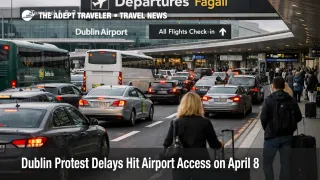
Passengers using Dublin Airport (DUB) on Wednesday, April 8, 2026, are dealing with a surface access problem, not an airside shutdown. Dublin Bus said fuel price protests were causing ongoing severe service disruption, Luas said there was no service between St. Stephen's Green and Dominick on part of the Red Line, and Dublin Airport told passengers to allow extra time because protest activity could disrupt roads around the airport. The operational risk is that routine airport runs from the city have become slower and less predictable across multiple modes at once. Travelers with checked bags, short haul cutoffs, same day hotel to airport transfers, or onward rail and coach links after landing should add buffer now and avoid treating normal cross city timing as reliable.
Dublin Airport Access Delays: What Changed
The most important change is that the failure point sits on the ground network feeding the airport. Dublin Bus reported severe disruption on April 8, while Luas said the city centre segment between St. Stephen's Green and Dominick was not operating because of protest activity near O'Connell Bridge. RTE and other Irish reporting also said Garda warnings covered possible road blockages toward Dublin Airport and the Port Tunnel, which matters because those corridors are high leverage links for airport buses, taxis, coaches, rental cars, and private drop offs.
In practical terms, the worst affected corridors appear to be central Dublin crossings and the routes that depend on moving through them. Irish Times coverage pointed to an indefinite blockade around O'Connell Bridge, while other reporting described Fleet Street and multiple city centre approaches under pressure. That does not mean every airport road is closed. It does mean the city's normal ability to absorb delay is weaker, and a problem in the centre can spread outward into airport access timing fast.
First order, passengers face slower and less predictable trips to and from the terminal. Second order, the knock on effects are missed airline check in cutoffs, tighter security timing, higher demand for parking and rideshares, and more overnight rebooking exposure for travelers who would normally treat Dublin as an easy same day airport run. That is the real seriousness here. Flights may operate, but some passengers can still miss them if the surface trip fails.
Which Travelers Face the Most Disruption
The most exposed travelers are those crossing the city to reach the airport. Anyone coming from the south side or from accommodation that normally depends on Luas plus a bus, coach, or taxi connection is vulnerable because the tram break between St. Stephen's Green and Dominick weakens one of the main city centre transfer patterns. Bus users are also exposed because Dublin Bus itself described the disruption as severe and ongoing.
Passengers are also more exposed if they are relying on road based airport access from the centre during the busiest daytime window, especially when they need checked baggage processing or are flying a short haul itinerary with limited later alternatives. Short haul travelers often run closer to minimum recommended airport timings, so a moderate delay on the road can become a hard miss at bag drop or check in. Travelers landing in Dublin face a different version of the same problem, with slower hotel transfers, longer taxi queues, and weaker confidence in getting across the city on schedule for tours, meetings, or onward rail.
The least exposed travelers are those already near the airport, those using accommodation on the north side that avoids city centre crossings, and those with enough slack to arrive very early. No access mode is fully insulated today. Airport buses, taxis, private cars, and coaches all depend on the same road network to some degree, and Dublin has no direct rail link into the airport terminal that would let passengers bypass the roads completely. The tradeoff is simple, leave earlier than feels necessary, or accept a much higher odds of friction.
What Travelers Should Do Now
Travelers heading to Dublin Airport on April 8 should move the airport trip forward, not just pad it slightly. Dublin Airport has already told passengers to allow extra time, and the combination of bus disruption, partial Luas interruption, and possible road blockages means the usual "I know my route" logic is weaker than normal. For flights departing today, especially with checked bags, the safer move is to leave well ahead of your normal departure from hotel or home.
For city to airport transfers, the most resilient strategy is the one that avoids unnecessary dependence on the blocked core. That can mean repositioning closer to the airport before departure, choosing a route that stays out of the O'Connell Bridge area where possible, or abandoning a tight tram to bus to airport chain in favor of a simpler direct run with more time built in. Travelers starting from outside central Dublin should also avoid assuming that the city centre can still serve as a reliable interchange today. The weaker the interchange, the more fragile the itinerary becomes.
For decision thresholds, travelers should stop waiting once a late arrival would put check in, bag drop, or a nonrefundable onward segment at risk. Business travelers, passengers on the last practical flight of the day, and anyone connecting to a cruise, tour departure, or long distance coach should treat delay risk more aggressively than a traveler with a flexible point to point ticket. If you are landing in Dublin, expect slower than normal ground transfers and avoid same day commitments that assume a routine terminal exit and city trip.
Why the Disruption Spreads Beyond the Protest Zone
The mechanism is straightforward. A protest centered in high value city corridors does not need to reach the airport itself to disrupt airport access. Once central crossings and key approaches slow, buses divert, trams lose continuity, taxis take longer to complete trips, and private cars compete for the remaining workable routes. That pushes delay outward through the rest of the network. In Dublin, that spread matters even more because airport surface access relies heavily on roads and buses rather than a dedicated rail link into the terminal.
What happens next depends on whether the protest footprint shrinks, relocates, or continues into another day. Irish reporting on April 8 described the city centre blockade as still active and, in at least one account, indefinite, with protesters signaling more action. That means travelers should not assume the issue disappears just because they have not seen a new airline alert. The next decision point is the road and transit picture before departure, not the flight status alone. A flight can remain on time while the airport transfer fails.
In an earlier Adept Traveler article, Dublin Taxi Protests Hit Airport Access December 8-13, the weakness was planned action aimed at airport and city transfers over several days. The April 8 problem is broader and messier in one key way, multiple ground modes are under pressure at the same time, so travelers have fewer clean substitutions when one link breaks.
Sources
- Service Disruption, Diversions & Delays, Dublin Bus
- Travel Updates, Luas
- Fuel protesters call for 'massive' demonstration tomorrow, as Dublin city centre blockade causes traffic 'chaos', The Irish Times
- Live: Wrong that motorways, streets blocked, says Taoiseach, RTÉ
- Fuel protest enters second day, Anglo-Celt
- Dublin Taxi Protests Hit Airport Access December 8-13, The Adept Traveler