

Southwest Portable Charger Rule Starts April 20
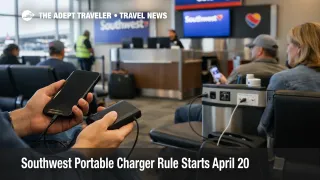
The Southwest portable charger rule will change how passengers manage device power starting April 20, 2026, especially on longer flights and on itineraries where seat power is unavailable or unreliable. Southwest said customers will be limited to one lithium portable charger per flight, those chargers cannot be stowed in overhead bins, and they cannot be recharged using in seat power during the flight. For travelers who normally carry multiple backup batteries, the immediate consequence is simple, pack differently before departure, and expect less onboard charging flexibility.
Southwest Portable Charger Rule: What Changed
Southwest's change is tighter than the new international baseline now taking shape. Reuters reported the airline will cap passengers at one lithium portable charger per flight beginning April 20, 2026, while Southwest's own guidance says portable chargers used onboard must stay visible and may not be used to charge devices in overhead bins. That shifts the traveler pressure point from security screening to preflight packing and onboard seat organization. A passenger who boards with multiple power banks, or who assumes they can keep charging from the bin area, could end up repacking at the gate or flying with fewer backup options than planned.
The operational significance is moderate, not catastrophic. This is not a schedule disruption, but it does create a real workflow change for passengers who depend on tablets, phones, battery powered medical accessories, or work devices during long travel days. The main friction will show up on flights where travelers have a long airport dwell, a connection, and a final ground transfer still ahead of them after landing. One battery limit means less redundancy when a device drains faster than expected, or when onboard outlets are unavailable.
Which Travelers Will Feel This Most
The most exposed travelers are people who already treat a power bank as part of their trip infrastructure rather than as a just in case item. That includes business travelers working gate to gate, families managing multiple devices for children, passengers using older phones with weak batteries, and anyone on a multi segment day where the charging window between flights is short. Travelers on Southwest are especially worth watching here because Reuters also reported the carrier expects to equip its fleet with in seat power by mid 2027, which means this rule arrives before that convenience is universal across the operation.
The second order effect is easy to miss. When fewer passengers can rely on personal battery backups, gate area plugs, airport charging stations, and predeparture dwell time become more important. That can push travelers to arrive a little earlier, stay closer to outlets at the airport, and protect phone battery for boarding, rideshare pickup, hotel access, and rebooking if irregular operations hit later in the trip. In practical terms, the policy reaches beyond the cabin. It changes how travelers manage the whole travel day.
What Travelers Should Do Now
Passengers flying Southwest on or after April 20 should treat this as a packing rule, not an onboard surprise. Bring one compliant power bank, keep it in an easy access part of your personal item, and assume it needs to stay under the seat or on your person rather than in an overhead bag. Charge every essential device before leaving for the airport, and do not plan around being able to top off your battery pack in flight through the aircraft's power system.
The decision threshold is straightforward. If your travel day depends on carrying two or more power banks, or if your phone battery health is poor enough that one pack is not enough, solve that before the trip instead of hoping for discretion at boarding. A battery replacement, a higher capacity single bank that fits airline rules, or a full charge plan built around airport outlets is the cleaner fix. Waiting until check in or boarding raises the chance of last minute bag reshuffling and a weaker battery position once the flight is underway.
Over the next few weeks, travelers should also watch for copycat policies. Lufthansa Group already bars the use or charging of power banks onboard and limits passengers to two, while the International Civil Aviation Organization, ICAO, moved on March 27, 2026 to limit power banks to two per passenger and prohibit inflight recharging. Southwest is going further on count, which raises the odds that other carriers may tighten their own rules if safety concerns continue to rise.
Why Airlines Are Tightening Power Bank Rules
The mechanism is fire containment. Lithium battery incidents are dangerous in the cabin because overheating devices can produce smoke, intense heat, and fire in a confined space where fast detection matters. Keeping power banks out of overhead bins improves the odds that a problem is seen early and handled quickly, instead of smoldering inside a closed compartment above passengers. Limiting the number of batteries per passenger also reduces the total risk load carried in the cabin.
This policy shift follows a broader safety push. ICAO said its new power bank restrictions took effect on March 27, 2026. Reuters and AP reported the FAA has flagged rising lithium battery concerns, with 97 incidents involving smoke, fire, or extreme heat in 2025, up from 89 in 2024. That does not mean battery fires are common on any given flight, but it does mean regulators and airlines now have enough trend evidence to tighten passenger handling rules. For travelers, the next step is not panic. It is accepting that the Southwest portable charger rule is part of a wider move toward stricter inflight battery control.
Sources
- Southwest Airlines to limit passengers to one portable charger on flights
- Traveling with Lithium Batteries, Chargers, E-Cigs & Lighters, Southwest Help Center
- New power bank restrictions will safeguard international aviation, ICAO
- Power Banks On Board: Updated Regulations Starting 15 January 2026, Lufthansa Group
- Electronic Devices and Batteries, Lufthansa
- Travelers will face limits on how many chargers they can carry as airlines try to reduce fire risks
- Lithium Battery Incidents, Federal Aviation Administration