

Petacciato Landslide Travel Routes Stay Fragile
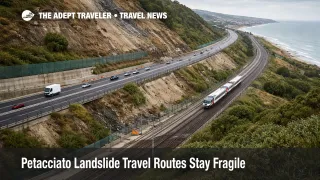
Petacciato landslide travel routes are moving again on April 10, 2026, but they are not back to normal. Italy has reopened the affected A14 motorway sections and restarted trains on the Adriatic rail line with a precautionary speed restriction, while a separate bridge collapse on State Highway 16 continues to cut a key coastal road link. For travelers heading south toward Puglia this weekend, the main problem has shifted from total shutdown to unreliable journey times, thinner recovery options, and tighter pressure on any itinerary built around same day connections.
Petacciato Landslide Travel Routes: What Changed
The most important change since the full interruption earlier this week is that the A14 Bologna to Taranto motorway is no longer fully severed at Petacciato. Autostrade per l'Italia said the reopened sections are Vasto Sud to Termoli toward Bari and Poggio Imperiale to Vasto Sud toward Pescara, restoring through movement on the main motorway spine after the landslide forced closures. Rail also resumed on April 10 at 6:00 a.m. local time between Vasto San Salvo and Termoli, but Rete Ferroviaria Italiana said trains are running with a cautionary speed reduction and warned that Alta Velocità, Intercity, and regional services can still face delays, changes, or cancellations.
That means the corridor is open in a technical sense, but not dependable in the way travelers usually need for a tightly timed weekend trip. RFI also said some north south services had been rerouted via Foggia, Caserta, Rome, and Bologna during the disruption, which shows how quickly a single break on the Adriatic side can spill traffic into longer inland routings. Reuters reported the landslide had already pushed motorists onto lengthy country road detours and forced partial rail reroutes via Rome, adding hours in some cases.
Which Adriatic Trips Still Face the Most Risk
The most exposed travelers are people driving or taking the train between Abruzzo, Molise, and Puglia, especially anyone connecting onward to coastal hotels, holiday rentals, cruise embarkations, or regional rail services farther south. The direct motorway and rail assets are functioning again, but they are operating under recovery conditions rather than normal resilience, which raises the odds that a modest delay on the trunk route turns into a missed onward segment later in the day.
Road travelers also need to separate the Petacciato reopening from the wider Adriatic road picture. The bridge collapse on State Highway 16 over the Trigno River near Montenero di Bisaccia cut off road links toward Abruzzo after earlier extreme weather, and Reuters said reconstruction is expected to take six to seven months. That matters because the motorway reopening does not restore every coastal fallback option. If traffic, weather, or safety checks slow the A14 again, the parallel road network is weaker than usual, which reduces detour flexibility for self drive trips and local transfers along the coast.
What Travelers Should Do Now
Travelers heading south this weekend should treat the reopened corridor as usable but fragile. For rail, that means checking the specific train number before departure, not just the route, because the warning from RFI applies across high speed, Intercity, and regional services. For road trips, it means keeping more fuel, more time, and a live navigation check in reserve rather than assuming the old Adriatic rhythm has returned.
The decision threshold is simple. If your plan depends on a same day handoff, a cruise check in, a late hotel arrival in Puglia, or a rail to road transfer with under about two hours of slack, you should rebuild the itinerary now instead of trusting the corridor to behave normally. If your trip is flexible and the southbound segment is the main event rather than a connection chain, the reopened A14 and resumed rail line may be sufficient, but only with extra buffer and a willingness to absorb changes. The tradeoff is time versus certainty.
Why the Corridor Is Still Unstable, and What Happens Next
The Italian government's emergency response makes clear this is bigger than one short closure. Civil Protection published the April 9, 2026 emergency declaration covering weather damage across Abruzzo, Basilicata, Molise, and Puglia, and the text specifically says the Petacciato landslide significantly affected road and rail mobility as well as nearby settlements. Reuters reported the government also earmarked an initial €10 million, about $11.68 million, for restoration work.
Operationally, the next phase is not just repair, but monitoring. The rail line is back only with a speed restriction, and the motorway reopening followed emergency stabilization rather than a long structural reset. At the same time, the SS16 bridge loss will keep a major coastal road gap in place for months, so even if the Petacciato section stabilizes, the Adriatic side remains less forgiving than normal. For travelers, that means Petacciato landslide travel routes may be passable this weekend, but they still do not support tight, low buffer planning.
Sources
- A14, AUTOSTRADE PER L'ITALIA RIAPRE IL TRATTO TRA VASTO SUD E POGGIO IMPERIALE CHIUSO PER LA FRANA DI PETACCIATO
- Linea Pescara - Foggia: circolazione ferroviaria in graduale ripresa tra Vasto S. Salvo e Termoli dopo un movimento franoso
- Delibera del Consiglio dei Ministri del 9 aprile 2026
- Bridge collapses on State highway amid extreme weather in Molise
- Italy pledges emergency funds to reopen rail, motorway after landslide on key Adriatic corridor