

Cruise Growth Raises Port Fees and Crowd Controls
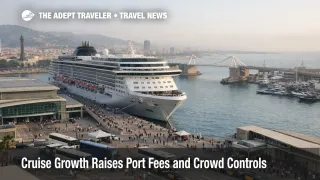
Cruise port fees and crowd controls are moving from policy debate to trip-planning reality as the cruise industry adds volume again. WTTC says cruise tourism contributed $98.5 billion to global GDP in 2024 and supported 1.8 million jobs, while CLIA's 2024 economic report shows global cruise activity remained strong and passenger flows rose to roughly 34.6 million. For travelers, the practical shift is not just bigger industry numbers, it is that more ports are responding with fees, caps, staggered arrivals, and tighter terminal management that can change what a shore day costs and how much of it you actually get.
Cruise Port Fees and Crowd Controls Are Spreading
The strongest travel intelligence angle here is not that cruising creates jobs. That point is real, but it is too broad to help someone decide what to book. The more useful signal is that demand is large enough, and expected to keep growing, that destinations are increasingly managing cruise volume rather than simply welcoming more of it. WTTC's release points to long-term cruise growth, and CLIA has separately projected global cruise passenger capacity to grow 19% between 2022 and 2028.
That growth is already translating into concrete traveler-facing measures. MSC says Greece's cruise passenger fee took effect on July 21, 2025, with charges that vary by season and port, reaching €20.00 for Mykonos and Santorini in peak season and €5.00 for other Greek ports. In Barcelona, the city council and Port of Barcelona agreed in July 2025 to cut the number of cruise terminals from seven to five as part of a broader mobility and sustainability push.
Which Cruise Travelers Will Feel This Most
Travelers on Mediterranean itineraries are the most exposed right now, especially anyone booking high-season calls in places already under pressure from crowding, transfer demand, and local political scrutiny. Mykonos, Santorini, and Barcelona stand out because the response is no longer theoretical. It is being expressed through direct passenger charges, terminal limits, and efforts to spread visitor flow over time and geography.
This also matters more for first-time cruisers and budget-sensitive travelers than for frequent cruisers with flexible expectations. A higher fee does not usually destroy the value of a trip on its own. The bigger issue is stacked friction. First order, passengers can pay more for the same port-heavy itinerary. Second order, staggered arrivals, tighter berth management, or restricted terminal capacity can shorten effective time ashore, push excursion timings around, and make a ship's marquee stops feel more compressed than the brochure suggests.
WTTC highlights another important mechanism, more than 60% of cruise passengers return later to destinations they first visited by cruise. That helps explain why ports and city governments are trying to preserve economic upside while reducing crowd spikes in the most fragile zones. Travelers should read these controls as a signal that some destinations now want cruise demand, but on stricter local terms.
What Travelers Should Do Before Booking
For 2026 cruise shopping, travelers should stop comparing sailings only on cabin fare and ports listed. Compare the full port stack. On Greek itineraries, for example, multiple port calls can now add meaningful per-person costs, especially in summer. That cost may still be worth paying, but it should be priced before final payment, not discovered later in operator notices.
The next decision point is itinerary design. Travelers who care most about maximum shore time and lower crowd pressure should look harder at shoulder-season departures, smaller ships, and itineraries that rely less on the most saturated ports. Travelers who mainly want iconic names and are comfortable with shorter, denser port days can still book the headline routes, but they should do it with realistic expectations about queues, tender timing, excursion pacing, and local surcharges. That tradeoff is now central, not secondary.
Watch the port, not just the cruise line. Cruise lines can sell the itinerary, but local governments and port authorities increasingly shape how the day works once the ship arrives. When a port begins imposing fees, limiting terminals, or scheduling arrivals more tightly, that is a sign the operational rules on the ground are changing faster than cruise marketing copy.
Why This Is Happening, and What Comes Next
The broader system logic is straightforward. WTTC and CLIA are both describing a cruise sector that is large, globally connected, and still expanding. CLIA's 2024 global report says North America and Europe accounted for more than 80% of global demand, and its North America market page says 34.6 million cruise guests sailed worldwide in 2024, with the United States accounting for about 19 million of them. When that volume concentrates in a relatively small set of marquee ports, local authorities move to protect mobility, infrastructure, and resident tolerance before they simply accept more ship calls.
That is why the overtourism debate now matters to cruise buyers even when a sailing is not disrupted. The main risk is not that cruising stops growing. The main risk is that the best known ports become more managed, more expensive, or less forgiving in peak season. Expect more destination-specific fees, more berth and arrival controls, and more attempts to steer passengers into longer stays, secondary neighborhoods, or shoulder-season demand. Travelers who plan around those rules early will usually keep more value in the trip than travelers who assume every port day will keep working the way it did a few years ago.
Sources
- WTTC's "Cruising for Impact" Report Highlights the Positive Impact of Cruise Tourism for Communities Worldwide
- Contribution of Cruise Tourism to the Global Economy 2024, CLIA
- North America, CLIA
- New Cruise Passenger Fee for Guests Visiting Greek Ports, MSC Cruises
- Barcelona City Council and Port of Barcelona Sign an Agreement to Reduce the Number of Cruise Terminals and Improve Mobility
- Europe's Busiest Cruise Port Barcelona to Scale Back Amid Overtourism Concerns, Reuters