

Eurostar April 13 Delays Hit Cross-Channel Hubs
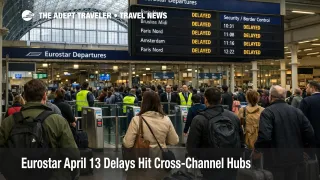
Eurostar April 13 delays have moved back into a live, multi station operating problem, not just a background spring timetable story. On Monday, April 13, 2026, Eurostar was posting same day delay notices at London St Pancras International, Paris Gare du Nord, Amsterdam Centraal, Brussels Midi, and Rotterdam Centraal, alongside wider Belgian, Dutch, and German network issues, while its longer cancellation window from March 22 through May 17 was still active behind the day's disruption. For travelers, that means the corridor is working with less slack at the exact moment multiple hubs are slipping. The practical move is to stop treating tight rail to flight, rail to cruise, and same day hotel check in chains as low risk today.
Eurostar April 13 Delays: What Changed
The new fact pattern is the stack. Eurostar's disruption page listed delays on April 13 tied to technical issues at London St Pancras International, station crowding and operational restrictions at Paris Gare du Nord and Amsterdam Centraal, earlier late arrivals at Paris and Brussels Midi, operational restrictions at Rotterdam Centraal, traffic issues on the Belgian, Dutch, and German networks, and a police assistance request at Brussels Midi. One same day service change was more concrete than a generic delay notice, train 9133 lost its Lille Europe stop because Amsterdam Centraal was very busy.
That would already be enough to weaken same day plans. What makes April 13 more serious is that it is landing on top of a thinner timetable. Eurostar's live update page still shows a broader cancellation notice running from March 22, 2026, through May 17, 2026, and the operator is also carrying additional published disruption windows later in April and May, including Dutch engineering related cuts on April 18 to April 19, Eurostar network cancellations on April 21 to April 23 and April 27 to April 30, a one day cut on May 1, limited Dutch service on May 9, and a further limited Eurostar service notice on May 13. In practical terms, a corridor with fewer fallback departures becomes less forgiving when one station or one inbound set starts running late.
Which Travelers Face the Most Eurostar Disruption
The most exposed travelers are the ones who built Eurostar into a chain rather than a standalone city to city trip. Same day handoffs into flights from London, Paris, Brussels, or Amsterdam now carry more misconnect risk because the problem is not isolated to one platform or one city. Belgian and German network delays can feed late trains into Brussels and Paris, Rotterdam restrictions can slow Dutch side movements, and station crowding at Amsterdam and St Pancras can turn a manageable delay into a lost recovery option once security, border checks, or platform access starts tightening.
Day trippers and business travelers are also more exposed than flexible leisure travelers. A city break can usually absorb a late arrival. A traveler trying to reach a long haul flight, a cruise embarkation, or a meeting with a fixed start time has less room to recover. The Lille Europe stop cancellation on train 9133 is a good example of why this matters operationally, because a traveler relying on that exact boarding point does not just get delayed, they may lose the intended train pattern altogether. In an earlier Adept Traveler article, Eurostar April 12 Delays Layer Onto Spring Cuts, the concern was that live delays were starting to layer onto a reduced spring timetable. April 13 broadens that picture across more stations and network segments.
What Travelers Should Do Now
Travelers with a same day flight, cruise, or long onward rail leg should add margin immediately, or shift the chain if that margin no longer exists. For April 13 travel, the safer play is to separate Eurostar from the next hard deadline with several extra hours, or an overnight if the next leg is expensive or difficult to rebook. This is especially true for passengers moving through London St Pancras, Paris Gare du Nord, Brussels Midi, Amsterdam Centraal, and Rotterdam Centraal, because those are the stations Eurostar itself is flagging in the live update picture.
The decision threshold is blunt. If your Eurostar arrival is meant to feed an airport check in cutoff, a final departure of the day, or a nonrefundable timed event, waiting for the network to self correct is a weak plan. Rebook earlier, move the onward segment later, or break the journey with a hotel night. If your trip is a flexible city pair with no hard handoff, waiting may still be reasonable, but only after checking the exact service status on your train rather than assuming the corridor wide problem will stay small. In an earlier Adept Traveler article, Eurostar April 6 Delays, Cuts Stretch Into May, the structural risk was already clear. April 13 reinforces that travelers should treat this corridor as a lower margin network on disruption days.
Over the next 24 to 72 hours, the main thing to watch is whether Eurostar's same day station notices shrink back to isolated incidents, or whether the corridor keeps layering live delays onto the existing reduced schedule. That distinction matters more than any single late train, because a thin timetable is what turns ordinary lateness into missed flights, forced hotel nights, and expensive last minute shifts into air or coach alternatives.
How the Disruption Spreads Through Travel
The mechanism is straightforward. Eurostar is a tightly sequenced network that depends on inbound trains, station processing, border formalities, and shared infrastructure all holding together at once. When an earlier train arrives late at Brussels Midi or Paris Gare du Nord, that delay can roll into the next working. When Amsterdam Centraal is busy or maintenance overruns, Dutch side timings lose slack. When Belgian or German network traffic issues slow feeder movements, the problem stops being a single station story and becomes a corridor timing problem.
What happens next depends on whether the live issues fade while the reduced timetable remains stable, or whether the network keeps adding new station constraints on top of the trimmed schedule. Eurostar has not posted a blanket suspension for April 13, and the current pattern still reads as degraded operations rather than collapse. But the presence of active same day notices across London, Paris, Brussels, Amsterdam, Rotterdam, plus Belgian and German network impacts, means the practical risk has already shifted beyond a routine delay story. Travelers should plan on fragility first, then downgrade that assumption only if their exact service improves.