

La Paz Airport Access Strike Disrupts Bolivia Travel
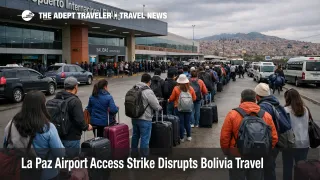
Bolivia travelers should now treat La Paz as a transfer failure point, not simply a protest headline. The operational change is broader than city traffic disruption: the U.K. Foreign, Commonwealth and Development Office says an indefinite public transport strike is affecting both the city and department of La Paz, access to El Alto International Airport (LPB) is disrupted, the cable car is the only public transport still running with extremely long queues, the main bus terminal is closed, and intercity transport to other parts of Bolivia is suspended. For travelers, that shifts the main risk from unrest itself to whether they can still reach the airport, leave the city, or keep an overland itinerary intact on the same day.
La Paz Airport Access Strike: What Changed
The immediate problem is that several transport layers are failing at once. Airport access is disrupted, city public transport is largely offline, the main bus terminal is closed, and intercity movement has been suspended from La Paz under current official travel advice. That makes La Paz, Bolivia's main high altitude gateway, a bottleneck for travelers connecting between flights, city hotels, Lake Titicaca routes, Uyuni bound overland plans, and domestic onward transport.
This is more serious than a standard demonstration day because the one public system still running, Mi Teleférico, is already described by FCDO as the only operating public transport option, with extremely long queues. When one surviving mode has to absorb airport passengers, local commuters, and stranded intercity travelers at the same time, delay stops being a road issue and becomes a throughput issue. Travelers can still move in some cases, but the city is no longer functioning like a normal gateway where a late taxi or a bus backup can be solved with a quick switch.
Which Travelers Face the Most Disruption
The highest exposure group is anyone flying into or out of El Alto on the same day they need to cross the city. That includes travelers with early departures, separate tickets, short hotel to airport transfer windows, or same day onward plans to other Bolivian cities. A second high risk group is overland travelers who expected to use La Paz as a bus connection hub, because the main bus terminal closure and suspended intercity transport remove the usual fallback path when flights or tours change.
The next exposure bucket is travelers whose itinerary depends on layered timing rather than a single segment. Think airport arrival, hotel check in, next morning bus, then a timed tour or border move. In that kind of chain, the first order effect is obvious, a missed airport transfer or lost bus departure. The second order effect is where costs rise: extra hotel nights, wasted tour deposits, misconnected domestic flights, and tighter rebooking options once other stranded travelers start competing for the same limited seats and cars. That risk is higher because the strike is unfolding against a wider fuel backdrop. Reuters has reported recent fuel quality and supply tensions in Bolivia, including an indefinite transport strike in La Paz over poor quality fuel and a government investigation into adulterated gasoline imports tied to supply contracts.
What Travelers Should Do Now
Anyone due to fly through La Paz should stop planning airport transfers on a normal city timeline. For departures, the practical move is to build in a large buffer, ideally by positioning closer to the airport well before flight day when possible, or by treating the transfer as the primary uncertainty rather than the flight itself. For arrivals, assume that getting from the airport into the city may take substantially longer than usual even if the flight lands on time, because the disruption sits outside the terminal as much as inside the transport network.
For overland trips, do not assume that a closed bus option can be replaced easily on the same day. If your itinerary depends on La Paz bus departures, Lake Titicaca onward movement, or intercity road transfers, contact operators before checkout and ask whether they are running, rerouted, or simply waiting. If they cannot confirm operation in writing, treat the segment as broken until proven otherwise. Waiting for things to normalize only makes sense if your next booking is flexible and you are already in a hotel with room to extend. Rebooking or repositioning makes more sense when you have a fixed flight, a separate ticket, or a time sensitive tour that becomes worthless after one missed connection.
Over the next 24 to 72 hours, watch for three signals. First, whether official advice changes on airport access or bus terminal status. Second, whether Mi Teleférico remains the only functioning public system, because that keeps queue pressure high. Third, whether fuel related disruption widens or eases, since that will shape how quickly buses, drivers, and intercity links can recover even after the strike itself softens. If those signals do not improve, La Paz becomes a city where the safest travel decision is often to reduce movement, not improvise more of it.
Why the Disruption Spreads Beyond a Street Strike
The mechanism here is network concentration. La Paz and El Alto function as a linked urban system, and the airport sits inside that wider movement network rather than apart from it. When regular public transport stops, road access weakens, the bus terminal closes, and intercity services pause, traffic does not merely slow, it compresses into whatever still works. Right now that means the cable car system is carrying pressure far beyond its normal traveler mix, while air passengers and overland passengers compete for the same reduced mobility channels.
What happens next depends on two unresolved issues. One is the strike itself, which FCDO still describes as indefinite. The other is whether Bolivia's fuel problems keep dragging on transport reliability after the immediate labor action fades. Reuters reporting in late March and early April pointed to contamination claims, contract friction, and continuing stress around gasoline supply. Even if the street blockage phase eases, travelers should not assume that city to airport and city to bus recovery will snap back at the same speed. La Paz is still usable for some trips, but until transport layers reopen together, it is a gateway where buffer time and overnight flexibility matter more than itinerary ambition.