

Brisbane Rail Closures Stretch Airport, Gold Coast Trips
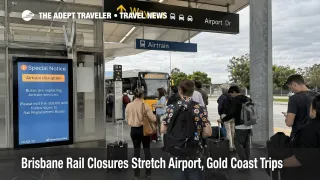
Travelers moving between Brisbane Airport, central Brisbane, and the Gold Coast should treat the rest of April as a disrupted rail period, not a routine train month. Queensland Rail says closures between Bowen Hills, Eagle Junction, and Northgate were extended until April 16, and the Boggo Road to Banoon closure now runs until May 1, after work was delayed by union protected industrial action over the Easter period. Translink says April service changes across the network can make journeys significantly longer than usual, with replacement buses, altered train patterns, and changing best-route advice depending on the date. For travelers with flights, cruise check-ins, conventions, or fixed hotel transfers, the safe assumption is that rail plans now need extra buffer and a road backup.
Brisbane Rail Closures: What Changed
The disruption now falls into two distinct phases. Through April 16, the airport side and inner north are part of the problem, because Queensland Rail extended the Bowen Hills to Eagle Junction and Northgate closure to April 16. Through April 30, the bigger issue shifts south, where Translink says the Beenleigh, Gold Coast, and Doomben corridors remain under altered operation, with no trains on some sections, combined services on others, and buses replacing rail on key stretches. From May 1, Translink says the full closure ends, but some peak Beenleigh line services will still run express through several southside stations through December 2026.
This is not a uniform all lines failure. On April 13 to 15, Translink says buses replace trains between Northgate and Bowen Hills, and between Varsity Lakes and Boggo Road. On April 16 to 19, buses replace trains between Varsity Lakes and Boggo Road, while Doomben line trains run only between Doomben and Eagle Junction. From April 20 to 30, Beenleigh and Gold Coast services run as a combined pattern between Varsity Lakes and Banoon, with no trains between Banoon and Boggo Road.
Which Travelers Face the Most Disruption
The most exposed travelers are those chaining multiple modes in one day. Airport passengers relying on the normal Airtrain pattern are particularly vulnerable early in the closure window, because Brisbane Airtrain normally markets a frequent airport to city and airport to Gold Coast service, with trains every 15 minutes in peak periods and 30 minutes off peak. That normal rhythm is what breaks the moment rail replacement buses or short-turn train patterns appear in the middle of the trip.
Gold Coast travelers are the other major exposure group. Translink says Gold Coast line trains do not run during the April 16 to 19 closure window, and from April 20 to 30 the line operates only as a combined service between Varsity Lakes and Banoon, with the final stretch into inner Brisbane still broken by the Banoon to Boggo Road gap. That makes airport to resort, city hotel to theme park, and Brisbane to cruise or event transfers harder to predict, especially when a bus bridge has to absorb both local and longer distance demand.
Travelers headed only to some other parts of the network may face less pain, but they still should not assume normal conditions. Queensland Rail says replacement buses must be allocated across multiple closure areas, and some services may run at reduced frequency. Translink separately warns that railbuses are affected by road and traffic conditions, which means the delay risk is not only the closure itself, but the way the closure spills onto congested roads once passengers are pushed off trains and onto buses.
What Travelers Should Do Now
For airport trips, a prudent planning threshold is to add at least 60 minutes of buffer over the normal rail plan, and more if the trip includes a bus replacement segment, checked luggage, or an international departure. That is not an official minimum. It is the practical consequence of Translink and Queensland Rail warning that journeys may take significantly longer than usual, combined with the fact that the normal Brisbane Airport to city rail product is built around a fast, frequent pattern that closures interrupt.
For Brisbane to Gold Coast moves, the safer approach is to treat rail as a flexible option, not a fixed-time guarantee, through April 30. Travelers with cruise embarkations, conference start times, ticketed attractions, or nonrefundable transfers should strongly consider whether a direct road transfer, rental car, or earlier departure protects the itinerary better than trying to thread a train plus bus sequence. Where rail still makes sense, use the live Translink journey planner rather than a saved timetable or a generic Airtrain assumption.
The next decision point is simple. If your arrival or departure is fixed, re-plan now. If your travel is discretionary, midday, or fully flexible, rail may still be workable, but only if you check the exact date-specific closure pattern before leaving. Travelers should also confirm the replacement bus stop location in advance, because Translink says those locations can change and day-of signage matters.
Why This Is Happening, and What Comes Next
The immediate trigger for the extension is labor related. Queensland Rail says multiple days of planned work were lost because of union protected industrial action over the Easter long weekend, and that the Fair Work Commission issued orders on Easter Sunday, April 5, so works could begin as soon as possible after the delay. But the broader operational context is bigger than the labor dispute alone. Official service pages say the April closures also support a stack of major works, including Cross River Rail, the European Train Control System, Logan and Gold Coast Faster Rail, Loganlea Station Relocation, the Ormeau rail facility, the Beerburrum to Nambour Rail Upgrade, and general maintenance.
That matters because a long multi-project closure behaves differently from a one-day outage. The first order effect is obvious, trains are replaced or short-turned. The second order effect is where travelers actually lose time, bus bridge crowding, slower road legs, different transfer points, and a journey planner that can change as operators keep updating available service patterns. Translink has already said the best travel option may change throughout April, and Queensland Rail has said updated replacement bus details will continue flowing into the planner.
The likely next phase is uneven normalization, not an instant reset. April 30 is the key date for the broad extended closure pattern, but Translink already signals that some Beenleigh corridor peak services will remain altered from May 1. Travelers booking southeast Queensland rail-dependent itineraries in the second half of April should therefore plan for a rolling recovery rather than assuming the network snaps cleanly back to normal the moment one closure window ends.
Sources
- Planned Track Closures Extended Due to Union Protected Industrial Action
- April Extended Track Closures, Impacts All Lines
- Major Track Closure, Beenleigh, Doomben and Gold Coast Lines
- Service Changes, Brisbane Airtrain
- Frequency and Hours, Brisbane Airtrain
- Timetable, Brisbane Airtrain
- Rail Replacement Bus Stops