

Miami Caracas Flights Near Return on American
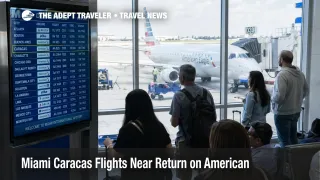
Miami Caracas flights are close to becoming a real planning option again, but they are not fully back yet. American Airlines says it expects to restart daily nonstop service between Miami International Airport (MIA) and Simón Bolívar International Airport (CCS) as soon as April 30, 2026, using an Embraer 175 operated by Envoy, its regional subsidiary, once remaining government approvals and security checks are complete. That would restore a nonstop U.S. link to Caracas for the first time in more than six years, which is a meaningful shift for travelers who have been forced into longer third country routings. Travelers should treat this as bookable soon, not guaranteed now, and assume the first weeks back could be capacity constrained and operationally fragile.
Miami Caracas Flights: What Changed
The change is not a broad reopening of Venezuela travel. It is a specific airline and route development. Reuters reported on April 9 that American aims to resume the route after the U.S. Transportation Department approved the airline's request in March, following the lifting of the 2019 U.S. ban earlier this year. American's own update says the route is still subject to government approval and ongoing preparations, which means travelers should separate the policy opening from the final operational start. Until tickets are actively on sale and the flight is loaded into normal booking channels, the route remains pending rather than complete.
This is still a high consequence route even with only one daily regional jet. A single daily Embraer 175 does not create much recovery capacity if the first days see delays, a late regulatory clearance, or a temporary pullback. That makes Miami connection strategy more important than on thicker Caribbean or Latin America routes. Travelers connecting from elsewhere in the United States should be cautious about tight same day banks in Miami until the route has operated reliably for a stretch.
In an earlier Adept Traveler article, American Venezuela Flights Reopen, Approval Still Pending framed the route as a reopening story still waiting on approvals. The difference now is that American has named an intended start date, aircraft type, and daily frequency, which moves this from abstract permission into near term route planning. Miami Venezuela Flights Approved for American Airlines remains useful background for how the earlier approval phase developed.
Who Benefits Most From the Route Return
The clearest beneficiaries are travelers whose trips are hard to replace with tourism style flexibility, business travelers with time sensitive meetings, families handling cross border visits, and humanitarian travelers who need fewer handoffs and less exposure to third country transit risk. A nonstop between Miami and Caracas cuts out some of the missed connection, overnight hotel, immigration, and baggage recovery problems that came with circuitous routings through other countries. That matters most for travelers carrying documents, aid items, medical needs, or fixed onward appointments.
The tradeoff is that the destination risk picture has improved from its earlier peak, but it has not normalized. The U.S. Department of State lowered Venezuela to Level 3, Reconsider Travel, on March 19, 2026, and said the advisory changed alongside updates to U.S. embassy operations. At the same time, the State Department still warns about crime, kidnapping, terrorism, poor health infrastructure, limited consular reach outside Caracas, suspended routine consular services inside Venezuela, and security risks tied to unregulated taxis and nighttime movement between the airport and Caracas. Travelers who hear "direct flights are back" and interpret that as "normal conditions are back" would be making a bad read of the current environment.
What Travelers Should Do Before Booking
The first decision point is whether the route is actually for sale and operating under a stable timetable. If travel is essential and the nonstop appears in American's normal channels, travelers should still leave margin in Miami, avoid last bank domestic connections where possible, and treat the first weeks as a proving period. A route with one daily regional flight offers less resilience than a multi frequency mainline market. Missing it could mean a full day lost, not a quick same day recovery.
The second decision point is whether the nonstop changes your risk profile enough to justify booking now. For some travelers, especially those who were previously forced into two or three segment routings through third countries, the nonstop may reduce friction enough to be worth it. For others, especially travelers who need strong trip insurance assumptions, dependable consular backup, or flexibility to recover from irregular operations, the advisory context still argues for caution. Insurance terms, assistance coverage, and medical evacuation language deserve a harder read here than they would on a routine Latin America trip.
Ground movement planning matters too. Travelers arriving into Caracas should pre arrange trusted transfers, avoid improvising airport taxis, and be conservative about nighttime arrival logistics. The route may restore nonstop air access, but it does not remove the security and support constraints that still shape what happens after landing. That is where some of the second order risk shifts once a direct flight becomes available again.
Why Approval Still Matters, and What Happens Next
The remaining approval path has two practical parts. One is final government clearance on both sides for the service restart. The other is security readiness at the airport level. Reuters reported that the Transportation Security Administration reviewed airport security procedures in Caracas about a month before the April 9 report, and American says flights will begin only when all government approvals and security checks are complete. That means April 30 is best understood as the earliest target, not a guaranteed line in stone.
The broader mechanism behind this route return also matters. The FAA said on January 29 that it had removed four Caribbean region NOTAMs, including one related to Venezuela, and said it looked forward to facilitating the return of regular travel between the United States and Venezuela. That aviation side easing, combined with the lower State Department advisory level and the March route approval, created the conditions for an airline to move from interest to a dated restart plan. The next useful signals for travelers are simple, actual ticket sales, a published schedule that holds, and evidence that the first week of Miami Caracas flights operates without immediate interruptions or last minute regulatory slippage. Until then, this is a promising nonstop return, but still one that should be planned with buffers, caution, and backup assumptions.