

Italy Adriatic Reopening Leaves Molise Road Gaps
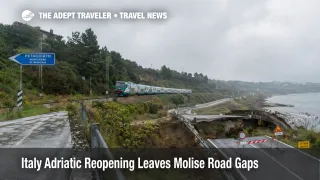
Italy Adriatic reopening has improved north to south rail movement, but travelers should not read that as a full corridor recovery. The Adriatic railway between Termoli and Montenero di Bisaccia reopened on Friday, April 10, after the Petacciato landslide, and Italy also partially restored A14 motorway traffic. But a major road link remains down after the collapse of the SS16 bridge over the Trigno River near Montenero di Bisaccia, with reconstruction expected to take six to seven months. For travelers, that shifts the problem from total corridor shutdown to a messier split system, where through rail is back but local road access and self drive routing in Molise remain unstable.
Italy Adriatic Reopening: What Changed
The biggest change is that the Bologna to Taranto rail spine is moving again. ANSA reported that the Adriatic rail segment between Termoli and Montenero di Bisaccia reopened on April 10, with Trenitalia warning that services were resuming gradually and could still face delays, changes, or cancellations. Reuters had reported the day before that rail service was expected back by Friday, and that expectation was later borne out.
The road picture is more mixed. The A14 motorway section through the affected area reopened on April 9, but it did so under constrained conditions, with traffic restored by using a diversion setup that keeps one lane running in each direction on the northbound carriageway. Separate local road sections around Petacciato were also reopened after precautionary closures, including stretches of the SS709, the SS16 Adriatica, and the SS157. That is a meaningful improvement for through movement, but it is not the same thing as normal road resilience.
What has not been fixed is the road break that matters most for local coastal continuity. The bridge on State Highway 16 over the Trigno River collapsed after extreme weather in early April, cutting road links toward Abruzzo. Reuters later said that the road affected by the collapsed bridge was still expected to take six to seven months to rebuild, a timeline that runs straight into the coastal tourism season.
Which Travelers Still Face Road Risk
Rail first itineraries now look materially better than they did during the immediate shutdown. Travelers moving between northern cities and Bari, Puglia, or other points along the southern Adriatic coast should now treat rail as the cleaner long distance option, especially if their trip does not depend on a final self drive segment in Molise. That includes city to city travelers, rail pass users, and anyone trying to avoid uncertain coastal road timing.
The exposure is higher for travelers whose plans depend on road continuity rather than just corridor continuity. Beach town stays, agriturismo bookings, coach tours, airport pickups, and hotel sequences that assume easy crossing between Molise and southern Abruzzo remain more vulnerable. A traveler can now get through the corridor again, but the last mile and local detour logic are still weaker than the headline reopening suggests. That matters most for people collecting rental cars near Pescara, Bari, or smaller Adriatic stations and expecting a simple coastal drive.
The seriousness is therefore moderate for through passengers and higher for self drive and transfer dependent travelers. The initial network break has eased, but the remaining damage can still distort arrival times, excursion planning, and hotel check in windows. Second order effects are straightforward: when one bridge remains out, detours lengthen, coaches bunch, transfer buffers shrink, and a rail recovery does not fully protect travelers whose trips reconnect to road transport at the end.
What Travelers Should Do Now
For the next several weeks, travelers should default to rail for long north south movement on this corridor when they have a choice. That is the cleaner play because the rail line is operating again, while the road network still carries a structural weak point. Even so, travelers using Trenitalia on this segment should keep extra connection margin because the restart was described as gradual, with possible delays, changes, or cancellations.
Self drive travelers should stop treating the Adriatic coast road as normal. Before departure, confirm whether your route depends on the SS16 crossing near Montenero di Bisaccia, then check whether your hotel, beach club, or transfer provider has updated detour instructions. The right threshold is simple: if your trip includes timed check in, a ferry, a wedding, or a same day onward connection, build in much more road buffer or shift the long leg to rail and collect a car closer to your final destination.
Travelers should also watch the next operational trigger, not just the original landslide headline. The corridor is in a recovery phase now. That means the useful signals are service notices from Trenitalia, road updates from ANAS and motorway operators, and any fresh weather that could slow stabilization work or reintroduce restrictions. If those alerts stay quiet, the Italy Adriatic reopening becomes more trustworthy. If they do not, the remaining road gap will keep spilling into summer itineraries.
Why the Corridor Is Still Fragile
This is a recovery story shaped by geography as much as by engineering. Reuters said the Petacciato landslide was triggered by heavy rain in an area with a history of hydrogeological instability, and the disruption hit three layers of the same mobility system, motorway, railway, and local roads. Once that happens, reopening one layer does not erase stress on the others.
That mechanism explains why the traveler risk has changed rather than disappeared. Rail reopening restores backbone connectivity between the north and the south. Partial motorway reopening restores a degree of vehicle flow. But the bridge collapse on the SS16 still weakens local redundancy, which is what turns a normal coast trip into a detour heavy one. In practical terms, the corridor is functioning again for many through journeys, but it is still fragile for place based travel in Molise and nearby coastal zones.
What happens next is likely to split along those same lines. Rail service should keep normalizing if no new instability appears, while the road side will remain the slower recovery track because the bridge rebuild is measured in months, not days. That is why the core traveler takeaway is not that the corridor is fixed. It is that the Italy Adriatic reopening has restored movement, but not full flexibility, and travelers who still rely on coastal road continuity should plan accordingly.
Sources
- Italy pledges emergency funds to reopen rail, motorway after landslide on key Adriatic corridor
- Adriatica railway reopens after massive Molise landslide
- Section of A14 highway reopened after landslide in Molise
- Bridge collapses on State highway amid extreme weather in Molise
- RIAPERTE AL TRAFFICO SS709, SS16 E SS157 IN LOCALITA PETACCIATO DOPO GLI INTERVENTI DI ANAS