

Caribbean Cruise Growth Tightens Port Hotel Pressure
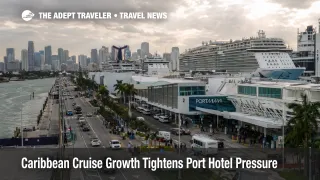
Caribbean cruise port pressure is rising into 2026 trip planning because CLIA says 44% of global ocean-going cruise passengers sailed the Caribbean, Bahamas, and Bermuda in 2025, a gain of more than 1.25 million travelers from 2024. That is no longer just a popularity story. It is a capacity-concentration story for embarkation cities, nearby airport corridors, hotel inventory, and same-day transfer timing when multiple ships turn over at once. Travelers booking Caribbean sailings should treat pre-cruise logistics as part of the cruise itself, not as an afterthought.
Caribbean Cruise Port Pressure Is Moving Ashore
CLIA's 2026 industry report shows 16.27 million passengers sailed the Caribbean, Bahamas, and Bermuda in 2025, up 8.4% year over year, making the region by far the largest cruise destination market. The same report also shows the behavior around those sailings is sticky and operationally important, about half of cruisers drove to embark, and 64% stayed at least one room-night before or after their trip. In practice, that means extra cruise demand does not stop at the pier. It spills into hotel check-in windows, ride-share and shuttle demand, parking, port approaches, and airport-to-port transfer chains.
That spillover is already easier to imagine at the largest Florida homeports. PortMiami reported a record 8.56 million cruise passengers in its latest fiscal year, Port Canaveral said it handled more than 8.6 million passenger movements in FY 2025, and Port Everglades says it handled more than 4.7 million cruise passengers in FY 2025. Those port records do not prove every Caribbean sailing day will be tight, but they do show that the biggest embarkation nodes are already operating at very high scale before adding the normal disruption variables of late flights, weather, traffic, or a ship delay.
Which Travelers Face the Tightest Caribbean Embarkation Days
The most exposed travelers are not just first-time cruisers. They are people trying to compress too many steps into one day, especially fly-cruise passengers landing the morning of embarkation, families moving with luggage and children, and anyone sailing during school breaks, holiday weeks, or weekends when multiple ships turn at the same port. A cruise can leave on time even when the travel chain around it does not. The first order effect is missed boarding windows or expensive last-minute hotel changes. The second order effect is a scramble across airport rebooking, ground transfers, and port-area lodging that is harder to solve once thousands of other passengers are doing the same thing.
Drive-to-port travelers are not insulated. If roughly half of cruisers are arriving by car, peak embarkation days can tighten roads into the port, parking flow, and drop-off zones at the same time hotels are flipping rooms for the next wave of guests. That matters most in markets where the cruise port, airport, and beach-hotel district all draw from the same pool of roads, labor, and rooms. The operational risk is not that the Caribbean has become unbookable. It is that the margin for error is thinner than the marketing makes it look.
What Travelers Should Do Before Final Payment
Travelers booking Caribbean cruises should price the sailing with the logistics package attached. If the itinerary requires a flight, the safer default is arriving the day before, not the morning of departure. That advice is stronger now because CLIA's own data shows overnight stays are the norm, not the exception, and because concentrated Caribbean demand means more travelers are competing for the same hotel rooms and transfer capacity around major homeports.
The next decision point is whether to lock in the port-city hotel early. Book earlier if your sailing falls in a school-break period, on a holiday weekend, or from a giant homeport where multiple ships can turn the same day. Wait longer only if your trip is fully drivable, you have flexible cancellation terms, and you can tolerate parking or traffic friction on embarkation morning. For flyers, the tradeoff is simple, saving one hotel night can cost the entire cruise if the inbound flight slips and the ship does not.
Travelers should also monitor the parts of the trip that cruise marketing barely mentions, airport arrival time, transfer distance, hotel checkout timing, and the latest acceptable terminal check-in window. Those are the points where a popular Caribbean sailing turns into a missed-ship problem. Using a travel advisor can help here, and CLIA says 63% of people who cruised in the last 12 months used one to book.
Why Caribbean Growth Spreads Beyond the Pier
The broader signal is that Caribbean dominance is not easing yet. CLIA says global cruise volume reached 37.2 million in 2025, up 7.5% from 2024, and its forecast points to 38.3 million in 2026 and 42.1 million by 2029. The same report says about 48% of surveyed travel advisors expect their 2026 cruise sales volume to be at least 6% better year over year. That combination, continued passenger growth plus advisor optimism, suggests the pressure on Caribbean embarkation ecosystems is more likely to persist than fade, especially if capacity growth at ports, hotels, roads, and airports does not keep pace with demand.
For travelers, the takeaway is practical. The Caribbean is still the easiest cruise region to book at scale, but scale is exactly why pre-cruise execution matters more now. The main risk is no longer choosing the wrong ship. It is underestimating the ground game around the ship, hotel rooms, airport arrivals, transfer time, and port access on a day when thousands of other passengers are trying to make the same handoff. That is the real shape of Caribbean cruise port pressure in 2026 planning.