

Taba Border Fees Rise, Cash Planning Now Matters
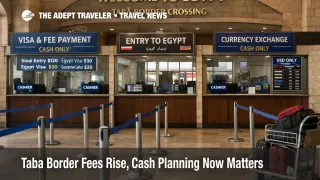
Travelers crossing from Israel into Egypt at Taba now need to treat the border as a cash heavy planning point, not a cheap same day handoff. U.K. government advice says travelers should bring at least $170 in cash per person, plus extra, because charges have been rising at short notice since early March 2026. The cost split is now sharp: about $20 for a Taba only stay, $120 for wider Sinai movement, and $120 plus a $30 visa and roughly $20 letter of guarantee for travel beyond Sinai. That changes the decision fast for anyone trying to reach Sharm el Sheikh, Cairo, Hurghada, or an onward hotel pickup without delay.
Taba Border Crossing Fees: What Changed
The core change is that Taba border crossing fees are no longer a minor add on. GOV.UK now says travelers entering Egypt from Israel at Taba should arrive with at least $170 in U.S. cash per person, with more on hand for unexpected costs, after short notice fee increases began in early March 2026. The current fee logic is route based. Travelers staying in Taba pay a $20 border tax for an entry permission stamp valid up to 15 days. Travelers going farther within Sinai, including toward Sharm el Sheikh, pay $120 for that same Sinai only entry permission. Travelers heading beyond Sinai, including those planning to fly onward from Cairo or Hurghada, must pay the $120 border tax, buy a standard $30 visa, and purchase a letter of guarantee at the crossing for around $20.
That means the old Sinai math no longer works for many budget or lightly planned crossings. A traveler who once treated Taba as a low friction overland hop now faces a border process where route choice changes the cash requirement by roughly $100 or more before vehicle or parking charges enter the picture. If traveling by car, British guidance also says there may be another $100 charge, plus parking costs. All of that still has to be handled in cash.
Which Travelers Face the Most Friction
The most exposed travelers are those building same day border to airport or border to hotel plans. That includes travelers leaving Israel overland to catch flights from Sharm el Sheikh International Airport (SSH), Cairo International Airport (CAI), or Hurghada International Airport (HRG), as well as anyone relying on a prebooked Sinai transfer that assumes a quick border clearance. A cash shortfall at Taba is not a minor inconvenience. It can turn into a missed driver meet, a lost hotel night, a broken domestic flight connection, or an extra night in Eilat or Taba while the traveler tries to rebuild the route.
The ATM problem makes that worse. GOV.UK says ATMs at the Taba Border Crossing are unreliable and frequently run out of cash, and advises travelers to obtain U.S. dollars before travel or in Eilat before arriving at the crossing. In practice, that means travelers should not expect to fix an underfunded border plan on arrival. Card fallback is not the working assumption here. Cash is.
This also changes the traveler fit for Taba itself. Taba still works best for short Sinai stays, especially when the traveler is actually staying in Taba or making a limited South Sinai trip that does not require mainland Egypt access. Once the plan involves Cairo, Hurghada, or a more complex onward chain, the border becomes a process risk as much as a transport route. In an earlier Adept Traveler article, Taba Border Fees Raise Israel Exit Costs outlined the earlier version of this cash squeeze. In an earlier Adept Traveler article, Ben Gurion Departure Cap Pushes Border Exits explained why more travelers were already being pushed toward overland exit options.
What Travelers Should Do Before Reaching Taba
Travelers should decide their Egypt itinerary before they reach the crossing, because the fee logic depends on where they are actually going next. Someone staying in Taba for a short resort stay is in a very different cash position from someone crossing into Egypt to connect onward to Cairo or Hurghada. If your plan goes beyond Sinai, assume the higher cost structure and carry enough U.S. cash to clear the border without improvising. Based on current official guidance, that means at least $170 per person, and more if you expect car fees, parking, or any route change after arrival.
The next decision point is whether Taba still fits the trip at all. For a simple South Sinai stay, especially a short Taba or Sharm el Sheikh plan with time flexibility, the crossing can still make sense. For travelers on a hard clock, such as same day flight departures, fixed transfer windows, or multi stop Egypt itineraries that depend on mainland access, flying may now be the safer planning choice even if it costs more upfront. The tradeoff is straightforward. Taba can still save money on the transport side for some Sinai trips, but it now carries more cash handling risk and less tolerance for mistakes.
Travelers who want the broader Egypt option should also review Egypt Tourist Entry Requirements For 2026 before departure, then recheck official border advice close to travel because fee levels and procedures are changing at short notice. Travelers should also avoid building a plan that assumes a border delay can be absorbed without consequence. Same day margins need to be wider now than they did a few months ago.
Why the Taba Route Now Breaks More Easily
The mechanism is simple. Taba is no longer just a border crossing, it is a cash settlement point with different price tiers tied to how far you plan to travel inside Egypt. That raises friction at the exact point where travelers are most vulnerable, after they have left one country, before they have fully entered the next, and often while a driver, hotel, ferry, or flight timing is already running. A route that looks open on paper can still fail operationally if the traveler arrives with the wrong amount of cash, the wrong expectation about Sinai versus mainland access, or too little buffer after the crossing.
What happens next depends on whether the border fee structure stabilizes. Right now, the official guidance points the other way. The U.K. advice says charges have been rising at short notice since early March 2026, which means travelers should treat this as a moving cost environment, not a fixed published tariff they can safely memorize weeks in advance. Until that changes, Taba remains usable, but it works best for travelers with cash in hand, a clearly defined Sinai plan, and enough time buffer to absorb a slow crossing without breaking the rest of the trip.