

Teotihuacán Shooting Tests Mexico Site Security
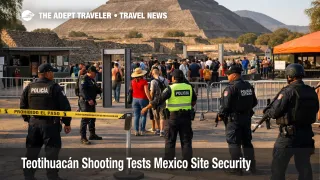
A Teotihuacán pyramids shooting on April 20, 2026, turned one of Mexico's most visited archaeological sites into an active crime scene after a gunman killed a Canadian woman, wounded several other foreign visitors, and then took his own life. For travelers, the immediate change is not a national shutdown of Mexico tourism, but a sharp reminder that high profile visitor sites are not automatically insulated from violent incidents. Anyone planning a Teotihuacán day trip from Mexico City in the next few days should expect tighter police presence, possible operational changes at the site, and closer attention to site security procedures while investigators establish motive and sequence.
Teotihuacán Pyramids Shooting: What Changed
Preliminary reporting from Reuters, citing Mexico's Security Cabinet, says the attack happened at the Teotihuacán pyramids in the State of Mexico on Monday, April 20. A Canadian woman was killed, and four other foreign nationals were reported wounded, including two Colombians, another Canadian, and a Russian national. AP reported a higher injured count because it included people hurt while fleeing, which means the confirmed fatality is clear, but the final injury total may still change as authorities reconcile gunshot wounds with panic injuries. Authorities said the site was later calm and under control, but the investigation was still in its early stage.
That uncertainty matters. There is no verified public evidence yet that the attacker was acting on behalf of a cartel, targeting a specific tour group, or carrying out a broader coordinated operation. Early footage and witness reporting point instead to a single gunman firing from the monument area before dying by suicide. Until prosecutors or federal authorities release more, the most accurate framing is a deadly attack at a major cultural site with motive not yet established.
Which Travelers Should Read This As a Planning Warning
The travelers most directly affected are those with near term plans for Teotihuacán, especially day trippers from Mexico City, escorted coach tours, and independent visitors relying on fixed timed itineraries. A site that drew about 1.8 million visitors last year will now face intense scrutiny over screening, perimeter control, and on site response. Even if the archaeological zone reopens quickly, the operating environment can change fast after an incident like this, with bag checks, access controls, or partial area restrictions introduced with little notice.
The broader Mexico travel takeaway is more limited, but still serious. The U.S. State Department already advises increased caution for both Mexico City and the State of Mexico, and says violent crime can occur in tourist and non tourist areas across the country. That does not mean travelers should treat all Mexico itineraries as equally unsafe, but it does mean famous sites, resort zones, and major cities should be planned with the same basic security discipline people often reserve only for obviously higher risk regions.
What Travelers Should Do Now
Travelers with Teotihuacán plans in the next 24 to 72 hours should verify site status with their operator or transport provider before departure, not just assume normal access because roads from Mexico City remain open. If a visit is still going ahead, this is a day to arrive earlier, keep plans flexible, and avoid stacking the pyramids into a tightly timed airport transfer or same day onward connection. A security review at a site like this can slow entry even without a formal closure.
For broader Mexico trips, the right response is adjustment, not panic. Use registered transport where possible, avoid casual late changes that push you into poorly lit pickup points or isolated routes, and keep more margin around day trips in areas with heavy tourist throughput. If you are deciding between a tightly choreographed excursion and a looser self guided plan, the safer choice right now is the one with better communication, clearer pickup logistics, and an easy exit option if security conditions change on the day. That logic applies especially in the State of Mexico and in destinations where crime advisories already note bystander risk.
The next decision point is official disclosure. If authorities describe the shooting as an isolated act with no wider threat, the travel effect will likely stay local to Teotihuacán and focused on site procedures. If investigators instead tie the attacker to organized crime, extortion networks, or a targeted grievance linked to tourism activity, the story becomes much bigger for Mexico's cultural site security posture.
What This Does, and Does Not, Share With Jalisco and Quintana Roo Violence
There is a real connection to Mexico's wider violence problem, but not yet a proven direct connection to the recent Jalisco violence or the Quintana Roo tourist zone bloodshed from 2021 and 2022. The Jalisco violence that drew international attention in February 2026 was openly linked to cartel retaliation after the capture and death of Ruben "El Mencho" Oseguera, with burned vehicles, roadblocks, shuttered businesses, and broader urban disruption around Guadalajara. That was organized criminal blowback with a clear trigger and a regional operating pattern.
Quintana Roo's earlier tourist area violence also followed a different mechanism. Reuters' 2022 reporting on Canadian deaths near Cancún and Playa del Carmen pointed to criminal disputes, targeted victims, and bystander exposure inside or near resort environments. In other words, those cases were part of a known pattern in which organized crime activity leaked into places marketed as insulated tourist space. The Teotihuacán attack may end up fitting none of those categories. Right now, what it clearly shares with Quintana Roo and Jalisco is something more basic and more troubling, Mexico's tourism economy operates inside a national security landscape where high visibility visitor spaces can still be exposed to sudden violence, even when the exact mechanism differs from place to place.
For travelers, that distinction matters. If this proves to be a lone actor attack, the planning lesson is about venue security, screening, and emergency response at marquee sites. If evidence later points to organized crime, then the lesson shifts toward the same spillover risk already visible in Jalisco and Quintana Roo, where violence tied to larger criminal systems can abruptly intrude on normal visitor movement. As of April 20, 2026, the first explanation is possible, the second is not confirmed, and travelers should plan around facts, not assumption.
Sources
- Gunman kills Canadian woman, wounds four at Mexico's Teotihuacan pyramids, Reuters
- Shooting at pyramids north of Mexico City leaves 1 Canadian tourist dead, injures 6 people, AP News
- Mexico Travel Advisory, U.S. Department of State
- Mexico's Guadalajara hosts World Cup playoff match under specter of violence, Reuters
- Mexico sends 2,000 soldiers to Jalisco after cartel leader's death, Reuters
- Two Canadians die in shooting at Mexican Caribbean resort, Reuters
- Two Canadians killed in Mexican Caribbean beach resort, Reuters