

Venezuela Airport Transfer Risk After Advisory Ease
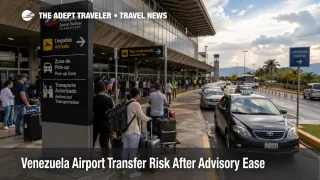
Venezuela airport transfer risk did not disappear when the U.S. advisory improved. The U.S. State Department lowered Venezuela from Level 4 to Level 3 on March 19, 2026, and the page was updated again on April 20, 2026, but it still warns against unregulated taxis at Maiquetía Simón Bolívar International Airport (CCS), says ATMs near the airport carry security risk, and states that nighttime travel between the airport and Caracas is risky. For travelers tempted to read the downgrade as a return to normal, the real change is narrower: the headline eased, but the arrival chain still needs careful planning.
Venezuela Airport Transfer Risk: What Changed
What changed is the top line U.S. government posture, not the ground reality at the curb. The State Department says Venezuela is now Level 3, Reconsider Travel, rather than Level 4, Do Not Travel, and it also updated the advisory summary to reflect changes in U.S. embassy operations. At the same time, the advisory still says routine consular services remain suspended in Venezuela, that most consular help is still handled through U.S. Embassy Bogotá, and that the Venezuela Affairs Unit cannot provide emergency services to U.S. citizens outside Caracas. That means travelers have a slightly less restrictive advisory headline, but not a robust in-country safety net if something goes wrong on arrival.
That gap matters more now because the federal barrier to direct U.S. air service has also eased. DHS published a notice on April 17, 2026, making the rescission of the 2019 suspension applicable April 15, 2026, after TSA assessed Maiquetía and concluded sufficient security measures were in place at CCS to begin commercial operations from the United States. The practical consequence is straightforward: easier aviation policy can bring back flights faster than it rebuilds ground transport reliability, after-hours recovery options, or traveler support capacity.
Which Travelers Face the Most Exposure
The most exposed travelers are people arriving after dark, first-time visitors who do not have a trusted pickup arranged, and anyone assuming they can improvise transport on arrival. The State Department warning is unusually specific on the airport handoff, flagging unregulated taxis and nighttime travel between Maiquetía and Caracas, not just general country conditions. Canada's travel advisory goes further on the airport environment itself, warning that violent crime occurs frequently in and around the airport and that criminals may pose as taxi drivers or currency exchangers.
Family visits, humanitarian trips, business travel, and any future direct U.S. services all run into the same operational problem first: the weak point is not only whether you can land, it is whether you can get from the airport to your hotel or host safely and predictably. First order, arrival time, pickup quality, and hotel location matter more than before. Second order, a delayed inbound flight can turn a nominally safe afternoon arrival into a higher-risk night transfer, while limited consular support and uneven ground options reduce recovery choices if a pickup fails or a traveler needs to rework plans quickly.
What Travelers Should Do Now
Travelers going to Venezuela should structure the trip around the airport transfer, not around the advisory label alone. The safer approach is to land in daylight, use a prearranged airport pickup from a vetted hotel, employer, host, or professional transfer provider, and avoid relying on curbside transport decisions after arrival. The State Department's warning about unregulated taxis and nearby ATMs means the airport is not the place to solve cash, exchange, or transport problems on the fly.
The next decision point is your arrival window. Rebook if the itinerary pushes arrival into late evening, or if a connection makes a same-day ground transfer into Caracas likely after dark. Waiting may still make sense for travelers with a trusted local reception plan, a confirmed daytime arrival, and lodging that can coordinate transport directly. Travelers without those elements should treat the trip as less forgiving than the new Level 3 label implies.
Over the next few days and weeks, watch for two things before assuming Venezuela is becoming easy again. One is actual, operating U.S. air service at scale. The other is any official sign that consular access, airport-area security, or formal transfer reliability has materially improved. Air links can return before traveler support does. Until those pieces strengthen together, the sensible posture is not panic, but disciplined logistics. In an earlier Adept Traveler article, Venezuela Airspace Advisory, Caribbean Flights, February 2 the main concern was regional routing. Now the decision pressure has shifted back to the arrival corridor itself.
Why the Headline Improved Before Conditions Fully Did
The advisory change sits inside a broader U.S. policy shift, not a claim that all traveler risk is resolved. DHS said the old 2019 suspension was rescinded because conditions no longer justified keeping all direct commercial passenger and cargo flights blocked, and TSA said it had completed an assessment at CCS and found sufficient security measures for service to begin there. The State Department also removed the blanket Level 4 framing on March 19, 2026. But the same State Department page still preserves detailed crime, kidnapping, health infrastructure, border-area, and transport warnings, and it keeps important limits on what the U.S. mission can actually do inside the country.
That is why travelers should separate aviation access from trip friction. A country can become more reachable before it becomes operationally forgiving. What happens next will likely be uneven: more interest, more test demand, and possibly more direct service, but also a continued need for conservative arrival planning, stronger hotel coordination, and better backup options for anyone whose transfer or schedule slips. The improved advisory is real. So is the airport-to-city risk it still spells out.
Sources
- Venezuela Travel Advisory, Travel.State.gov
- Venezuela International Travel Information, Travel.State.gov
- Rescission of the Suspension of All Direct Commercial Passenger and Cargo Flights Between the United States and Venezuela, Federal Register
- Travel Advice and Advisories for Venezuela, Government of Canada