

Athens Weighs Hotel Caps in Saturated Central Districts
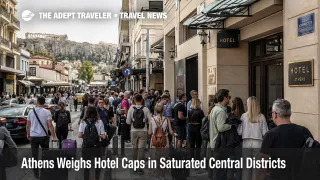
Athens is signaling that central hotel growth may no longer be treated as an automatic good, and that matters more for booking strategy than for politics. Mayor Haris Doukas said on April 21, 2026, that the city needs to decide whether it still wants more hotels, where it can absorb them, and which areas are already saturated. Nothing has been frozen yet for hotels. But once a city starts talking publicly about bed caps, carrying capacity, and "not becoming Barcelona," travelers should stop assuming that central Athens will keep adding easy backup supply around the Acropolis, Syntagma, and other high-demand districts.
Athens Hotel Permit Cap: What Changed
The immediate change is not a law, it is a planning signal. At the This is Athens, Agora event, Doukas raised the possibility of restricting new hotel permits in parts of the capital that are already carrying heavy tourism pressure. That is a step beyond ordinary overtourism rhetoric because Athens has already moved against part of its accommodation pipeline before. Greece imposed a ban on new short-term rental registrations in three central Athens districts starting on January 1, 2025, and city officials are now openly discussing whether hotel growth also needs limits in saturated zones.
For travelers, that moves the story from housing politics into practical trip design. Athens has been one of Europe's stronger city-break performers, and the city is no longer just a quick gateway to the islands. Athens International Airport handled a record 33.99 million passengers in 2025, while INSETE reported 12.0 million international air arrivals at the airport. If demand keeps rising while the city becomes more selective about where new beds can be added, the easiest place to feel that pressure will be the historic core, where many visitors want to stay and where replacement options are already concentrated.
Which Travelers Will Feel It First
The people most exposed are not bargain hunters booking one random night far from the center. They are travelers who need a precise location and limited friction. Think first-time visitors who want to walk to the Acropolis and Plaka, conference and event attendees who need central hotels near meeting venues, cruise pre-night passengers who want short, predictable transfers, and shoulder-season city-break travelers who expect late inventory to remain available in the center.
This does not yet mean Athens suddenly runs out of rooms. It means the market may become more segmented. Central districts could get tighter first, while supply farther out, or in less saturated parts of the metro area, remains more flexible. That widens the tradeoff. Staying near the main sights preserves walking convenience and reduces local transfer complexity. Staying farther out may preserve budget and availability, but it can add metro dependency, taxi exposure, or more time pressure on early tours, ferry departures, and airport runs.
There is also a second-order effect for hotels themselves. If new central permits become harder to win, existing centrally located properties gain pricing power during high-demand windows. That does not just affect room rates. It can change minimum-stay patterns, suite availability, group allotments, and how quickly refundable inventory disappears around major events.
What Travelers Should Do Now
Travelers do not need to panic book Athens because no hotel freeze has been announced. But they should treat central Athens as a market where future supply may grow more slowly than demand. For peak spring and fall dates, especially if the trip depends on staying in the city center, booking earlier is the safer play than assuming another wave of new properties will appear at the last minute.
The decision threshold is simple. If location is part of the itinerary's success, book the district, not just the city. Travelers who need to be near Syntagma, the Acropolis corridor, Monastiraki, Kolonaki, or a specific convention venue should lock in a cancellable room once dates are firm. Waiting still makes sense for flexible leisure travelers who can tolerate a metro ride, a taxi commute, or a shift to a different neighborhood if central rates spike.
Over the next few months, watch for three signals. First, whether the municipality moves from public discussion to a formal consultation or zoning proposal. Second, whether officials define "saturated areas" clearly, because that will determine whether the practical effect is narrow and symbolic or broad enough to reshape inventory growth. Third, whether hotel and non-hotel accommodation policy starts being planned together. If Athens manages hotel permits, short-term rentals, and convention-led development as one system, the city becomes more predictable in the long run, but less forgiving for travelers who leave booking to the final weeks.
Why Athens Is Moving This Way
Athens is not improvising from nowhere. City and destination bodies have already been building the language and tools of managed growth. Develop Athens has been advancing a Sustainable Tourism Observatory, and the city presented a Tourism Carrying Capacity Study in late 2024. That matters because the current discussion is not only about too many tourists in the abstract. It is about where bed growth belongs, what parts of the center can still absorb it, and how to avoid letting accommodation expansion outrun infrastructure, housing tolerance, neighborhood livability, and transport capacity.
The hotel sector itself is also talking in planning terms, not just expansion terms. At the same event, the president of the Athens, Attica, and Argosaronic Hotel Association argued for a fuller bed strategy across hotels, short-term rentals, and other accommodation types, while noting that some future development may still make sense in targeted areas such as a convention-oriented zone. That is the key mechanism travelers need to understand. Athens is not signaling that tourism growth is over. It is signaling that future bed growth may become more selective by district and by use case.
That makes this a meaningful planning story, not an immediate disruption story. No new Athens hotel permit cap has taken effect. But the public shift is real, and it changes the assumptions behind central Athens bookings. Travelers who value a specific neighborhood should book with more discipline, watch where the city draws the saturation line, and treat the Athens hotel permit cap debate as an early sign that convenience in the historic core may become scarcer before it becomes officially restricted.
Sources
- Euronews, "We must not become Barcelona: Athens considers banning new hotels, mayor says"
- Reuters, "Greece to ban new short-term lets in Athens for at least a year"
- This is Athens, This is Athens Agora About Page
- This is Athens, Athens in the News, Sustainable Tourism Observatory and Carrying Capacity Study references
- Athens International Airport, Facts and Figures
- INSETE, International Air Arrivals 2024-2025 PDF