

China Warning Turns Seattle Into a Riskier U.S. Gateway
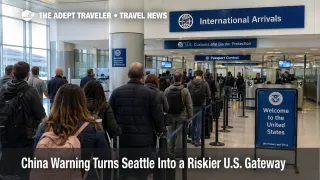
Seattle airport entry risk jumped on April 16, 2026, when China told its citizens to avoid entering the United States through Seattle-Tacoma International Airport (SEA) after about 20 Chinese scholars with valid visas were reportedly questioned and refused entry. That does not prove a broad operational change in U.S. policy, but it does turn one named airport into a planning variable for Chinese travelers, universities, companies, and tour operators who normally treat gateway choice as mostly a fare and schedule question.
Seattle Airport Entry Risk: What Changed
What changed is unusually specific. China did not just issue a general caution about travel to the United States. It singled out Seattle-Tacoma International Airport and said Chinese citizens should avoid entering through that airport after what it described as repeated incidents of harassment and "malicious questioning" aimed at Chinese scholars. Reuters and AP both reported that the immediate trigger was the denial of entry to roughly 20 Chinese scholars who were traveling with valid visas to attend an academic conference.
For travelers, that matters because U.S. airport choice is not a cosmetic decision on international itineraries. The first U.S. airport where a traveler lands is normally the inspection point where U.S. Customs and Border Protection decides admissibility. If Seattle is now viewed by Chinese travelers and travel managers as a higher friction entry point, some passengers will start paying more to enter elsewhere, even if their final destination is in Washington, Oregon, British Columbia connections, or the broader Pacific Northwest business corridor.
That does not mean Seattle is officially subject to a different published CBP rule set than other U.S. gateways. CBP's own guidance says all arriving travelers are subject to inspection, and a visa does not guarantee admission. The travel consequence comes from perceived port specific risk, not from a publicly announced new federal entry rule.
Which Travelers Face the Most Friction
The most exposed travelers are not every inbound visitor from China in equal measure. The highest friction risk falls first on Chinese scholars, conference attendees, researchers, business visitors, and other travelers whose trips involve scrutiny of purpose, affiliations, institutions, electronics, or documentation that can lead to extended inspection or denial. China's warning itself was tied to scholars, which narrows the most immediate risk profile even if the perception effect spreads wider.
The second group is travelers whose itinerary depends on Seattle as a clean first stop. That includes passengers connecting onward to Vancouver, Victoria, Alaska cruises, Pacific Northwest meetings, university events, and regional tours. Once a first U.S. entry point looks less predictable, the cost of switching gateways rises fast. Fares can move higher on alternatives such as San Francisco, Los Angeles, or New York, and travelers may need an extra hotel night, a separate domestic leg, or a longer connection to protect the trip. The problem is not just inspection time, it is itinerary fragility after inspection.
A broader commercial effect could follow even without any formal airline schedule change. If enough travelers or travel managers begin excluding Seattle from preferred U.S. entry points, demand can shift toward other gateways, which can affect transpacific fare patterns, hotel demand near alternate arrival airports, and meeting planning for organizations that depend on smoother academic or business arrivals. That is the real second order consequence here. Seattle's issue is not only border friction at the desk, it is the way border uncertainty can reprice an entire itinerary.
What Travelers Should Do Now
Chinese travelers with flexibility should treat Seattle as a port selection problem, not just a destination problem. If the trip is time sensitive, professionally important, or tied to a conference, campus event, cruise embarkation, or fixed meeting window, entering through a different U.S. gateway is the lower risk choice until there is clearer evidence that this episode is isolated. Travelers whose final destination is Seattle should weigh whether the lower fare or simpler routing is worth the added uncertainty at first entry.
For travelers who still need to enter through Seattle, the practical threshold is documentation strength and schedule tolerance. Carry a clear trip purpose, invitation letters where relevant, hotel and onward booking records, and enough buffer that a long secondary inspection does not destroy the trip on day one. Avoid same day cruise embarkations, tight onward domestic connections, and short meeting turnarounds after arrival. At SEA, all arriving international passengers clear passport control there unless they arrive from a U.S. preclearance airport, so the inspection point is not optional once Seattle is the first U.S. stop.
The next decision point is whether this stays a targeted warning tied mainly to academic travelers, or grows into a broader planning advisory that changes corporate travel policies and tour routing. Watch for any public response from CBP, additional reports of denied entry at Seattle, or signs that universities and conference organizers begin recommending alternate gateways. If that happens, Seattle airport entry risk stops being a narrow consular warning and becomes a more durable booking signal.
Why Seattle Became the Flash Point
The mechanism here is not mysterious, even if some facts remain unconfirmed. U.S. border admission decisions are made at the port of entry by CBP officers, and every arriving traveler can be referred to secondary inspection. That means a cluster of high profile denials at one airport can quickly damage that airport's reputation among a specific traveler group, even when the federal legal framework is national rather than local.
Seattle is especially vulnerable to that kind of reputational shift because it functions as a transpacific gateway and a first stop for academic, technology, cruise, and Pacific Northwest travel flows. The Port of Seattle's own materials make clear that international arrivals at SEA are routed through CBP passport control, while port policy emphasizes a "Welcoming Port" approach and prior commission statements have raised concerns about CBP detention practices at the airport. That does not validate China's allegations in this case, but it does mean Seattle already carried political sensitivity around border experience before this warning landed.
What happens next depends on whether this becomes a one airport diplomatic flash point or the start of a wider chilling effect on U.S. inbound travel from China. For now, the serious consequence is narrower but still real. Seattle airport entry risk is no longer just about CBP discretion in theory. It is now a visible planning factor that can change gateway choice, trip cost, and itinerary resilience for travelers who need the cleanest possible U.S. arrival.
Sources
- China issues US safety alert for citizens citing 'malicious questioning' by US border officers
- China urges travelers to avoid Seattle airport after 20 scholars were denied entry to the US
- Admission into United States
- Requirements for Immigrant and Nonimmigrant Visas
- Border Search of Electronic Devices at Ports of Entry
- Seattle, Washington - 3001
- International Arrivals and Passport Control
- Port of Seattle Commission Statement on CBP Detention Practices at SEA
- Port of Seattle Commission Welcoming Port Policy Directive