

EU Jet Fuel Plan Raises Europe Summer Flight Risk
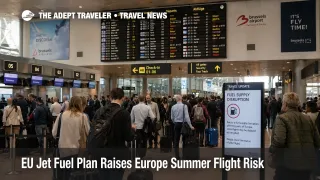
Europe's summer fuel story just moved closer to intervention. Brussels is no longer only monitoring supply, it is openly preparing tools to hold, map, and potentially redistribute jet fuel across member states if the Iran war keeps squeezing flows through the Strait of Hormuz. There is no active shortage yet. But once policymakers start discussing how to share fuel region by region, travelers need to stop treating this as a distant price problem and start treating it as an operational risk that could reshape schedules, backup options, and fares across the continent.
Europe Jet Fuel Risk: What Changed
The key change is not simply that Europe remains exposed to jet fuel imports. It is that the European Commission's April 22 package moved into contingency planning that is much more interventionist than normal market management. Reuters reported that Energy Commissioner Dan Jorgensen said the EU could require countries to hold jet fuel stockpiles and, if necessary, introduce redistribution tools, while the Commission's own plan says it will create a Fuel Observatory, optimize distribution among member states, and assess whether strategic stock rules should include specific jet fuel requirements.
That matters because the bloc imports about 40 percent of its jet fuel, and roughly half of those imports come through the Strait of Hormuz. Reuters also reported that Europe previously relied on the Gulf for nearly 75 percent of its jet fuel imports, while the International Energy Agency has warned shortages could emerge by June if only half of normal Middle East supply can be replaced. In practice, that means the headline risk is shifting from expensive fuel to uneven physical availability at the airport level.
The seriousness is still below active rationing, but it is above routine summer volatility. Brussels and Reuters both say there is no current jet fuel shortage, yet the Commission is already preparing guidance on airport slots, anti tankering rules, public service obligations, and imported fuel use if shortages start affecting air transport operations. That is the kind of planning governments do when they want legal room to protect connectivity before a system starts breaking.
Which Airport Systems Are Most Exposed
The most exposed airport systems are likely to be the ones furthest from secure refining and storage buffers. Reuters reported that jet fuel stocks are uneven across Europe, that Spain is in a stronger position because it exports fuel, and that some airports and fuel handling consortia do not keep large long term stocks on hand. The Commission's own document also highlights refining capacity concentrated in only some parts of Europe and frames balanced supply across "all regions and airports" as a specific policy goal, which implies some locations are structurally more vulnerable than others.
For travelers, that points to higher exposure on itineraries that rely on smaller airports, island systems, peripheral leisure markets, or thinly served city pairs where there are fewer daily frequencies and less room to recover after even modest cuts. The opposite end of the spectrum, large hub systems with stronger logistics, storage access, and political importance, may still face higher fares and schedule trimming, but they are more likely to be defended if fuel has to be steered across regions. That last point is an inference from the Commission's stated goal of preserving essential connectivity and balancing fuel distribution, not a published airport ranking.
There is also a second layer of exposure inside the airline network. If fuel becomes regionally uneven, carriers may protect longer haul trunk routes, banked hub waves, and flights that preserve fleet positioning, while marginal short haul frequencies and thinner point to point service take the first hit. That pattern is already visible in the wider market response, with Lufthansa cutting 20,000 short haul flights through October and TUI and easyJet warning about fuel related pressure on summer operations and profits.
What Travelers Should Do Now
Travelers booking Europe for June through August should put more value on itinerary resilience than on a small fare difference. A nonstop, a longer hub connection, or a routing through a larger airport may now be worth paying for if your trip includes cruise embarkation, a long haul self connection, a wedding, a tour join, or any other same day commitment that is expensive to miss. The main risk is not an immediate continent wide shutdown. It is a thinner recovery margin once one leg breaks.
The next decision point is whether to lock in now or wait. Book now if you are traveling on fixed dates into peak leisure markets, especially if your plan depends on one or two critical flights and there are limited backups. Wait a little longer only if your dates are flexible, your airport choices are broad, and you are prepared to pivot between hubs or even between countries. In this environment, the tradeoff is straightforward, waiting may save money, but early booking may save the itinerary. That judgment is based on the Commission's escalation to contingency tools, the industry's call for swift implementation, and the already visible schedule and profit pressure among European carriers.
Watch for signals that the crisis is moving from warning to active rationing. The biggest signs would be coordinated releases of oil or jet fuel stocks, formal guidance that changes slot use or anti tankering enforcement, more airlines cutting frequencies rather than just warning on profits, and localized reports of airports managing fuel availability rather than just paying more for it. If those signals appear, Europe jet fuel risk stops being a planning issue on the margin and becomes a trip design problem that can justify reroutes, extra buffer nights, and avoiding tight same day connections.
How Redistribution Could Work, and What Happens Next
Redistribution would not mean a simple Brussels command telling airlines where to fuel. The Commission's plan points to a more practical chain, map refining capacity, track stocks and flows through a Fuel Observatory, coordinate with member states and the aviation sector on alternative sourcing, then optimize distribution across regions and airports if supply starts tightening. It is also preparing guidance on legal flexibilities so carriers and airports can keep essential connectivity moving even if normal rules become too rigid for a shortage environment.
What happens next depends on whether replacement imports from the United States and Nigeria, plus higher European refinery output, can keep pace with the loss of Gulf supply. Reuters reported that inflows from those alternative sources have already hit record levels, but also that airports and airline groups say recovery in jet fuel supply will still take weeks. That leaves Europe in a fragile middle stage, not yet short of fuel, but already far enough into contingency planning that a deeper disruption would spread quickly through schedules, positioning, and pricing.
For summer travelers, the practical takeaway is that fuel policy in Brussels now belongs on the same watchlist as strikes, weather, and ATC disruption. The market can absorb higher prices for a while. It has a much harder time absorbing uneven physical supply at the wrong airports during peak season. That is why Europe jet fuel risk now matters even before any formal rationing begins.
Sources
- EU looks to tighten grip on jet fuel as Iran war spotlights shortage risks, Reuters
- Europe's response to the Iran war energy crunch, Reuters
- EU working on jet fuel plan as Iran crisis threatens air travel, Reuters
- Spain says it would join potential EU jet fuel sharing as data shows more supply coming, Reuters
- Europe facing jet fuel crunch sees record inflows from US, Nigeria, Reuters
- Commission proposes actions to protect Europeans from the energy price shock and accelerate the clean transition, European Commission
- AccelerateEU Communication PDF, European Commission
- Europe's airports welcome the European Commission's action plan to address jet fuel shortage risks, ACI EUROPE