

Guatemala State of Prevention Still Covers 5 Key Corridors
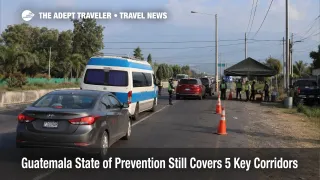
Guatemala state of prevention is still affecting real traveler movement, but the active map is narrower than it was earlier in April. On April 21, Guatemala renewed the measure for 15 more days in Guatemala, Escuintla, Izabal, San Marcos, and Huehuetenango, while Petén and Sacatepéquez dropped out of the current decree. That means Antigua and Tikal no longer sit inside the live emergency footprint, but Guatemala City approaches, Pacific corridor routes, Caribbean access, and parts of the western overland network still face added checkpoints, vehicle inspections, and possible traffic controls through the current window.
Guatemala State of Prevention: What Changed
The current measure is tied to Decree 6-2026 and took effect on April 21 for 15 days, which points to an active window through May 6, 2026, unless authorities change it again. Official Guatemalan sources say it now applies only in the departments of Guatemala, Escuintla, Izabal, San Marcos, and Huehuetenango. That is the key operational update, because the broader April 6 footprint no longer matches the live decree.
For travelers, the practical issue is not that the whole country suddenly became unbookable. It is that the government has a temporary legal framework to intensify patrols, install control points, inspect vehicles, restrict or redirect traffic in certain places and at certain times, and limit open air gatherings. Guatemala's Ministry of the Interior says those powers are being used in strategic zones, including border areas and places near detention facilities, with more vehicle checkpoints and identity verification.
Which Travelers Face the Most Friction
The travelers most exposed now are not Antigua hotel guests moving only inside Sacatepéquez, or Tikal visitors flying straight into Petén, because those two departments are no longer included in the current decree. The higher friction sits on routes that touch Guatemala department, Escuintla, Izabal, San Marcos, and Huehuetenango, especially movements that depend on road timing rather than one fixed urban stay.
That keeps several common tourist and transit flows in play. Guatemala City arrivals using La Aurora International Airport (GUA) remain exposed on airport to hotel transfers and on departures toward the Pacific side through Escuintla. Travelers heading for Pacific coast properties and surf towns often pass through Guatemala department and Escuintla, so even if flights run normally, the ground segment can slow. Izabal matters for Caribbean side access and overland connections toward Livingston or Puerto Barrios. San Marcos and Huehuetenango matter more for western overland travelers, including anyone moving toward the Mexican border region, where Australia's Smartraveller already advises travelers to reconsider border areas between Guatemala and Chiapas because of organized crime and drug related violence.
The first order effect is simple, more checks, more stops, and less predictable road timing. The second order effect is where itineraries start to break. Airport pickups can miss the clean handoff window. Shared shuttles can run late enough to disrupt hotel check in or onward coach departures. A transfer that normally looks safe on paper can become tight once one stop becomes three. That does not mean every route will see visible disruption every day, but it does mean travelers should stop treating standard online drive times as reliable trip planning inputs while the Guatemala state of prevention remains active.
What Travelers Should Do Now
Travelers moving inside the five active departments should add buffer before every time sensitive handoff. For airport arrivals into Guatemala City, that means avoiding same hour assumptions for private pickups and not stacking a domestic transfer or premium timed activity too close to landing. For road journeys through Escuintla, Izabal, San Marcos, or Huehuetenango, daytime movement is the safer planning pattern, both because checkpoints can slow progress and because foreign advisories already warn that crime risks rise after dark in Guatemala.
The rebooking threshold is not "Guatemala has a state of prevention, cancel the trip." A better threshold is whether your plan depends on tight road timing inside one of the five active departments. If you have a same day cruise transfer, a fixed border crossing, a nonrefundable late evening arrival into a remote property, or a chain of shared shuttles, it is smarter to simplify the itinerary now. If your trip is concentrated in Antigua or Petén, the current decree is less directly relevant than your seed suggested, though you still need to watch for knock on delays if your access route passes through Guatemala department or another active zone first.
Over the next 24 to 72 hours, the main signal to monitor is not broad rhetoric. It is whether authorities extend the decree again, widen the departmental map, or announce new traffic controls in specific corridors. Travelers should also watch local operator messaging, because shuttle companies, guides, hotels, and airport transfer providers will often spot checkpoint related slowdowns before foreign advisories are updated in detail. The current Guatemala state of prevention is manageable for many trips, but only if the ground plan has slack.
Why the Active Map Still Matters
The government says it renewed the measure because authorities still need exceptional powers in departments that are border facing or host detention centers, and because it is trying to prevent attacks by gangs or other criminal groups against security forces and civilians. Foreign travel advice reflects that broader backdrop rather than this decree alone, warning of violent crime, cautioning against demonstrations and public gatherings, and advising travelers to follow local authority instructions.
That wider context matters because this is not just a public order headline. It changes how friction spreads through travel. A checkpoint regime does not need to close roads outright to damage itinerary reliability. It only needs to make travel times less predictable in a country where many leisure itineraries already rely on long overland segments stitched between Guatemala City, the Pacific coast, the Caribbean side, and western highland routes. The present map is narrower than earlier in April, which is good news for Antigua and Petén travelers, but the live decree still covers enough of the transport network that visitors should plan around timing risk, not around worst case fear.