

YOTEL Washington DC Adds an Autism-Friendly Edge
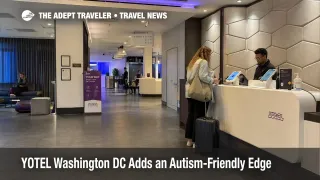
YOTEL Washington DC has turned autism-aware training and sensory-friendly design into a real booking variable, not just a feel-good amenity. The hotel says it is the first U.S. hotel to receive Autism Speaks' Autism Friendly Designation, with front-office staff trained to better support autistic guests, plus quiet areas and specialized lighting intended to reduce sensory overload. For travelers planning Washington trips where predictability matters, that creates a more specific reason to choose one hotel over another, especially near Capitol Hill and Union Station.
Autism-Friendly Hotel: What Is New
What changed is not that accessible lodging exists in Washington, D.C. What changed is that one centrally located hotel now has a named, outside designation tied to autism support, and that gives travelers a clearer planning signal before they book. Autism Speaks says its program is designed to show that an organization recognizes, supports, and welcomes autistic people and their families, and that the designation includes employee training plus onsite resources and supports.
YOTEL says the Washington property's front-office team completed specialized training, and the hotel also points to quiet areas and specialized guest-room lighting as part of a more sensory-friendly environment. That matters because hotel stress often shows up in small moments, check in, lobby noise, elevator bottlenecks, lighting, and unfamiliar transitions, long before a traveler ever reaches the museum, meeting, or family event they came for.
Who Benefits Most From This Washington DC Stay
The clearest fit is for autistic travelers, families traveling with autistic children, and caregivers who want fewer unknowns in the stay itself. It also fits advocacy and event travel, because YOTEL Washington DC is about a 10 minute walk from Union Station and the Red Line, with rail and Metro access that also connect onward to Ronald Reagan Washington National Airport (DCA), Washington Dulles International Airport (IAD), and Baltimore/Washington International Thurgood Marshall Airport (BWI) through Union Station links.
The location sharpens that value. A hotel that reduces sensory friction is more useful when it also shortens transfer complexity, and this one sits close to Capitol Hill and major visitor infrastructure. That makes it a stronger fit for short policy trips, school and advocacy visits, museum-focused family travel, and train-first itineraries where cutting one more stressful transfer can matter as much as shaving a few dollars off the room rate.
YOTEL also says the property offers accessible king and double-queen rooms, with either grab-bar shower and tub combinations or roll-in showers, and it says wheelchairs are available at no extra cost on request. That does not make the hotel a universal fit for every neurodivergent traveler, but it does widen the overlap between sensory planning and broader accessibility planning.
How To Book and Plan Around It
Travelers considering this property should treat the designation as a useful filter, not a guarantee that every need is automatically solved. The best move is to book directly with the hotel, note specific sensory or room needs before arrival, and ask concrete questions about room placement, hallway noise, lighting controls, elevator proximity, and the location of quieter spaces. A designation helps most when it is paired with an explicit request tied to the traveler's actual triggers and routines.
For Washington trips built around early Hill meetings, Amtrak arrivals, or packed sightseeing days, this also shifts the tradeoff. A traveler may reasonably accept a slightly smaller room, or a similar nightly rate elsewhere, in exchange for a shorter walk from Union Station and a hotel team that has completed autism-focused training. That is especially true for one- or two-night stays, where one rough arrival can throw off the entire trip.
The next decision point is simple. Book this property when sensory predictability is part of the trip's success, and keep shopping when the stay is mainly about price, loyalty points, or a different D.C. neighborhood. Travelers should also watch whether YOTEL expands the same model to more U.S. properties, because one designated hotel is useful, but a repeatable network standard would matter far more for multi-city planning.
What Makes This Different, and What Happens Next
The most important context is that "first" here is narrower than it sounds. YOTEL Washington DC appears to be the first U.S. hotel to receive Autism Speaks' Autism Friendly Designation, but it is not the first autism-trained or autism-certified hotel concept in the broader U.S. travel market. Other organizations, including IBCCES, already certify hotels and resorts under separate autism and accessibility programs. That distinction matters because travelers should compare the actual training model, review standards, and property-level supports, not just the headline claim.
Autism Speaks says its designation requires businesses to enroll, complete training, hold an experience conversation with Autism Speaks leadership, and reach a threshold where 80 percent of customer-facing employees complete training. That gives the designation more substance than a self-applied accessibility label, but it still leaves a bigger unanswered question for travel planning, whether more city hotels, airport hotels, and major chains decide this is worth copying.
If that expansion happens, the second-order effect is larger than one Washington stay. Autism-friendly lodging could become a more visible comparison layer in the same way travelers already weigh airport access, family rooms, parking, or free breakfast. For now, the operational significance is modest but real, minor for the overall hotel market, meaningful for the travelers who specifically need a calmer and more predictable base in Washington.