

Burj Al Arab Closure Hits Dubai Luxury Planning
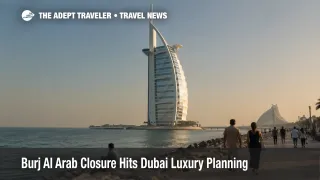
The Burj Al Arab closure is no longer just a renovation footnote. Reuters reported that the landmark Dubai hotel is shutting during a major restoration expected to run about 18 months, while Jumeirah has confirmed a phased programme of roughly the same length led by interior architect Tristan Auer. For travelers, that means one of Dubai's most recognizable ultra luxury stays is effectively out of the live inventory pool deep into 2027, and guests already booked during the works are being moved into alternative nearby hotels instead. The headline is simple. The harder planning question is which replacement stays are close enough in location, experience, and pricing to count as a real substitute.
Burj Al Arab Closure: What Changed
What changed is operational, not cosmetic. Jumeirah said on April 15, 2026, that Jumeirah Burj Al Arab will undergo a carefully phased restoration lasting about 18 months, its first major restoration since opening in 1999. Reuters then added the traveler facing fact that matters most, the hotel is shutting during that work, and guests with bookings in the window are being offered alternative accommodation in nearby hotels. That moves this story from future brand maintenance into a live inventory reduction for Dubai's luxury market.
The practical window now looks like an April 2026 start with reopening likely landing in late 2027 if the roughly 18 month timeline holds. Reuters also reported that staff said the closure period remains subject to change, so travelers building milestone trips around a specific reopening month should not treat late 2027 as fixed until Jumeirah publishes a firm restart date. This is also a clear update from the earlier Adept Traveler article, Burj Al Arab Closure Reshapes Dubai Luxury Supply, because the planning issue is no longer mainly whether the landmark will go offline, but how displaced bookings now ripple through nearby luxury options.
Which Dubai Travelers Face the Biggest Rebooking Problem
Not every Dubai visitor is equally exposed. The biggest planning problem falls on honeymooners, wedding parties, milestone celebrants, and high end leisure travelers who chose Burj Al Arab for the property itself, not just for a beach stay in Dubai. A substitute room nearby may preserve dates and geography, but it does not automatically preserve the same symbolic value, room style, dining mix, or brand cachet attached to that specific sail shaped landmark.
The second exposed group is advisors and guests who need comparable beachfront or near beachfront luxury inventory around Jumeirah Beach and Umm Suqeim. Jumeirah has not publicly named the exact replacement hotels in its press release, but its own Dubai portfolio shows the nearest obvious in brand family substitutes include Jumeirah Beach Hotel, Jumeirah Marsa Al Arab, and the Madinat Jumeirah complex, including Jumeirah Al Qasr, Jumeirah Al Naseem, Jumeirah Mina Al Salam, and Jumeirah Dar Al Masyaf. That does not mean all of those will be available at matching rates or room types. It means travelers should expect the replacement conversation to cluster around those properties first.
There is also a broader market effect. Reuters tied the restoration timing to a period of weaker regional tourism demand, even though Jumeirah did not officially link the project to the conflict environment. That matters because uneven demand can cut two ways for travelers. Softer Dubai demand can reduce pressure in some corners of the market, but a full closure of a flagship 198 suite property can still tighten availability in the exact luxury segment and micro location that Burj Al Arab usually serves.
What Travelers Should Do Now
Travelers already booked into Burj Al Arab during the closure window should ask Jumeirah or their advisor for the exact replacement property, the confirmed room category, whether breakfast, transfers, butler style services, beach access, and restaurant inclusions are being matched, and whether the new booking remains refundable on the same terms. A nearby replacement can preserve the trip, but only if the value stack is close enough to what was originally purchased.
For new bookings, the main decision threshold is emotional, not just financial. If the trip is specifically about staying inside Burj Al Arab, changing Dubai dates into late 2027 or later is the cleaner choice. If the priority is still Dubai beach luxury in the same part of the city, rebooking into a nearby Jumeirah property now is more sensible than waiting, because once displaced guests are fully redistributed, comparable inventory can get thinner and package math can shift. That is especially true for weddings, anniversaries, school break travel, and short lead luxury trips where room type matters more than simple destination access.
Over the next few weeks, the signal to watch is whether Jumeirah starts publishing more precise rebooking guidance or reopening timing. Until then, travelers should compare three things side by side, location, room equivalency, and total trip cost after substitutions. In this planning window, Burj Al Arab closure is less a question of whether Dubai is still bookable, and more a question of whether an alternative stay still delivers the same trip.
Why This Matters Beyond One Closed Hotel
A single hotel shutdown does not make Dubai unbookable. But this is not an ordinary hotel either. Burj Al Arab has functioned for years as both a lodging product and a landmark experience, which means its temporary removal hits travelers who book with symbolism in mind, not only square footage or star rating. When that kind of property goes dark for roughly 18 months, the disruption spreads beyond one reservation ledger into proposal trips, wedding photography plans, dining bookings, chauffeur routing, and the way travelers compare Dubai against other flagship luxury stays in the region.
The mechanism is straightforward. Jumeirah is preserving a marquee asset after more than a quarter century of continuous operations, but travelers make decisions in the meantime with the market they have, not the one that returns later. As a result, nearby substitutes become more important, exact amenity matching matters more, and late 2027 becomes the next meaningful decision point for anyone who sees the Burj Al Arab closure as central to the trip rather than incidental background.