

Mexico's Maya Train Misses as a Tourist Connector
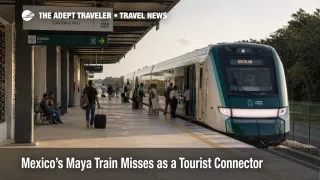
Travelers eyeing the Maya Train as an easy way to stitch together Cancún, Tulum, Bacalar, Campeche, and archeological sites across southeastern Mexico should reset expectations. Reuters found that legal fights, environmental rerouting, and land constraints pushed key segments inland, leaving many stations far from city centers and airports, while usage on some trips looked thin, including fewer than 40 passengers on a 230 seat weekday run between Bacalar and Chetumal. The line still covers a huge footprint, but for many visitors the real friction now sits before and after the rail ride, in the transfers the marketing pitch tends to gloss over.
Maya Train Tourist Connector: What Changed
The sharpest new development is not that the train exists, it is that on the ground reporting now shows a gap between the project's tourism promise and the way it works for actual visitors. Reuters reported on April 22, 2026 that stations it visited were largely empty, and that the line has become less practical for tourists than advertised because some segments were pushed inland and away from the places many travelers are actually trying to reach. That matters because the train was sold as a smoother alternative to long road journeys around the Yucatán Peninsula, especially for travelers who wanted to combine beach zones, archaeological sites, and inland towns without renting a car.
Official Maya Train materials still show a broad network across 1,554 kilometers with stations including Cancún Airport, Tulum Airport, Bacalar, Chetumal Airport, Campeche, Mérida Teya, Chichén Itzá, and Palenque. On paper, that looks like a strong tourism spine. In practice, the official stop pattern itself helps explain the problem, because several flagship access points are airport stations or outlying nodes rather than simple walk up city center arrivals.
That does not make the train useless. It means the traveler facing question has changed. Instead of asking whether the route map looks impressive, travelers need to ask whether the station on their specific leg lands close enough to their hotel, airport, or attraction to beat a bus, private transfer, or rental car once door to door time is counted.
Which Travelers Will Feel the Weakest Fit
The weakest fit is for visitors trying to use the train like a classic urban or intercity rail system, where the station itself drops them close to the center of action. Travelers doing airport to resort, airport to centro, or beach town to ruins combinations may find that the rail segment only solves the middle of the journey, while the expensive or time sensitive parts sit on either side as separate ground transfers. Reuters' findings on inland routing and low occupancy on the Bacalar to Chetumal run reinforce that this is not yet behaving like a high frequency, high convenience tourism connector.
The line is a better fit for travelers whose itinerary already matches the station geography. Airport linked moves can make more sense where the station itself is designed around the air gateway, such as Cancún Airport, Tulum Airport, and Chetumal Airport. Longer leisure itineraries with flexible timing may also benefit, especially when the train ride is part of the trip experience rather than a strict time saver. Travelers with luggage heavy families, timed tours, cruise transfers, or same day flight connections face a harsher tradeoff, because every extra handoff between airport, station, hotel, and attraction adds another failure point.
The southern and inland legs deserve the most caution for first time visitors who assume the line will function like Europe's city to city tourist rail. Bacalar, Calakmul, Xpujil, and other inland stops can still be valuable for destination driven travel, but they are harder sells for travelers who mainly want seamless movement between dense hotel zones and transport hubs. The further the station sits from the place you actually sleep, depart, or visit, the less the rail ride helps.
What Travelers Should Do Instead
Travelers should plan Maya Train trips backward from the first and last mile. Before booking a rail segment, check how long the transfer will take from the station to your hotel, airport terminal, ruin site, or ferry point, then compare that full journey against a direct road option. On paper, the train may look cheaper or cleaner. In reality, a taxi plus rail plus taxi chain can erase both the time and cost advantage.
Choose road transport when your day depends on precision. That includes airport arrivals feeding same day hotel check in, timed archeological visits, cruise or tour departures, and multi stop beach itineraries where bags, children, or mobility constraints make extra transfers costly. On those legs, a direct bus, shuttle, or rental car will often be the more reliable option even if the train segment itself looks appealing.
Choose the train when the station geography already matches your trip, when you have slack in the schedule, or when the rail ride is part of the experience rather than the operational backbone of the itinerary. For many leisure travelers, the best use case is a selective one, not a full peninsula strategy. Use it on the leg where it fits cleanly, then switch back to road transport where the Maya Train tourist connector stops being truly connective.
Why the Gap Opened, and What Happens Next
The mechanism is straightforward. Reuters reported that legal challenges, environmental rerouting, and land constraints pushed key stretches inland. Once a station moves away from the city center, beach zone, or airport travelers care about, the transport burden shifts to local roads and private transfers. First order, the train no longer delivers the seamless handoff many visitors expected. Second order, hotel choice becomes more sensitive, airport to station timing matters more, and travelers who book around the wrong node can end up rebuilding the trip with cars or buses anyway.
The broader project data points also suggest this is not just a branding problem. Reuters reported that annual ridership expectations were cut from 3 million to 1.2 million, that the budget grew from about $7 billion to more than $25 billion, and that revenues last year covered less than 13% of operating costs. That does not prove the line cannot improve, but it does show the current product is still searching for a sustainable traveler fit.
What happens next depends on whether service patterns, feeder transport, and tourism packaging improve around the line. Mexico's government continues to defend the project and promote tourist packages, and official materials still present the network as a major regional spine. Until the last mile gets easier, though, travelers should treat the Maya Train tourist connector as a selective tool, not a default answer for moving around the Yucatán Peninsula.