

Japan Golden Week Shinkansen Caps Seat Flexibility
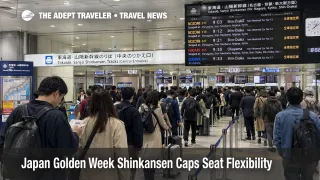
Japan Golden Week Shinkansen travel is moving into a tighter reservation window just as Japan's busiest spring holiday period begins. Nozomi trains on the Tokaido and Sanyo Shinkansen are operating with all reserved seats during the peak period, removing the normal non reserved seating option from the fastest Tokyo, Kyoto, Osaka, Hiroshima, and Fukuoka rail corridor. The change is not a general crowding warning. It is a specific capacity control that can leave last minute travelers standing, shifting trains, or reworking hotel and onward connection plans.
Japan Golden Week Shinkansen: What Changed
JR Central and JR West say Nozomi trains are operating with all reserved seats during major peak periods because crowding is expected on the Tokaido and Sanyo Shinkansen. For 2026 Golden Week planning, the relevant period is April 24 through May 6, covering the run into the national holidays around April 29 and May 3 through May 6.
The operational change is simple but important. Nozomi trains do not have non reserved seats during the peak period. Travelers who want to sit on Nozomi need a reserved seat limited express ticket before boarding. A passenger holding only a non reserved limited express ticket may be able to board and stand on the deck of an ordinary car, but JR Central warns that overcrowding can still prevent passengers from boarding the train they want.
Hikari, Kodama, Mizuho, Sakura, and Tsubame services continue to offer non reserved seating as usual, but that does not make them friction free. JR Central warns that non reserved seats on those trains can also be crowded during peak periods, which means the fallback trains may be slower, fuller, or both.
Which Travelers Face the Tightest Seat Risk
The highest exposure is on the main leisure and intercity corridor linking Tokyo, Kyoto, Shin Osaka, Hiroshima, and Hakata. Travelers building same day plans around Tokyo to Kyoto, Kyoto to Hiroshima, Osaka to Fukuoka, or similar high demand legs should not assume they can arrive at the station and choose from the next few departures.
Japan Rail Pass travelers need extra care. The Japan Rail Pass site says pass holders can book and issue reserved seat tickets through reserved seat ticket machines or ticket offices, but it also notes that Nozomi and Mizuho trains are not included in the standard pass without the separate Nozomi and Mizuho option. During crowded periods, the pass does not guarantee a seat on a specific train.
The first order effect is lost flexibility. A traveler who misses a preferred train may have to stand, shift to a slower service, or wait for a later departure with available reserved seats. The second order effect shows up at the next travel layer. A late arrival into Kyoto, Osaka, Hiroshima, or Fukuoka can push hotel check in, dinner reservations, timed museum entries, airport rail connections, and domestic flight connections out of sequence.
What Travelers Should Do Before Boarding
Travelers should reserve Shinkansen seats as soon as trip timing is firm, especially for May 2 through May 6, when holiday movement is likely to be heaviest. JR Central says reserved seats normally go on sale at 10:00 a.m. one month before the departure date, while some online reservation products can be requested earlier through Shinkansen Online Reservation.
The practical threshold is whether the train time is tied to another fixed commitment. If the Shinkansen leg connects to a flight, cruise, prepaid hotel night, ryokan dinner, tour, or timed entry booking, reserve the seat rather than treating non reserved cars as a backup. If the schedule is flexible, shift away from peak morning outbound and late afternoon return windows, and be willing to use Hikari, Kodama, Sakura, or other slower services with available seats.
Travelers already holding non reserved tickets should try to change them before boarding. JR Central says a non reserved ticket can be changed once without a fee, with the traveler paying any fare difference. Waiting until the ticket gate narrows the choices to standing on Nozomi, trying a non reserved seat on a slower train, or following station staff directions if crowding limits boarding.
Why The Capacity Rules Change The Backup Plan
The Nozomi rule changes the psychology of Shinkansen travel during Golden Week. On ordinary days, non reserved cars give travelers a useful margin when plans run late or a previous sightseeing stop takes longer than expected. During this peak period, the fastest trains remove that margin by converting Nozomi seating to reserved only.
JR Central says 165 seats that would otherwise be non reserved on Nozomi are switched to reserved seats during the target peak periods. That can increase the number of bookable reserved seats, but it also removes the first come, first served safety valve that many visitors rely on when moving between cities without fixed rail times.
The next sign to monitor is seat availability for the exact corridor and day, not just generic Golden Week crowding forecasts. If Tokyo to Kyoto, Shin Osaka to Hiroshima, or Hakata bound Nozomi trains are showing limited seats, travelers should lock in a slower train while it is still available, move departure to a shoulder hour, or add more buffer between rail arrival and the next fixed commitment. Japan Golden Week Shinkansen travel can still work well, but the safe plan is now reservation first, flexibility second.
Sources
- All seats on Nozomi trains on the Tokaido and Sanyo Shinkansen are reserved seats during the major peak periods
- All Seats of Nozomi Trains Are Reserved Seats During the Year End and New Year Holidays
- How to Book a Reserved Seat
- JR Central and JR West Expand Periods When All Nozomi Seats Are Reserved on Tokaido and Sanyo Shinkansen
- Japanese Public Holidays in 2026