

LAX Protest Blocks Airport Access Roads Nov 25, 2025
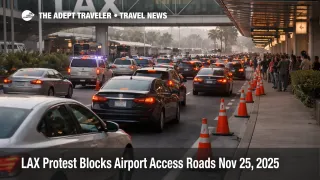
A protest near Los Angeles International Airport (LAX) temporarily disrupted vehicle access into the terminal area and slowed approaches for departures on November 25, 2025. Travelers heading to check in with bags, travelers relying on curbside drop offs, and rideshare users were the most exposed, because access disruptions can break timing even when flights are operating normally. The practical move is to treat ground access as the constraint, add a larger buffer than you would on a routine day, and be ready to switch to a shuttle or transit based approach if your vehicle is not moving.
The LAX protest access roads failure mode matters because the airport's central terminal area is a loop system. When one corridor is blocked or partially blocked, traffic can collapse into a smaller number of usable approaches, and the spillback quickly reaches surrounding arterials. Local reporting around a similar access disruption described travelers abandoning vehicles and walking to make flights when queues stopped moving.
Who Is Affected
Departing passengers are the main risk group, especially anyone checking a bag with a hard cutoff, anyone with a tight security buffer, and anyone on the last viable flight of the day to protect an onward connection or a fixed event. Even a short lived protest can create a longer tail, because once the curbside loop jams, it takes time for the queue to drain, and it can remain unstable through the next departure bank.
Rideshare travelers are also exposed because app pickup logic assumes normal circulation patterns. When access routes change, drivers can be sent into slow moving traffic that cannot reach the expected pickup point, and passenger instructions can lag behind real world closures. LAist has previously noted that access disruptions can affect Uber and Lyft operations when key airport approaches are impacted.
Ground access disruptions propagate beyond the curb. First order effects are missed bag drops, missed boarding, and long curbside dwell times that tie up cars and drivers. Second order ripples hit the air network when passengers misconnect and are rebooked onto later flights, filling remaining inventory and stressing standby lists. A third layer often hits local hotels, because late day misses can force an overnight stay near the airport when same day options are gone, and that can compress inventory and raise last minute rates.
What Travelers Should Do
Take immediate actions that preserve options. If you are still at home, shift your departure time earlier than you normally would, and plan for the possibility that the final few miles into the terminal loop will take longer than the freeway segment. If you are already in the queue and progress slows to a crawl, start looking at your backup path immediately rather than hoping it clears, because your real deadline is not takeoff, it is bag cutoff and boarding.
Use a decision threshold for switching modes. If you are within roughly 60 to 90 minutes of your airline's bag cutoff, or if your vehicle has been largely stationary for more than 15 to 20 minutes, it is usually rational to pivot to an off airport drop off plus shuttle, or to a transit connection that drops you at an airport shuttle node, rather than staying in the car line. That threshold is even stricter for international departures, premium cabin itineraries with lounge detours, and any trip where a missed flight triggers expensive downstream losses.
Over the next 24 to 72 hours, monitor two signals. First, watch for any planned demonstration notices or recurring labor actions that could repeat the access disruption pattern, because repetition is common around high visibility travel periods. Second, watch official airport ground transportation advisories, because construction and lane restrictions can amplify protest impacts by reducing baseline capacity even before an incident begins.
If you want a resilient fallback that does not depend on driving into the terminal loop, Los Angeles World Airports and Metro describe a free terminal shuttle connection from the LAX Metro Transit Center that links rail and bus services to the terminals. That option can be slower than a clean curbside run on a normal day, but it becomes valuable when road access is the constraint.
For additional airport process friction planning, see TSA ConfirmID U.S. Airport ID Fee Starts Feb 2026 and Flight Delays and Airport Impacts: February 7, 2026.
How It Works
Los Angeles International Airport's central terminal area is designed around a circulating roadway system that concentrates arrivals, departures, shuttles, taxis, and commercial traffic into a constrained loop. When a protest blocks, partially blocks, or even just narrows a primary approach, traffic control often redirects vehicles to fewer entry points, which creates a sudden surge at the remaining approaches. That is why a disruption outside the terminal can still translate into missed flights, because the failure happens before you reach the curb.
The airport's ground access ecosystem also has multiple parallel systems that interact under stress. Rideshare staging and pickups rely on predictable circulation routes and consistent curb access, so sudden changes can produce mismatched pickup instructions and long waits. Shuttle systems can become more valuable during disruptions because they often originate from off loop facilities, but they can also slow if the same roads are congested. Transit becomes a strategic hedge because it can move you to an airport transfer node without committing your entire trip to the terminal loop.
Rail and transit access at LAX has improved with the opening of the LAX Metro Transit Center and its shuttle link to terminals, but travelers should treat it as a bus plus shuttle connection until the Automated People Mover is fully operational. Planning for that reality means building extra time for the final shuttle segment, especially during peak departure banks.