

Australia New Zealand Flight Delays From Weather
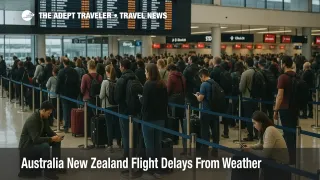
Australia New Zealand flight delays have shifted from a one day scare into a rolling pattern of disruption that now stretches across multiple hubs and several dates, with fresh data for November 30 showing more than 70 flights cancelled and 336 delayed across Sydney, Melbourne, Brisbane, Auckland, and other gateways. Travelers on Qantas, Virgin Australia, Jetstar, and Air New Zealand are seeing frequent same day changes, while queues have spilled through terminals after a nationwide passport system outage slowed border checks at Australian airports. Anyone planning Tasman hops or domestic links into long haul flights over the next few days should assume a higher baseline risk of missed connections, and build extra buffer into their itineraries.
In practical terms, this wave of Australia New Zealand flight delays means that storms, staffing gaps, and aircraft availability problems are combining to make journeys through key hubs less predictable than usual at the start of the Southern Hemisphere summer travel season.
Over the past fortnight, delay trackers and regional outlets have documented several separate spikes rather than a single bad day. On November 16, lightning storms over Australia's east coast and air traffic control staffing shortages wiped out 16 flights and delayed more than 100 others at Sydney Kingsford Smith Airport (SYD) and Melbourne Airport (MEL), with delays in some cases stretching past three hours. On November 25, a follow on system of storms and crew scheduling problems triggered more than 90 cancellations and 672 delays across Australia and New Zealand, an event VisaHQ described as a "perfect storm" that disrupted domestic and trans Tasman services and forced long haul retimings. Today's Travel And Tour World snapshot adds another 70 plus cancellations and 336 delays across key gateways in both countries, confirming that operational stress has persisted into the end of the month.
The airport level data gives travelers a clearer sense of where delays are most likely. Travel And Tour World's November 30 table lists 18 cancellations and 114 delays at Sydney, and 16 cancellations with 114 delays at Melbourne, implying that roughly a quarter to a third of movements at those hubs ran late today. Brisbane Airport (BNE) recorded 6 cancellations and 58 delays, while Auckland Airport (AKL) saw 6 cancellations and 46 delays, pointing to elevated but slightly less severe disruption in those cities. Earlier in the week, another Travel And Tour World report identified about 85 cancellations and 793 delays affecting Sydney, Melbourne, Auckland, and Christchurch in a single day, underscoring that this is now a region wide pattern rather than a one off glitch.
A key aggravating factor has been the urgent global software recall affecting Airbus A320 family aircraft. Jetstar, which relies heavily on A320s, confirmed that 34 of its 85 aircraft needed immediate downgrades or patches after Airbus warned that intense solar radiation could corrupt flight control data on jets running a particular software version. As engineers worked through the fleet, Jetstar cancelled about 90 flights, a mix of domestic and international services, and warned of knock on delays as aircraft and crews ended up in the wrong places. Qantas and Virgin Australia reported that their A320 operations were not significantly affected, but even a single carrier's grounded fleet can strain shared terminals, boarding gates, and air traffic control, especially at already busy hubs such as Sydney and Melbourne.
By November 30, Jetstar said that all but one affected A320 had been updated and returned to service, and Airbus suggested that the recall might be less burdensome than first feared. However, the residual effects on rosters and aircraft rotations are still feeding into the broader pattern of delays, particularly when combined with convective weather and existing crew shortages in Australia's east coast control sectors. Once rotations drift, crews can time out under duty rules before completing scheduled runs, which can force same day cancellations even if the aircraft itself is available.
On top of these operational strains, travelers in Australia faced a separate shock on November 30 when the Australian Border Force (ABF) passport processing system went down nationwide for about an hour. According to national outlets, the outage forced manual immigration checks at major airports, including Sydney, Melbourne, and Brisbane, with authorities prioritizing some flights while long queues formed in departure and arrival halls. ABF and airport operators said that systems were fully restored by mid afternoon local time, but that delays and missed connections would ripple through the evening as airlines tried to re accommodate passengers.
Background: Why Small Shocks Produce Big Delays
Australia and New Zealand rely heavily on a relatively concentrated hub system for both domestic and international flights. Sydney Kingsford Smith, Melbourne, Brisbane, Auckland, and Wellington International Airport (WLG) handle most long haul and Tasman traffic, which means disruptions at any one can quickly cascade. When storms reduce available runway capacity, air traffic control must space aircraft further apart, while low visibility or lightning slows ground handling, boarding, and refuelling. Combine that with tight crew rosters, aircraft waiting for software checks, and occasional system outages, and even minor issues can turn into missed banked connections and late night queues at rebooking desks.
For travelers, the impact is most acute on short haul feeder flights that connect into or out of long haul services. Domestic links into international departures at Sydney and Melbourne are particularly vulnerable, because those hubs mix local weather effects, crew and ATC constraints, and high long haul demand that leaves few spare seats when things go wrong. Air New Zealand's Tasman flights between Auckland, Wellington, and Australian cities also sit in the crosshairs, since disruptions on one side of the Tasman can strand aircraft and crews on the other.
How Long Could Disruptions Last
The most acute A320 related cancellations should ease as Jetstar completes the last software checks and returns its full narrow body fleet to service. Likewise, the ABF passport system outage appears to have been resolved within hours on November 30, and there is no indication yet of a long term systems issue.
However, the recent run of numbers suggests that volatility will remain elevated in early December, especially on peak days. On November 25 alone, more than 90 cancellations and 672 delays were logged across the Australia New Zealand network, and today's 70 plus cancellations and 336 delays show that the system has not fully absorbed those shocks. With pre Christmas demand ramping up and summer storm season underway, travelers should expect more days where a combination of weather delays and staffing gaps produces rolling knock on effects.
Practical Strategies For Travelers
For the next week or so, the safest strategy for anyone connecting through Sydney, Melbourne, Brisbane, Auckland, or Wellington is to build in more time and reduce dependency on a single perfectly timed connection. If you are flying from a regional airport into a trans Tasman or long haul flight, consider moving to an earlier domestic service, even if it means extra time in the hub terminal. Aim for at least three hours for domestic connections and four hours where you are changing from a domestic or Tasman leg to an intercontinental flight.
Avoid separate tickets where possible, especially on combinations such as a low cost domestic leg into a full service long haul carrier, because airlines are less likely to take responsibility for misconnects outside a single booking record. Where separate tickets are unavoidable, treat the first flight as if it might be delayed by one to two hours, and book onward legs accordingly.
Travelers with flexible dates should look carefully at airline waivers and change policies. During the A320 recall peak, Jetstar offered affected passengers options to change flights without additional fees, and other carriers sometimes introduce limited fee waivers during sustained disruption. Even when formal waivers are not in place, agents may be more willing to move you if you call before long queues develop at the airport.
Finally, expect airport experience to be uneven for a few days. Even with systems back online, some passengers from the ABF outage day may still be arriving late or rebooked, stretching check in, security, and immigration resources. Building in an extra 30 to 60 minutes for check in and security at Australia's major international terminals is prudent until operations clearly stabilize.
Within this environment, direct routings and early departures remain the best tools for reducing risk, and travelers who can avoid very tight Tasman and domestic connections into long haul flights will have a much easier time keeping their plans intact.
Sources
- Australia and New Zealand Face Travel Chaos as Air New Zealand, Qantas, Virgin Australia, and Jetstar Report Over 70 Flight Cancellations and 336 Delays
- Perfect Storm Causes 90 Flight Cancellations and 672 Delays Across Australia and New Zealand
- Australia and New Zealand in Oceania Face 85 Flight Cancellations and 793 Delays
- About 90 Jetstar Flights Cancelled Due to Global Recall of Airbus A320 Planes
- Nearly 100 Aussie Flights Cancelled Over Safety Concerns
- Nationwide Passport System Outage Leaves Travellers Stuck at Airports
- Chaos as Airports Hit by Major Nationwide Outage
- Australia's International Flights Resume After Passport System Outage Hit Hard
- Severe Weather and Staffing Shortages Wipe Out 16 Flights, Delay 100 Plus at Sydney and Melbourne
- Sydney Kingsford Smith International Airport