

Peru Chile Border Closure Disrupts Arica Tacna Buses
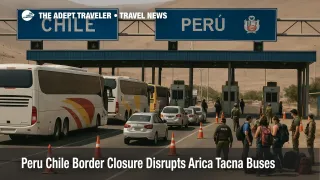
Peru Chile border closure has suddenly become more than a political soundbite for overland travelers, after Peru declared a 60 day state of emergency at its southern border with Chile on November 29, 2025, and sharply tightened controls at the Chacalluta Santa Rosa crossing between Arica and Tacna. Dozens of mostly Venezuelan migrants, and other travelers trying to move north, have already been turned back or stuck in limbo as Peruvian officials refuse entry to people without the right paperwork. Anyone planning to use this corridor by bus or shared taxi now has to assume serious disruption, build in generous buffers, and prepare fallback plans that rely on domestic flights or different border routes instead of a simple Arica Tacna hop.
In practical terms, the Peru Chile border closure is an emergency clampdown focused on irregular migration, but it also creates very real uncertainty for the long distance bus and backpacker routes that tie northern Chile to southern Peru's main tourist cities. The state of emergency puts the Tacna region under special security rules for 60 days, with the military reinforcing Peruvian police at border posts and tighter screening for anyone who tries to cross from Chile.
What exactly has changed at the Arica Tacna border
Peru's government confirmed that the state of emergency covers its southern border with Chile, including the busy Tacna corridor, and will run for 60 days beyond the announcement on November 29, 2025, which means at least through late January 2026. Under the decree, the Peruvian National Police keeps primary control of internal order, but is now backed by armed forces deployed around the frontier to reinforce border checks and respond to crime or potential violence in the area.
The trigger was a sudden buildup of migrants on the Chilean side near the Chacalluta Border Complex, roughly 25 kilometers north of Arica, many of them Venezuelans leaving Chile after presidential frontrunner José Antonio Kast promised mass expulsions of undocumented migrants if he wins the December 14 runoff. Reports from Reuters, the Associated Press, and regional outlets describe groups of migrants walking up the highway, then blocking or gathering near the access road, only to be forced back when Peruvian authorities refused to let them enter.
For now, Peru's message is blunt, that irregular migration will not be allowed and that the country lacks capacity to receive more undocumented people. Officials have announced a binational migration committee with Chile to manage the situation, but they have not given a timetable for easing controls or a clear explanation of how, or whether, legitimate tourists and bus passengers might be separated from migrants traveling without visas or entry permission.
Why this matters so much to bus passengers and backpackers
The Arica Tacna link is far more than a local crossing. It sits on the Panamericana and acts as the main hinge between Chile and southern Peru, serving shared tourism and trade between Arica and Tacna and funneling travelers toward Arequipa, Cusco, and Lima. Under normal conditions, people combine a short taxi or colectivo ride between Arica's terminal and Tacna's bus stations with onward coaches deeper into Peru, or they hop between the cities on international buses that bundle the border formalities into one ticket.
With the emergency order in place and migrants already being turned back at the line, that entire system becomes fragile. While the decree itself targets undocumented migration, frontline decisions at the Santa Rosa complex on the Peruvian side can easily slow down or halt mixed flows of migrants, tourists, and local residents. If Peru's border staff decide to throttle arrivals or close lanes, coaches and shared taxis may be held for hours, forced to turn around, or cancelled outright when operators judge that they cannot guarantee a legal crossing.
Travelers who bought tickets assuming the border would work like usual, often with tight connections onto night buses to Arequipa or Cusco, now face a real risk of being stranded in Arica or Tacna, or missing onward services entirely. Even those planning multi country overland loops through Chile, Peru, and Bolivia need to reckon with the possibility that this crossing will remain unreliable for the duration of the emergency.
How this interacts with Peru's wider migration and border pressures
The new border emergency does not sit in isolation. Only days earlier, Peru's migration workers announced an open ended strike from November 27 that threatened to slow passport control at airports and land borders around the country, including in Tacna. That labor dispute, centered on contract status and benefits at the Superintendencia Nacional de Migraciones, raised the prospect of skeleton staffing at key crossings even before the current security deployment.
Taken together, the strike risk and the state of emergency mean the Peru Chile frontier is being squeezed from two directions, industrial and security. Even if authorities move to limit or suspend strike actions on safety grounds, as they have in the past, migration offices may still be operating under unusual conditions. Travelers who have already built extra time into Lima connections or other border crossings because of the strike now need to add a second layer of caution for the Tacna route in particular.
What overland travelers with tickets in hand should do
If you already hold tickets for a bus or shared taxi between Arica and Tacna, the first step is to treat your booking as a reservation, not a guarantee. Contact your operator or booking platform to ask whether they plan to run services during the state of emergency, what happens if the vehicle is turned back at the border, and whether they offer free date changes or credit if the crossing is blocked. Policies will differ by company, and many smaller operators do not publish terms in English, so it pays to get written confirmation of any promises before you travel.
At the same time, travelers should make a conservative plan for what happens if they reach Arica and cannot cross. That might mean reserving a cancellable hotel night in Arica or Tacna, keeping enough cash on hand for last minute accommodation and food, and avoiding tight connections to nonrefundable flights, tours, or treks that depend on crossing the border on a specific day. For high season itineraries, it is safer to schedule major commitments such as Machu Picchu visits or Amazon trips several days after any planned border crossing so that delays do not cascade into bigger losses.
Alternatives when Arica Tacna is not a sure bet
When the Arica Tacna land route is unstable, the most reliable way to bridge Peru and Chile is often to move one leg by air and use domestic links on either side. Travelers starting in Chile can route north via Chacalluta Arica Airport (ARI) to Santiago's Comodoro Arturo Merino Benitez International Airport (SCL), then connect to Lima's Jorge Chavez International Airport (LIM), or vice versa, using carriers such as Sky Airline, LATAM Chile, and JetSMART.
On the Peruvian side, Coronel FAP Carlos Ciriani Santa Rosa International Airport (TCQ) and Lima can serve as staging points for flights toward Chile, either back into Arica or onward into central Chile and beyond. Rome2Rio data and airline schedules confirm several daily connections between Chacalluta and Santiago, and between Peruvian and Chilean hubs, which give travelers more flexibility than a single land crossing when border rules are shifting.
Some overlanders may look at detouring through Bolivia, crossing between Peru and Bolivia near Lake Titicaca or at Desaguadero, then heading south into Chile. That can work for travelers with enough time and the right visas, but it introduces its own weather, road, and political risks, so it should be treated as a Plan B rather than an automatic workaround. Anyone considering that route should check separate advice for Bolivian borders and avoid assuming that one closed crossing means all others will function normally.
Planning future South America itineraries while the emergency lasts
For trips that are still in the planning phase, the safest approach is to build South America itineraries that do not rely on a specific travel day through the Arica Tacna corridor until there is concrete news that controls have relaxed and normal flows have resumed. It may make more sense to spend an entire trip within Chile or within Peru, using domestic buses and flights to cover ground, instead of stitching together multiple countries with fragile land crossings.
If you do keep the Peru Chile crossing in your plans, treat it as a flexible element. Book fully refundable or at least changeable fares on any flights that depend on a successful crossing, and avoid nonrefundable train tickets or tours that start less than 48 to 72 hours after you intend to move through the border. Given that the state of emergency is explicitly set for 60 days, it is reasonable to assume that December and much of January will remain high risk for sudden changes.
Travelers who want a deeper understanding of how Peru handles strikes and border disruptions can review earlier coverage such as Peru Migration Strike To Slow Airports And Borders, then pair that operational view with broader planning advice from our Peru destination guide. Together, these pieces highlight a recurring theme, that Peru's borders and gateways can shift quickly under pressure from politics, protests, or migration, and that flexible, well buffered plans are the best defense.
Sources
- Peru declares state of emergency over expected migrant surge from Chile
- Peru's president to declare border state of emergency to prevent entry of undocumented migrants
- Peru to declare a state of emergency as migrants leaving Chile trigger backlash
- Peru to declare state of emergency to block Chile border crossings
- Dozens of migrants trying to leave Chile blocked at the border with Peru
- Peru Migration Strike To Slow Airports And Borders
- Chile Peru border crossing and bus from Arica, Chile to Tacna or Arequipa, Peru
- How to get from Chile to Tacna
- Tacna to Chile by plane, bus, car, or train