

Flight Delays And Airport Impacts: December 1, 2025
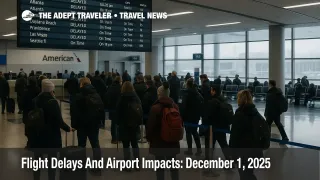
US flight delays December 1 2025 remain elevated at key hubs like Chicago, Newark, Palm Beach, and San Francisco, as winter storms and heavy post Thanksgiving demand keep pressure on the system. Travelers returning from the holiday weekend or starting early December trips are most exposed if their itineraries run through the Upper Midwest, the Northeast corridor, or busy Florida gateways. Anyone with tight domestic connections or separate tickets through these hubs should plan for long lines, de icing queues, and last minute gate changes, and should be ready to rebook or reroute.
The Federal Aviation Administration, FAA, operations plan for December 1 highlights a shift from yesterday's system wide storm chaos to a more targeted pattern of weather and volume related delays, with possible ground stops and ground delay programs at Palm Beach International Airport (PBI), Newark Liberty International Airport (EWR), Chicago O Hare International Airport (ORD), Chicago Midway International Airport (MDW), and San Francisco International Airport (SFO), plus en route flow restrictions on busy northbound routes out of Texas.
Over the weekend, the storm that swept across the Midwest and Great Lakes produced classic post Thanksgiving gridlock. FlightAware data cited by national outlets show that on Sunday alone there were roughly 12,113 inbound and outbound flight delays across the United States and 1,424 cancellations, with Chicago, New York, Boston, Des Moines, Fort Lauderdale, and Detroit among the hardest hit. A separate breakdown by VisaHQ, also based on FlightAware, counted more than 5,600 delays and 624 cancellations by mid afternoon Sunday, and emphasized that Chicago O Hare, Dallas Fort Worth, Charlotte, Atlanta, and Detroit bore the brunt of the storm's impact as de icing queues of 45 to 60 minutes cascaded through airline networks. That backlog is still rippling into Monday as aircraft and crews return to position.
Local reporting around Chicago confirms the scale of the disruption, with hundreds of flights canceled and delayed at O Hare and Midway, some passengers facing multi hour waits, and highways across the central United States seeing pileups and travel warnings as snow and ice linger. Meteorologists now expect snow to spread into the Northeast early this week, while rain and colder air spread across the Mid South, which means today's delay pattern is more about specific hubs and flows than an across the board meltdown.
Today's FAA operations plan and key hubs
The latest Air Traffic Control System Command Center, ATCSCC, advisory for December 1 frames today as a high volume day with several weather sensitive choke points. Winds in the Northeast, plus heavy traffic, may trigger terminal initiatives for Newark, and the plan explicitly notes that Palm Beach was added due to afternoon volume and lack of recovery time later in the day. Chicago O Hare and Midway are expected to see additional snowfall, which could lead to ground stops and or ground delay programs, while San Francisco is in the plan for terminal initiatives because of low ceilings and the current terminal aerodrome forecast, TAF.
The same plan lists wind related terminal constraints for Boston Logan International Airport (BOS), the New York terminal radar approach control area, and Philadelphia International Airport (PHL), plus low ceilings, reduced visibility, and snow for the Chicago terminal area and Minneapolis Saint Paul International Airport (MSP). For travelers, that translates into a familiar pattern: minor schedule adjustments at Boston and Philadelphia, but a higher risk of longer delays and cancellations at Chicago's two airports if snowfall rates spike near departure banks.
Live status messages on individual FlightAware route pages back up the picture. Chicago O Hare has been experiencing both arrival and departure delays averaging around 40 minutes this morning, Denver International Airport (DEN) has posted typical departure delays of roughly 40 minutes, Charlotte Douglas International Airport (CLT) has seen departures running more than an hour behind schedule on some flights, and San Francisco and Miami International are also reporting average delays in the 30 to 50 minute range. That means that even if your own flight shows "on time" now, the operating aircraft or crew may arrive late, so you should be cautious about booking tight connections.
How It Works: Ground stops and ground delay programs
A ground stop temporarily halts departures to a particular airport, usually because of weather, runway closures, or an unexpected reduction in arrival capacity. A ground delay program, GDP, allows some flights to depart but spaces them out by assigning new departure slots, which stretches the arrival stream into a manageable rhythm. Both tools reduce the risk of airborne holding and go arounds, but they also lengthen door to door travel times and increase the chance that a tight connection will misconnect. When the FAA warns that ground stops or GDPs are "possible" for an airport, as it does today for Palm Beach, San Francisco, Newark, O Hare, and Midway, travelers should treat that as a sign to add buffer or consider alternate routings.
En route traffic flows, thunderstorms, and launches
Beyond individual hubs, the December 1 operations plan flags national airspace constraints related to what it calls "snowbird volume" and thunderstorms over the Gulf of Mexico and western Atlantic. A special flow program is already active for traffic from Texas and the Memphis Center area into New York and Boston airspace, which can mean reroutes and level restrictions on some long haul flights heading to the Northeast. The plan also anticipates possible capping and tunneling in Jacksonville Center, plus "regional route structure" adjustments and potential oceanic and Y route closures as storms bubble over the Gulf and offshore corridors.
Business aviation and some premium leisure travelers should care about the note that Teterboro Airport (TEB) and Westchester County Airport (HPN) near New York may see coded departure routes, CDRs, and severe weather avoidance plan, SWAP, measures during peak afternoon periods, while runway closures or construction persist at several airports, including Teterboro's Runway 01 or 19. None of this is unusual for early winter, but it adds complexity for crews trying to keep tight transcontinental and transatlantic schedules on time.
The plan also lists multiple SpaceX Starlink launch windows off Vandenberg Space Force Base in California and Cape Canaveral Space Force Base in Florida between December 2 and December 7. These launches occasionally require short term airspace closures or altitude restrictions in defined corridors, which rarely cause headline making delays but can force slight reroutes or holding stacks on affected routes along the Pacific and Atlantic coasts.
Construction and runway work through December
One underappreciated driver of delay is construction. Today's FAA operations plan lists a long roster of runway and taxiway projects across the system, including taxiway F pavement repairs at San Francisco through December 20, a west ramp expansion at Charlotte Douglas through December 2 and again through mid April, taxiway work at Seattle Tacoma International Airport (SEA) through December 6, major runway closures at Nashville International Airport (BNA) through December 10, and ongoing runway closures and rehabilitation at LaGuardia Airport (LGA), Midway, Palm Beach, and San Diego International Airport (SAN) that stretch into late December or beyond.
For passengers, these projects usually manifest as longer taxi times, runway queues, or occasional use of remote stands and bus transfers. On a benign weather day, that might only add 10 to 15 minutes. On a day like today, with low ceilings at San Francisco, winds in the Northeast, and residual snow and ice around Chicago, those lost minutes can tip a marginal connection into a misconnect, especially if you are switching from a delayed inbound flight to a tightly timed onward segment.
General aviation and charter passengers also need to remember that, separate from the daily operations plan, the FAA has restricted non scheduled and general aviation operations at several large airports through December 31, closing them to most GA traffic except based aircraft and essential operations unless specifically authorized by ATCSCC. That does not directly affect most commercial passengers, but it reduces the system's flexibility to absorb overflow traffic when weather and volume peaks coincide.
Structural pressures from controller shortages
All of this is happening against the background of ongoing controller shortages and government shutdown related flight cuts. Earlier in November, the FAA instructed airlines to cut about 4 percent of daily flights at 40 major airports, ramping toward 6 percent and potentially 10 percent, as a safety valve while hundreds of air traffic controllers retired or stopped working unpaid shifts, contributing to more than 2,800 cancellations and 10,200 delays on the worst Sunday of the shutdown period and disrupting travel for an estimated 4 million passengers since early October. Lawmakers have started moving legislation to end the shutdown, and some reductions have been frozen at 6 percent, but the system remains fragile.
That structural fragility matters on days like December 1 because it reduces the margin for error. A winter storm that might once have produced localized delays at Chicago and Detroit now interacts with thinner staffing, longer training pipelines, and more conservative safety buffers, which means ATC facilities are quicker to impose ground delay programs or route restrictions. Travelers will feel that as more frequent moderate delays, a higher chance of rolling cancellations on peak travel days, and fewer spare seats when they need to rebook.
Practical strategies for today and the coming week
If you are traveling today through O Hare, Midway, Newark, Palm Beach, San Francisco, or any of the upper Midwest and Northeast hubs, the simplest strategy is to avoid tight connections. Aim for at least two hours between domestic flights and three hours if you are connecting to or from an international segment, especially in Chicago and Newark where snow, wind, and runway work can stack up.
Where your plans are still flexible, look at routings through hubs with friendlier weather and fewer immediate construction constraints. Dallas Fort Worth International Airport (DFW), George Bush Intercontinental Airport (IAH), and Phoenix Sky Harbor International Airport (PHX) often serve as useful alternates when Chicago or the Northeast are stressed, although they have their own congestion spikes. In Florida, alternate routings through Orlando International Airport (MCO) or Tampa International Airport (TPA) may be more stable than Palm Beach if the afternoon volume squeeze materializes.
For anyone still wrapping up Thanksgiving travel or starting December business trips, airline and airport apps remain your best friend. Enable push notifications, monitor your flight's inbound aircraft, and sign up for free text alerts where available. If your airline issues a weather waiver, use it early to move off peak times or crowded hubs rather than waiting at the gate. Given the controller backdrop, it is safer to assume that a flight which looks marginal will in fact run late than to bank on an on time miracle.
For a deeper look at how Winter Storm Bellamy Chan has been driving this weekend's disruption, including detailed airport by airport impacts, see our separate coverage of the storm's effect on United States flight operations, as well as our explainer on the Airbus A320 software recall that has added pockets of delay over the past week. If you are rebuilding itineraries for later in December, our guide to planning buffer time for connections walks through how to structure overnight stops and hub choices so that days like today become manageable inconveniences rather than trip ending surprises.
Sources
- FAA Daily Air Traffic Report
- ATCSCC Advisory 042 DCC 12/01/2025 Operations Plan
- Winter storms disrupt travel across U.S., thousands of flights delayed or canceled
- U.S. travelers face thousands of flight delays, hundreds of cancellations, over busy Thanksgiving weekend
- Winter Storm Snarls Record Setting Thanksgiving Travel Rush Across U.S. Airports
- US flight delays, cancellations accelerate as air traffic controller shortages surge
- FAA restricts general aviation operations at select US airports