

France December 2 Strike Spares Most Trains And Metro
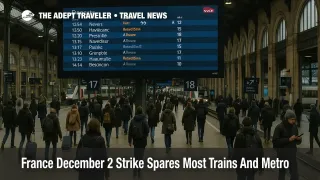
A nationwide public sector strike in France on December 2, 2025 is landing as a patchy disruption rather than a system wide shutdown, especially for trains and Paris transport. The France December 2 strike trains action has kept high speed traffic largely intact while nudging some regional services and one Paris RER line into reduced or delayed operation. For travelers, the practical picture is scattered slowdowns, localized cancellations, and heavier crowds in a few choke points, not the wall of red on departure boards seen during earlier strike waves.
The transport ministry now expects normal service on TGV Inoui routes across France and on most long distance corridors, with rail impacts concentrated on selected TER and Intercites lines plus the RER C suburban rail around Paris. Paris metro, tram, and bus services are running to standard schedules in spite of an overlapping three day RATP strike notice from December 1 at 600 p.m. to December 3 at 700 a.m., which unions had hoped would put more pressure on the government over pay and working conditions.
In practical terms, the France December 2 strike trains action leaves most mainline rail and Paris metro services operating normally, while travelers who rely on RER C or specific TER routes in southern and western regions need to plan around delays, thinner timetables, and busier trains.
Where Trains Are Most Affected
Official TGV forecasts from SNCF and the French transport ministry describe a normal timetable on December 2 for domestic and cross border high speed services, including links between Paris and major cities such as Lyon, Marseille, Bordeaux, Lille, Strasbourg, and international connections. That means long distance travelers with seat reservations on TGV Inoui or Eurostar routes should face minimal strike related disruption, aside from background winter weather and the usual knock on delays from congested nodes.
The picture is more mixed for regional services. SNCF Connect lists regional traffic as disrupted in Occitanie and Nouvelle Aquitaine, especially on Bordeaux to La Rochelle and Poitiers to La Rochelle, as well as in Provence Alpes Cote d Azur on Marseille to Narbonne and Avignon to Port Boule routes. Lighter but still noticeable issues are flagged in Auvergne Rhone Alpes and Hauts de France, where some TER frequencies are trimmed and a small number of trains are canceled outright. Travelers in these areas should expect slightly thinner daytime timetables and leave a buffer for missed or tight onward connections.
For Intercites, the ministry continues to describe traffic as quasi normal, with only local pockets of disruption where crews have joined the strike. This combination of mostly standard TGV and Intercites service, backed by uneven TER performance, is exactly what produces the patchy experience on the ground, where some travelers roll through France without a hitch while others face a missing segment that forces a reroute or a long dwell time in a regional station.
Paris Metro, RER, And Airports
In Paris, the strike outcome is surprisingly benign by recent standards. After several days of warnings about reduced service, local outlets now report that RATP has confirmed normal traffic on metro, tram, and bus lines for December 2. The RER network and Transilien suburban trains are also running normally except for RER C, which is experiencing a mix of delays and occasional cancellations that can cluster during commuter peaks.
RER C is the weak link because it is managed by SNCF and overlaps with some of the regional corridors where union participation is higher. Travelers staying near the Seine river corridor, heading to Versailles, or linking between Paris neighborhoods and outlying suburbs that depend on RER C should check the line specific forecast in the SNCF Connect app from 5:00 p.m. the day before travel, then confirm again the morning of their journey. If a critical train disappears, Paris city breakers can often shift to metro plus bus combinations, while business travelers might need to leave earlier or plan for a rideshare at one end to bridge a gap in coverage.
French airports are largely insulated from the December 2 action. The ministry of transport and French media describe a normal day for flights, even though a minor Air France union has filed its own strike notice in solidarity with the public sector protest. Paris Charles de Gaulle Airport (CDG) and Paris Orly Airport (ORY) both expect to operate full programs, with only a small risk of isolated cancellations or swapped aircraft if crew scheduling becomes tight. Travelers should still check airline apps on December 1 and December 2, but there is no broad air traffic control or ground staff action comparable to past nationwide stoppages.
Once inside the Paris region, the fact that RATP metro and tram lines are running normally means most visitors can navigate between hotels, stations, and airports using standard routes. Where RER C is unstable, practical backups include using RER A or B where they overlap, transferring across the ring of metro lines, or combining shorter metro hops with a rideshare or taxi for the last stretch if schedules remain unpredictable.
Why This Strike Is Milder Than Earlier Waves
The December 2 strike is driven by familiar themes, but the current political context and union strategy explain why its transport impact is limited. Three major union confederations, including the CGT and FSU, called the day of action to oppose the 2026 budget, demand higher public sector pay, defend pensions, and push back against staffing cuts in schools, health care, and social services. Transport unions inside SNCF, RATP, and Air France have supported the call, but they have not made it the kind of open ended showdown that defined earlier pension reform protests.
Ahead of December 2, the minister of transport publicly signaled that he expected only weak or localized participation in the rail and air sectors, and official traffic forecasts have borne that out. Where unions mounted longer or rolling walkouts in 2023 and 2024, this time they are using a single weekday signal to keep pressure on while minimizing the public backlash that comes with repeated full shutdowns. The result is a day where symbolic marches and school closures are more prominent than rail chaos.
How December Fits Into The Wider European Strike Calendar
For travelers planning December itineraries that cross several European countries, France on December 2 is only one tile in a busier strike mosaic. Italy faces a nationwide general strike on December 12 that is expected to hit rail, local transport, and some airport operations much harder, while Portugal has a broad public sector and aviation strike scheduled for December 11, with TAP Air Portugal crews among those expected to walk out.
At the same time, Greece is dealing with its own 48 hour nationwide taxi strike on December 2 and 3, organized by the Panhellenic Taxi Federation in protest at new tax rules and regulations. That action is already leaving airports, ferry ports, and city centers without normal cab service for two full days, which is especially relevant for travelers who have multi leg trips connecting through Athens or who rely on taxis for late night arrivals and early morning departures.
This clustering of December strike activity means a traveler could, for example, leave London on a Eurostar that runs normally through France, connect to a flight that is on time from Paris, then land in a city where taxis are not available or where local buses are on skeleton service. That is why the France December 2 strike trains story cannot be viewed in isolation, and why it is smart to review strike calendars across Italy, Portugal, France, and Greece before locking in nonrefundable tickets.
How To Plan Routes And Rebooking
For rail reliant travelers in France, the key tools on December 2 are the SNCF Connect app and site, plus the individual operator apps for TER and Intercites. The national plan for strikes and engineering works is only finalized at 5:00 p.m. the previous day, so it is important to check again after that point and not rely on provisional timetables published earlier in the week. If your TER or RER C train disappears, you can usually switch to a later or earlier departure on the same route, or in many cases cancel and rebook without fees under temporary strike related commercial policies.
In Paris, metro and tram lines are your most resilient backbone for city center movements on December 2. If you are connecting between Gare du Nord, Gare de l Est, and Gare de Lyon, build in at least 45 minutes door to door, not because of strike disruption, but because modest crowds and winter weather can still slow transfers. When moving between rail stations and airports, allow at least two hours if you are relying on RER C at any point, and consider defaulting to RER B or direct coach links where those are available. For late evening arrivals at Paris Charles de Gaulle or Paris Orly, plan a backup option such as a prebooked shuttle or hotel near the airport in case road protests or an unexpected local action slows you down.
For multi country trips later in December, use operator and government advisory pages to double check whether your dates overlap with the Italy December 12 general strike or the Portugal December 11 public sector strike. If they do, try to shift your most critical flights and train connections off those days, leave extra room for misconnects, and avoid separate tickets on different carriers where a missed first leg would leave you stranded without protection. In Greece, where taxis are out of service December 2 and 3, prearranged private transfers, hotel shuttles, or public transport lines that are not on strike will be essential to avoid long walks with luggage.
Background, How French Strike Days Work For Travelers
French strike days often sound more disruptive on paper than they feel at platform level because of the way minimum service rules and pre announced timetables work. When unions declare a national action, operators such as SNCF and RATP publish traffic forecasts and adapt their schedules in advance, trimming frequencies where staff participation is highest while concentrating remaining crews on core routes and peak hours. For travelers, this typically produces fewer trains or buses but with enough predictability to plan around them, provided you check the latest timetable and allow more slack than you would on a normal weekday.
The December 2 strike follows that pattern closely, but with a relatively low participation rate in the transport sector. That is why high speed services and most Paris metro lines look normal, while the strike's real weight is felt in classrooms, hospitals, and government offices. It is still an important signal in France's ongoing debate over wages, pensions, and public services, yet for most international travelers it remains an operational nuance rather than a trip breaking event, especially if they are willing to change departure times or adjust routes by a leg or two.
Internal links, cluster suggestions
In production, consider linking this piece to your earlier coverage of Italy's December general strike once live, which will help readers see how France fits into the wider European labor calendar, and to an evergreen explainer on how French transport strikes work for travelers, including minimum service rules and rebooking rights. Within the Paris section, an internal link from a sentence about RER C or metro contingency routes to your Paris public transport guide would also give city breakers a clear next click when planning their days on the ground.
Sources
- Perturbations dans les transports, mesures commerciales et suivi du trafic en temps réel, SNCF Connect
- Grève des transports ce mardi 2 décembre, les prévisions, Sortir à Paris
- Grève générale du 2 décembre 2025, secteurs impactés et perturbations, C est la grève
- Grève du 2 décembre 2025, qui sera concerné par les perturbations locales prévues dans les trains, TF1 Info
- Grève SNCF, Air France, des perturbations à prévoir dans les transports le 2 décembre, Tourmag
- France: December 2 public sector strike and impacts, Linternaute
- Italy, Portugal, and France Brace for Epic December Strikes: Travel Chaos Across Europe Threatens Your Holiday Plans, Travel And Tour World
- Greek Taxi Drivers Announce 48 Hour Strike for December 2-3, Greek Travel Pages
- Greek Taxi Drivers To Stage A Forty Eight Hour Strike, Travel And Tour World