

Eurostar French Strike Cancels London Paris Trains
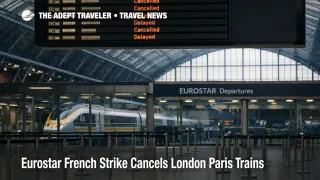
Eurostar service is being reshaped by disruption on the French rail network, and the practical problem for travelers is that it is now crossing borders rather than staying a France only issue. Eurostar's travel updates show schedule changes tied to strike action on the French network between February 10 and February 11, 2026, plus additional cancellations posted on the wider Eurostar network through February 12, 2026. That combination is what turns a domestic French reliability problem into a London to Paris, London to Brussels, and onward connection problem, because the same infrastructure and station slots underpin the international timetable.
What you feel day of travel is not just a cancelled train number. It is fewer departures, retimings that break planned handoffs, and longer station dwell times as trains are held for pathing, platform availability, or knock on recovery. Eurostar's live service updates also flag delays at London St Pancras International on February 11, 2026, which matters because even when your train runs, the station layer can become the bottleneck that erodes connection margins. Eurostar's own disruption notices list specific cancellations on key interchange legs, including Brussels Midi to Paris Gare du Nord cancellations on February 11 and February 12, which is a common hinge point for travelers using London as the start but Brussels as the connection.
Who Is Affected
Travelers most exposed are those riding Eurostar as a time critical leg rather than a flexible city to city trip. That includes same day return business travel, families with fixed museum or show entry times, and anyone building an itinerary that assumes a clean station transfer at Paris Gare du Nord or Brussels Midi. It also includes travelers who used Eurostar to make an airport segment work, for example using London St Pancras as a rail bridge before a flight out of London Heathrow Airport (LHR), or using Paris Gare du Nord connections to reach Paris Charles de Gaulle Airport (CDG) after arriving from the United Kingdom.
The risk rises if you are on separate tickets, or if your onward leg is the last workable departure of the day. When cancellations reduce capacity, reprotected inventory compresses quickly, and groups often get split across trains or pushed to the next day. That is why hotel night adds near London St Pancras and near Gare du Nord become a predictable second order outcome during short, intense disruption windows. Eurostar's travel update pages show the disruption centered on the February 10 to 12 period, and that is the window where you should assume same day solutions are not guaranteed.
What Travelers Should Do
Start by deciding whether your trip can tolerate a same day slip. If you have a hard deadline, such as an international flight, a cruise embarkation, or a paid timed entry you cannot move, treat Eurostar as a risk leg during February 10 to 12, 2026, and price an alternate now so you are not forced into last minute scarcity. The moment you see your train marked cancelled or heavily retimed, move your plan from waiting to action, because replacement inventory tightens fastest in the hours after a cancellation wave posts.
Use a simple rebook versus reroute threshold. If your itinerary needs a tight interchange at Paris Gare du Nord or Brussels Midi, or if a 60 to 90 minute slip breaks the rest of the day, rerouting is usually safer than hoping for recovery. Rerouting can mean shifting your Eurostar to a different departure time, or bypassing the fragile interchange by flying between London and Paris, or by repositioning to an alternate rail corridor that does not require the same bottleneck stations. If you do have slack and you are traveling point to point, waiting can be rational, but only if you accept that you may arrive much later than planned.
For ticket handling, follow Eurostar's own process rather than improvising at the station. Eurostar says that when a train is cancelled you can exchange your ticket or claim a refund, and it directs customers to Manage Booking to do that. Over the next 24 to 72 hours, keep checking your specific train number, because the operational picture can change as the French network and Eurostar work through staffing, paths, and rolling stock constraints. If you are also navigating local Paris movement during this week, note that Paris region works can further complicate station access and airport links, which makes conservative buffers even more important. Paris Transit Works Cut Metro and RER Feb 9 to 15 If your Brussels connection includes local transfers on strike affected days, treat the feeder layer as unreliable, and reduce the number of mode changes you are trying to chain. Belgium Strike Days Hit Brussels Airport Transfers Feb 10 For a stable London planning framework when you end up needing an unplanned overnight or a new station to hotel path, use London Travel Guide: The Ultimate 7-10 Day Itinerary for First-Time Visitors.
How It Works
International high speed rail is unusually sensitive to French domestic disruption because the whole chain is slot constrained. The first order effect happens at the source, when strike action reduces staffing or operational capacity on parts of the French network, Eurostar has fewer viable train paths and fewer station platform windows to work with, so it cancels, retimes, or truncates stops to keep some service moving. That is why you will sometimes see a train still running but with a cancelled stop, or a different departure time that breaks your planned transfer, even if the Channel Tunnel itself is not the issue.
The second order ripple is where travel plans actually break. Once a few trains are removed, the remaining departures become high demand, station dwell stretches as platforms churn, and connection margins vanish at interchange points like Paris Gare du Nord and Brussels Midi. From there, the disruption spreads across at least two other layers. First, airport transfers fail when the rail leg was your timing anchor, which is how a rail strike day turns into missed flights and unplanned hotel stays near stations. Second, crew and equipment rotation issues can produce later day cancellations that look unrelated to the initial strike window, because the trainsets and crews end up in the wrong place. The traveler takeaway is simple, if your itinerary depends on a precise Eurostar arrival time during the February 10 to 12 window, you should plan for an alternate and decide early rather than trying to recover after the network is already capacity constrained.