

France December 2 Strike To Disrupt Trains And Paris Transit
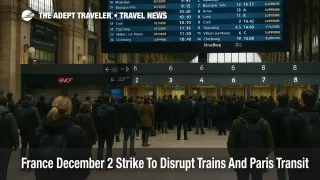
France December 2 train strike plans now mean that anyone using SNCF or Paris public transport on Tuesday, December 2, 2025, must assume limited timetables, busy remaining services, and slower airport transfers. French unions including CGT, FSU, and Solidaires have called a nationwide public sector walkout against the 2026 budget, and transport officials are already warning that regional trains and some Paris metro and RER lines will be significantly reduced. Travelers who cannot move their trips off the strike day should build generous buffers, stay within walking distance of key hubs where possible, and prepare backup options that do not rely on single tight rail connections.
The strike will reduce rail and transit options across France on December 2 and raise the baseline risk of crowding, delays, and missed connections, especially on regional SNCF lines and in the Paris region where RATP runs the metro, RER, tram, and bus networks.
What is happening on December 2
French transport and public services face a coordinated one day shutdown on Tuesday, December 2, 2025, as part of an interprofessional strike against proposed cuts and hiring freezes in the 2026 budget. Multi sector unions CGT and Solidaires, along with the FSU teaching union, have urged workers in rail, education, healthcare, and public administration to walk out, turning what might have been a sector specific rail dispute into a wide public sector protest.
Rail industry analysis and French media briefings indicate that SNCF, the national rail operator, expects the sharpest impacts on regional TER services, with fewer trains on many lines and some routes seeing only one train in two or one in three. Intercités long distance trains and selected TGV high speed routes are also expected to run on reduced timetables, although priority axes between major cities should see more protection than minor lines.
In the Paris region, RATP has received a strike notice covering the metro, RER, tram, and bus networks from Monday, December 1, at 600 p.m. to Wednesday, December 3, at 700 a.m., with December 2 as the core day of action. All staff are called to mobilize, and the operator has already signaled that there will be patchy service on multiple lines, although fully automated metro lines like 1, 4, and 14 should function close to normal.
How SNCF strike timetables work
For strikes of this type, SNCF usually publishes a special timetable the evening before, often after 500 or 600 p.m. local time, once staffing levels are clear. These forecasts show which trains are confirmed to run and which are canceled, sometimes expressed as a fraction such as one train in two. Travelers can see these plans in the SNCF Connect app and on the SNCF website, with separate sections for TGV INOUI, OUIGO, Intercités, and TER regional networks.
Because the official plan only appears at short notice, tickets bought well in advance may not line up with the final strike timetable. When a booked train is canceled, SNCF typically offers either a free exchange to another train on the same route or a refund, but choices can be limited once remaining services fill up. Travelers who must move on December 2 should keep checking the app or website in the evening of December 1, then again on the morning of the strike itself to catch late adjustments.
Expected impacts on French rail
Regional TER lines are expected to see the most visible cuts, especially outside the busiest commuter belts. Rail observers and logistics advisories already classify the risk as high for secondary routes where there may be only a few trains per day even in normal conditions.
On the main high speed axes, such as Paris to Lyon, Marseille, Lille, or Bordeaux, SNCF will usually try to maintain a core TGV service, but even a modest reduction can translate into packed trains and limited same day rebooking options. Travelers holding flexible plans should consider shifting to December 1 or December 3, or moving to off peak departure times that are more likely to retain some capacity.
Intercités trains, which serve non high speed intercity routes, often sit between TGV and TER in priority, which means some lines may run nearly normal while others see sharp cuts. Night trains can also be affected, especially if on board staff participate in the walkout. Anyone depending on a single overnight train to connect to a flight or cruise departure should treat December 1 and 2 as particularly fragile and look for daytime alternatives.
Paris metro, RER, and airport transfers
In Paris, the national budget strike intersects with the city and region's dense public transport network. RATP has already warned that traffic could be heavily disrupted on parts of the metro and RER systems, though the impact will vary by line. Automatic lines 1, 4, and 14 are expected to offer near normal service, while other routes may see lower frequencies or partial line closures depending on how many drivers and station staff join the strike.
RER trains, part of the Réseau Express Régional that links the suburbs and airports to central Paris, are a particular focus for travelers. On many strike days, RER A and RER B services are thinned rather than fully stopped, which can mean long waits and crowded carriages rather than a complete shutdown. For December 2, current guidance points to reduced but not necessarily suspended service, with details only confirmed in forecasts published on December 1.
Airport access is where these cuts will be most visible for visitors. Paris Charles de Gaulle Airport (CDG) relies heavily on RER B and dedicated buses, while Paris Orly Airport (ORY) depends on a mix of Orlyval, tram line 7, and buses. If RER B frequencies are cut or shuttle services are short staffed, wait times and crowding on platforms can rise quickly. Travelers connecting from trains to flights should build at least four hours between scheduled train arrival and flight departure, and those with checked baggage or families may want longer.
Where public transport looks particularly tight, taxis, ride share services, and private transfers become useful backup options, although these will also be affected by road traffic and any protest marches that block central bridges and boulevards. Travelers staying in Paris the night before should try to book hotels within walking distance of their departure station or shuttle stop, for example around Gare du Nord, Gare de Lyon, or Denfert Rochereau, so that they are not dependent on a second layer of struck services to reach their main departure point.
Other sectors and city center disruptions
The December 2 strike extends beyond transport to schools, hospitals, and public administration, which means cities may see a mix of closed facilities and large marches at key times of day. French outlets report that education unions are protesting proposed elimination of around 4,000 teaching positions, while healthcare and local government staff are also using the day to oppose budget cuts.
For travelers, the most visible knock on effects will be potential closures or reduced hours at museums, municipal offices, and some tourist sites, plus temporary road closures and rolling traffic restrictions when demonstrations move through central districts. In Paris, these marches often cross the Seine and can block popular axes such as Boulevard Saint Germain, Bastille, or République for part of the day, which in turn slows buses and taxis.
Practical tactics for December 2 travel
Anyone with non essential rail travel on December 2 should move those journeys to a different date if possible, especially if they involve long regional hops, last trains of the day, or separate tickets onto flights or cruises. For essential business trips and fixed departures, the priority is to reduce dependency on any one train or metro line.
For long distance rail, that means shifting to early morning or late evening departures that appear in confirmed strike timetables and leaving room to react if the first choice train is canceled. Travelers should download their SNCF tickets into the SNCF Connect app or as PDFs, then take screenshots so they can still show them if connectivity drops.
In Paris, travelers can combine modes to reduce risk. Where metro lines are heavily affected, walking one or two stops to reach a more reliable line, taking a tram that bypasses congested streets, or using bike share schemes may all be viable. For airport transfers, those who can afford it should have both a rail plan and a road plan, for example RER B plus a fallback taxi estimate, with clear decision points based on how crowded stations look when they arrive.
For evening returns, especially for families or solo travelers, it is sensible to avoid relying on the very last RER or TER of the night, since late cancellations can be harder to work around. Booking fully refundable accommodation near the station or airport gives an escape route if a planned last train home disappears from the board.
How to monitor conditions in real time
The most reliable sources for strike day information will be the SNCF and RATP official channels. Travelers should use the SNCF Connect app or website to check whether their specific train number is marked as running or canceled and to see any updated schedules on December 1 and 2. In the Paris region, the Bonjour RATP app and the RATP website will show line by line traffic forecasts, with simple icons indicating whether service is normal, slightly disrupted, or heavily disrupted.
For broader context and cross checking, national and local news outlets will run live blogs and updates throughout the day, and some logistics companies are publishing advisories that summarize likely disruption patterns for freight and passenger flows alike.
Travelers should also monitor alerts from their airlines, tour operators, and hotel chains, since some have begun to send proactive notifications or allow free date changes when a major strike overlaps departure dates. Finally, it is worth saving key information such as hotel addresses, station maps, and embassy contacts offline in case mobile data coverage is patchy or networks are overloaded during marches and peak travel periods.
Sources
- What to expect from December 2 strike across France, The Connexion
- Transport strike on December 1, 2, and 3, Sortiraparis
- Grève du 2 décembre 2025, Linternaute
- France readies for rail disruption ahead of Dec 2 strike, RailTech
- Nationwide strike announced in France against austerity, Kuehne Nagel
- Trade unions in France declare national strike over 2026 budget, Fakti