

Australia And New Zealand Flight Delays After A320 Recall
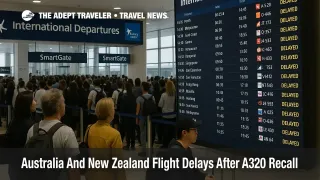
Anyone connecting through Australian or New Zealand hubs this week needs to assume a brittle network rather than a clean reset, because Australia New Zealand flight delays tied to the Airbus A320 software recall and a November 30, 2025 Australian Border Force passport system outage are still rippling through schedules at major airports. The weekend saw cancellations and long queues at Sydney, Melbourne, Brisbane, Auckland, Wellington, Christchurch, and Nadi as airlines pulled aircraft for urgent software work and border queues slowed departures. Travelers should build generous buffers into any itinerary that crosses multiple hubs or relies on back to back domestic and international connections.
The combined impact of the recall and the border IT failure means flights through Sydney Kingsford Smith International Airport (SYD), Melbourne Airport (MEL), Brisbane Airport (BNE), Auckland Airport (AKL), Wellington International Airport (WLG), Christchurch Airport (CHC), and Nadi International Airport (NAN) remain vulnerable to delays and occasional cancellations as aircraft, crews, and passenger flows are resequenced.
How The A320 Recall Hit Australia And New Zealand
The current disruption began when Airbus ordered emergency software changes on about 6,000 A320 family jets worldwide after a JetBlue flight experienced an uncommanded pitch event linked to solar radiation effects on flight control systems. The directive required affected A320 operators to roll back to an earlier, proven software version before the next passenger flight, grounding large portions of the global narrowbody fleet for several hours at a time while engineers loaded the fix.
In Australia, Jetstar reported that 34 of its 85 A320 family aircraft needed the update, triggering about 90 cancellations across its network on November 29, 2025 and leaving thousands of passengers needing rebooking. In New Zealand, Air New Zealand confirmed that 27 flights were cancelled across the weekend as the carrier updated its A320 and A321 fleet, with operations returning to normal only after all aircraft received the patched software.
Airbus now says that the majority of the 6,000 jets covered by the recall have been modified, and that fewer than 100 aircraft worldwide still require work, although some older A320s will need full computer replacements that may take longer because of chipset supply constraints. That broad global recovery has not translated into a clean schedule for Oceania, however, because aircraft and crews are still out of their usual rotations and many travelers displaced by weekend cancellations are using seats on later flights that would otherwise have been available for new bookings.
Australian media reports that Jetstar has declared its A320 network "back to normal" but continues to warn of knock on delays as aircraft and crews are repositioned across the domestic network. Similar messaging from Air New Zealand, which says its A320 fleet is fully updated and operating normally, coexists with ongoing recovery from cancelled services that affected routes between Auckland, Wellington, Christchurch, and major Australian gateways.
Border IT Outage Adds Pressure At Australian Hubs
Just as airlines were stabilizing flight operations after the recall weekend, a nationwide Australian Border Force passport system outage on November 30, 2025 forced SmartGate kiosks offline and pushed international arrivals and departures across Australia back to manual processing for much of the morning. Melbourne and Sydney were the hardest hit, with queues snaking through international terminals and both inbound and outbound travelers needing to be triaged by hand while ABF worked to restore systems.
Although officials reported that the outage was resolved by early afternoon, the hours of reduced throughput at the border created a series of rolling delays as departure banks were pushed back, aircraft missed allocated slots, and crew duty time limits forced schedule adjustments. Those changes intersected awkwardly with the A320 recovery plans, making it harder for airlines to thread updated aircraft into already constrained gate and runway windows.
At the same time, Sydney Airport has publicly criticized the pace of border technology upgrades, revealing that 32 of 40 new smart arrival kiosks remain idle because IT integration and staffing issues have kept them in storage rather than installed in the terminal. Airport leaders argue that this underuse of automation is already contributing to queues in peak periods, and that events like the November 30 outage underscore how little spare capacity exists in the system when manual processing is the only fallback.
Where Disruptions Are Still Showing Up
Even after airlines declare a "return to normal," hard numbers from flight tracking services show that the system is still working through a backlog. On December 1, 2025, Travel And Tour World, citing FlightAware data, reported 59 cancellations and 962 delays across major Australian airports, with Sydney carrying the highest number of delayed services and Melbourne recording the most cancellations.
For travelers, that translates into continued vulnerability at the main hubs. Sydney is juggling Jetstar, Qantas, Virgin Australia, and foreign carriers that all rely heavily on A320 family aircraft for domestic and trans Tasman routes. Melbourne and Brisbane face similar pressure on domestic banks, while Auckland, Wellington, and Christchurch remain the key New Zealand points feeding and receiving affected capacity from Australia.
Nadi International Airport is also in the mix, because Fiji Airways, Air New Zealand, Qantas, Jetstar, and Virgin Australia all use the hub to connect Australia and New Zealand with Pacific islands and long haul services, and any delay in getting aircraft back on sequence can cascade into missed island connections or forced overnight stays.
What This Means For Connections And Itineraries
The practical effect for most passengers is increased misconnect risk, especially on itineraries that involve crossing the Tasman Sea or connecting in Australia or New Zealand en route to the South Pacific, Asia, or North America. Short connections that may have worked in a fully stable operation are now far less forgiving.
Travelers with domestic to domestic connections within Australia or within New Zealand should plan for at least two hours between flights, especially when moving between different airlines or separate tickets that do not include through checked baggage or protected connections. For any itinerary that involves clearing Australian or New Zealand immigration, such as an international arrival followed by a domestic connection or a trans Tasman hop, three hours is a safer planning baseline this week given the recent ABF system failure and ongoing SmartGate capacity constraints at Sydney.
Anyone connecting from a long haul flight into a same day cruise departure, escorted tour, or remote island service from Nadi or a smaller New Zealand airport should strongly consider building in a buffer night at the gateway city rather than trying to make everything fit in a single day. The combination of residual aircraft repositioning, busy summer schedules in the Southern Hemisphere, and still fragile border processing means that a single delay can easily cut into the minimum check in windows that cruises and small regional flights enforce.
Where possible, travelers holding flexible tickets or change waivers from the recall weekend should use them to move out of peak midday banks, which currently see the heaviest queues and longest knock on delays at Sydney, Melbourne, Brisbane, and Auckland. Early morning and later evening departures are performing better on many routes, partly because they sit outside the heaviest connecting banks and partly because overnight recovery often allows airlines to reset their operations before the day builds momentum.
Background: Airbus A320 Software Recall And Border Systems
The Airbus A320 software recall grew out of an October 30, 2025 JetBlue incident in which an A320 experienced a sudden nose down movement that investigators linked to a software change interacting with solar radiation. Regulators and Airbus treated the issue as a precautionary safety measure, emphasizing that the risk could be mitigated by reverting to an earlier software version, but the scale of the recall, which covered more than half of the global A320 fleet, made short term disruption unavoidable.
Australian Border Force's passport processing systems are a separate layer of infrastructure, but they interact tightly with airline schedules. When SmartGate kiosks and associated IT fail, each arriving or departing international passenger has to be processed manually, which sharply reduces throughput across airports that are already running close to their design limits at peak times. For airlines trying to recover from events like the A320 recall, reduced border capacity shortens the margin for error, because a delayed inbound flight can quickly cascade into missed departure slots if queues at immigration or departure control grow faster than staff can manage.
For now, Airbus forecasts that only a small tail of older aircraft will remain under modification in coming days, and Australian authorities say the November 30 border outage has been resolved, but the combination of recent events shows how tightly coupled aircraft technology and border technology have become for travelers using Australian and New Zealand hubs. Until airlines and airports clear the backlog of displaced passengers and out of position aircraft, travelers would be wise to treat the region as operating in a heightened risk state rather than as fully recovered.
Sources
- About 90 Jetstar flights cancelled due to global recall of Airbus A320 planes
- Jetstar cancels 90 domestic flights across Australia after global Airbus A320 recall
- Here's what we know about the Airbus A320 recall
- Airbus narrows software crisis as airlines ride out A320 recall
- Air New Zealand cancels flights as global A320 fleet grounded
- Ley says Coalition's migration principles will include 'issues around language and values' - as it happened
- Australian Border Force passport system outage causes delays nationwide
- International travellers cop major delays as passport system outage affects airports nationwide
- Sydney Airport reveals 32 smart kiosks sitting idle as border delays hit
- Over 50 Flight Cancellations across Australia as Qantas, Virgin Australia, Jetstar and more disrupt travel