

Panama Canal Transit Rebound Eases 2026 Cruise Risk
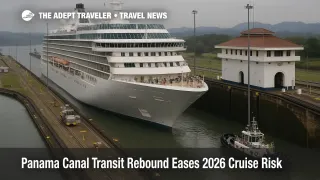
Cruise passengers planning Panama Canal sailings in late 2025 and Panama Canal cruises 2026 can work with a more normal level of reliability again, because the Panama Canal Authority reports that vessel transits in fiscal year 2025 jumped 19.3 percent to 13,404 ships after drought related cuts in 2024 forced sharp limits on daily slots and vessel draft. The rebound spans both Panamax and Neopanamax locks and comes with record preliminary revenues of about $5.7 billion, roughly 14.4 percent higher than the previous year. For mainstream cruise itineraries that use fixed transit dates booked months in advance, this reduces the near term risk of outright cancellations or forced re routings, even if operators still need contingency plans during the driest months.
In practical terms, the Panama Canal transit rebound means Panama Canal cruises 2026 will mostly run as scheduled again, with the waterway operating close to its normal capacity and drought related constraints narrowed to specific seasonal and booking risks rather than a systemic threat to the entire cruise season.
Background, How The Drought Disrupted Canal Itineraries
The recent rebound only makes sense against the severe squeeze that cruise lines and cargo operators faced in late 2023 and early 2024. During that drought, the Canal cut daily transits from a usual capacity of roughly 36 to 38 ships per day down toward the low 20s, and then toward 18, because there simply was not enough water in Gatun Lake to operate all locks safely at full draft. Authorities also tightened draft limits, introduced or expanded auctioned premium slots, and prioritized certain cargo segments, which left some cruise itineraries downgraded from full to partial transits or re routed off the Canal entirely.
For travelers, that period translated into longer waiting times for ships that did transit, last minute itinerary changes for shoulder season Canal cruises, and more frequent use of partial transits combined with overland excursions. Some repositioning voyages abandoned the Canal and instead used alternative routing, which added sea days and shifted port calls, because securing a guaranteed date and draft at the Canal was either too expensive or too uncertain.
By the second half of 2024, improving rainfall allowed the Panama Canal Authority to gradually lift many of those restrictions, restore higher daily transit ceilings, and resume a more normal balance between booked slots and spontaneous transits. That laid the groundwork for the much stronger traffic and revenue numbers reported for fiscal year 2025.
Transits And Revenues Back Near Record Levels
The new FY2025 figures confirm that the Canal has moved well beyond emergency drought mode. Total vessel transits rose from 11,240 in FY2024 to 13,404 in FY2025, a gain of 19.3 percent, with 3,342 Neopanamax transits and 10,062 Panamax transits across the year. Preliminary financial data show revenues up about 14.4 percent, to roughly $5.7 billion, driven mainly by container and liquefied petroleum gas traffic, while liquefied natural gas volumes lagged because of wider freight market conditions.
Even with that rebound, the Canal has not quite filled every slot. In early 2025, daily traffic averaged roughly 32.6 to 34.8 ships per day, compared with the 36 ships per day the Authority was willing to authorize after lifting drought caps in late 2024. Part of that shortfall reflects higher tolls and changing trade patterns that keep some cargo on alternative routes, but for cruise passengers, it also means that overall congestion is lower than it might have been in a fully maxed out year.
Operationally, the Canal still describes its normal sustainable capacity as roughly 36 to 38 vessels per day across the Panamax and Neopanamax systems, subject to maintenance and traffic mix. With FY2025 traffic approaching those levels without the severe backlogs of 2023 and early 2024, planners for cruise lines have more confidence that transit windows booked months ahead will be honored, and that knock on delays for later sailings will stay manageable.
The 2025-2026 Cruise Season, Busy But More Predictable
The Panama Canal Authority formally opened the 2025-2026 cruise season on October 9, 2025, when Cunard's Queen Elizabeth completed a northbound repositioning transit as part of a 22 day sailing from Seattle to the Caribbean and beyond. That voyage is the first of more than 195 scheduled cruise transits this season, a slight dip from prior years as major brands pivot toward shorter itineraries and greater use of Caribbean homeports, but still a robust program that shows confidence in Canal reliability.
According to the Canal's own market analysts, global cruise passenger demand is expected to grow by about 5 percent by 2026, while the worldwide cruise fleet expands by 14 ships to roughly 475 vessels. Under that backdrop, big names such as Norwegian Cruise Line, Carnival Cruise Line, Royal Caribbean Cruises, and others continue to offer full and partial Panama Canal transits, joined by smaller ships and expedition style vessels that use the Canal as part of longer Latin America and Pacific itineraries.
For late 2025 and 2026, the key structural change is not a drought cap, but a redesign of how long term transit slots are sold. The Canal's upgraded Long Term Slot Allocation program, often called LoTSA 2.0, splits booking into two six month cycles instead of a single 12 month horizon, with the first cycle running from January 4 to July 4, 2026. Within that window, the number of long term auctioned slots is trimmed from an average of 4 per day to 3 per day, and those slots are packaged into tiers aimed at different vessel types and certainty needs.
From a cruise perspective, this favors large, well capitalized lines that can bid early and commit to premium packages for marquee sailings, particularly full transits and repositioning voyages that must hit tight seasonal windows. Smaller operators, and those building itineraries later in the cycle, may have to rely more on regular reservation channels or accept less flexibility to move dates without penalties, although LoTSA 2.0 does allow limited date changes and introduces more customer facing support.
Remaining Constraints And Climate Risk
The good news for travelers is that the Canal has exited emergency rationing and is investing heavily for the next decade, including a planned Rio Indio reservoir and additional port infrastructure backed by an estimated $8.5 billion infrastructure program. The bad news is that climate volatility does not disappear just because a single year's rainfall improves.
Hydrology data and official statements make clear that Gatun Lake remains sensitive to El Niño and broader climate swings, and the Canal's own traffic statistics still show some months running below the theoretical maximum of 36 daily transits even without hard caps. In a future dry year, authorities could again tighten draft limits, reduce the number of bookings for certain locks, or prioritize specific cargo segments, which would ripple into cruise schedules.
That said, the combination of higher revenues, a more diversified traffic mix, and long term water projects leaves the Canal better positioned to manage such shocks than it was during the 2023 and 2024 drought. For most travelers looking at standard seven to fourteen day Canal itineraries on major brands in 2026, the risk has shifted from "will the cruise be canceled" to "might the exact transit day or timing move a little."
How To Book Panama Canal Cruises For 2026
For travelers comparing Panama Canal cruises to other long haul options over the next two years, the focus should now be on timing, operator strength, and flexibility rather than fear that every dry season will shut the locks. If the Canal is the centerpiece of a bucket list trip, booking with a line that has a long history of Canal operations, and that appears in the official transit schedules for the 2025-2026 season, is the most conservative approach.
Seasonally, the safest play is to avoid the very heart of the dry season if you are extremely risk averse about water levels, and instead target shoulder periods when rains are returning or still reasonably fresh. The Canal has proven it can run close to normal capacity even with some water stress, but the margin for error is thinner in late dry months, which is when unexpected adjustments are most likely.
Repositioning voyages that depend on hitting a particular window, for example moving ships between Alaska, the U.S. West Coast, and the Caribbean, will always carry slightly higher operational risk than round trip itineraries with more slack. Travelers who choose these sailings should build in extra protection by arriving at the embarkation port at least one day early, using flexible or changeable airfares, and avoiding nonrefundable pre or post cruise hotel and tour bookings that cannot absorb a shift of a day or two.
Travelers who want the Canal experience but are nervous about once in a decade drought patterns can also consider partial transits combined with overland excursions, which give a robust taste of Canal operations with more options to adjust timing if conditions tighten. Those who are aggressively optimizing for cost rather than certainty might still roll the dice on late booked or smaller operator sailings, but they should do so with eyes open to the small chance of a schedule change if climate conditions turn sharply.
From an information standpoint, keeping an eye on Adept Traveler coverage of Canal hydrology, historic drought impacts, and Canal operations, alongside official Panama Canal Authority updates, will help travelers and advisors spot any early signs that 2026 is deviating from the now normal baseline of restored, but climate aware, Canal transits.
Sources
- Panama Canal Maintains Operational and Financial Strength
- Panama Canal Cruise Season 2025-2026 Begins
- Panama Canal reports 14.4% revenue increase, transits jump 19%
- Panama Canal Revamps Transit Booking System to Boost Transit Certainty and Flexibility
- Panama Canal traffic fell to 33.7 ships per day in March, authority says
- Transits through Panama Canal fell in January for first time in almost a year
- Panama Canal drought to delay grain ships well into 2024
- Panama Canal Extends Transit Restrictions Caused by Drought
- Advisory To Shipping No. A-04-2024, Monthly Canal Operations Summary
- Panama Canal bets on LPG transits to offset world trade slowdown next year