

Rafah Crossing Reopening Lets Gazans Exit To Egypt
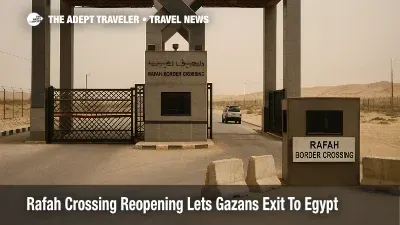
Travelers following the Rafah crossing Gaza Egypt border now have to separate humanitarian headlines from practical trip planning, because Israeli officials say Rafah could reopen within days under an EU supervised framework that allows thousands of pre cleared Gaza residents, many needing medical care, to exit into Egypt. Egypt has publicly pushed back on details, insisting any longer term arrangement must allow two way movement and reject permanent resettlement in Sinai. For tourists, business travelers, and tour planners, the early outlines point to a narrow humanitarian outlet rather than a usable route for normal travel.
In practical terms, the Rafah crossing Gaza Egypt border is shifting from a full shutdown to a tightly controlled humanitarian corridor, which does not restore routine passenger flows or tourism.
What Has Changed At Rafah
Israeli agencies and local media report that Rafah, Gaza s only non Israeli land outlet, is expected to reopen in the coming days to let vetted Palestinians leave for Egypt, with EU monitors helping supervise security checks and border management. Reporting on the ceasefire arrangements and earlier negotiation rounds indicates the plan builds on a previous model in which Palestinian authorities operated the crossing under international oversight, but with tighter screening after Israel seized the Gaza side in May 2024.
Humanitarian agencies, including the World Health Organization, estimate that more than 16,500 people in Gaza need to leave for medical treatment, and those cases are likely to dominate the earliest exit lists. Israeli statements and independent coverage stress that anyone crossing will require security clearance from both Israel and Egypt, and that for now the crossing is intended to move people out of Gaza, not bring people or goods back in.
Egypt, for its part, has signaled that it will not accept any framework that turns North Sinai into a permanent resettlement zone for displaced Gazans, and has publicly denied agreeing to some Israeli proposals about how Rafah will be run. Cairo has also repeated that any stable deal must eventually allow two way traffic, though officials have not laid out a clear timetable or criteria for that shift.
Who Might Actually Be Able To Cross
Based on ceasefire terms, humanitarian statements, and prior practice, early Rafah crossings are likely to prioritize several tightly defined groups. These include Gaza residents needing urgent medical care, some family reunification cases, and possibly students or workers with confirmed placements abroad, all subject to screening by Israeli, Egyptian, and Palestinian authorities, plus whatever EU mechanism is put in place.
Crucially, there is no indication that Rafah will reopen to general foreign tourist traffic, business trips, or ad hoc visits to Gaza. The U.S. State Department explicitly warns that Gaza crossings with both Israel and Egypt can close without notice for long periods and urges travelers to have plans that do not rely on government assisted evacuations. Canada, the United Kingdom, and other governments already advise against all travel to Gaza, and they treat any presence there as extremely high risk.
If you are not a Gaza resident being processed through this humanitarian channel, you should assume you will not be able to use Rafah at all. Even eligible residents will likely see slow, stop start movement as political and security disputes play out.
Why Rafah Remains Off The Table For Tourism
Government advisories make the limits clear. Canada notes that the Rafah crossing has been closed since May 2024 and continues to advise against all travel to the Gaza Strip. The U.K. Foreign, Commonwealth and Development Office, FCDO, advises against all travel to Gaza and against travel near the border, and it also warns against all travel to Egypt s North Sinai Governorate, which includes Rafah and other frontier areas. The U.S. advisory for Egypt labels the Northern and Middle Sinai Peninsula a Level 4, Do Not Travel, area because of terrorism and ongoing military operations.
Those warnings have practical consequences. Travel insurance may be void if a trip goes against official guidance, and consular support is very limited in or near Gaza and in much of Sinai. Overland crossings such as Taba between Israel and Egypt can close at short notice, and authorities can block movement in broader border zones when security worsens.
For now, tour operators and individual travelers should treat any itinerary that depends on entering Gaza, visiting Rafah, or transiting via North Sinai as unworkable. That includes faith based or solidarity trips that previously combined Gaza visits with stays in Jerusalem, Tel Aviv, or Sinai resorts.
Safer Ways To Structure Trips In The Region
While Rafah remains a humanitarian corridor, many standard tourist routes in Egypt, Israel, and Jordan are still operating under elevated but manageable risk, provided travelers accept the constraints of ceasefire era advisories.
In Egypt, most national governments describe Cairo, the Nile Valley, and the main Red Sea resorts such as Sharm el Sheikh and Hurghada as lower risk compared with Sinai s border interior. Travelers are generally advised to fly into Cairo International Airport (CAI) or Sharm el Sheikh International Airport (SSH), use licensed tour operators, and avoid overland routes through North Sinai altogether. Our Egypt Tourist Entry Requirements For 2026 guide has a deeper breakdown of where land borders are restricted and how visa rules interact with those closures.
In Israel, Ben Gurion International Airport (TLV) remains the main gateway. The U.S. currently rates Israel at Level 3, Reconsider Travel, because of terrorism and civil unrest, and the U.K. warns against all travel near Gaza and in parts of the northern border region, even as it treats trips to Tel Aviv and Jerusalem as possible with caution. Our recent coverage in Israel Spring Travel Rebounds As U.S. Flights Return and Tel Aviv Long Haul Flight Cuts As Emirates Exits explores how airlines are rebuilding and trimming capacity under those constraints.
Jordan continues to serve as an important alternate hub for Holy Land itineraries, with Queen Alia International Airport (AMM) in Amman and land crossings to Israel via Allenby Bridge and other posts. Official advisories and our own reporting emphasize recurring demonstrations in Amman, especially after Friday prayers, that can trigger rolling road closures and checkpoints along key routes, including roads to the airport and toward the Dead Sea and border areas. Travelers who route itineraries through Amman should avoid protest areas, steer clear of embassy districts on Thursdays and Fridays when possible, and build an extra 30 to 60 minutes into airport and border transfers.
Planning Ahead For 2025 And 2026 Itineraries
For tour planners, the main operational lesson is that Rafah should not be treated as a future selling point, even if humanitarian departures begin in the coming days. Trips that once highlighted Gaza visits or Rafah crossings should be redesigned around Cairo, the Nile, Red Sea resorts, Tel Aviv, Jerusalem, and Jordan s classic sites such as Petra and Wadi Rum, with contingency plans for sudden disruptions.
Advisors should read clients insurance policies carefully, since many exclude coverage when travelers enter areas under Do Not Travel or Avoid All Travel warnings. Where clients still want to visit border adjacent locations, such as southern Israel or the northern West Bank, contracts and payment schedules should stay flexible so trips can be postponed or rerouted if violence or closures spike. For group leaders, an explicit briefing about where your agency will and will not operate, and what happens if borders close, is essential.
Humanitarian workers, diaspora families, and people with deep personal ties to Gaza face far more complex decisions than leisure travelers. Anyone in these categories should be working through recognized agencies and consulates that can track Rafah lists, vet eligibility, and coordinate secure transports. Even then, the working assumption has to be that timelines will slip, criteria will change, and crossing points can shut without notice.
The bottom line is that a limited reopening of Rafah is a humanitarian lifeline for some Gaza residents, not a signal that the Israel Gaza Egypt corridor is returning to normal. For the foreseeable future, most travelers should structure trips around air links into safer hubs, stay well clear of Gaza and North Sinai, and use our Israel and Egypt entry guides as reference points instead of trying to read Rafah announcements as a green light for tourism.
Sources
- Israel says it will reopen the Rafah border crossing. Here's what it means for Palestinians in Gaza
- Rafah crossing to open soon to let Gazans cross into Egypt, Israel says
- Understanding the Israel Hamas Truce
- Travel advice and advisories for Israel and Palestine
- Egypt travel advisory, regional risks and Sinai guidance
- Israel, the West Bank, and Gaza International Travel Information
- Egypt Travel Advisory
- Jordan Fridays, Expect Protest Related Road Closures Near Embassies And Downtown Amman
- Israel Spring Travel Rebounds As U.S. Flights Return
- Egypt Tourist Entry Requirements For 2026