

Amman Protests And Airport Transfers Risk Guide
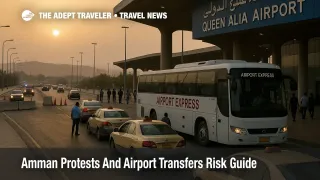
Jordan remains under a Level 2 travel advisory from the U.S. Department of State, which calls for increased caution due to terrorism and regional tensions, and specifically warns travelers to avoid demonstrations and large gatherings. In Amman, protests linked to Gaza and other political issues continue to flare near embassies, downtown mosques, and key government areas, and security forces often respond with checkpoints and rolling roadblocks that can catch travelers off guard. For visitors connecting via Queen Alia International Airport (AMM), staying downtown, or road tripping to the Dead Sea, Petra, or Wadi Rum, the practical fix is to treat Thursday evenings and Fridays as higher risk for transfers, add buffer time, and route around known protest nodes rather than through them.
In practical terms, the Amman protests airport transfers problem is about predictable weekly peaks in demonstrations that translate into slow traffic, checkpoints, and occasional road closures on key corridors between Queen Alia International Airport, central Amman, and the main tourist routes, so conservative routing and extra time matter more than shaving a few minutes off the drive.
Recent protest cycles in Jordan have centered on solidarity with Gaza and wider regional politics, with large gatherings repeatedly forming near the Israeli embassy districts in Abdoun and Rabieh, downtown near Al Husseini Mosque, and other symbolic locations. Local practice, as reflected in on the ground reporting and embassy alerts, shows that these protests tend to build after Thursday evening and especially Friday noon prayers, when people are off work and able to join marches. At higher turnout levels, authorities deploy the gendarmerie and other forces to block feeder roads, set up checkpoints, and steer traffic away, which can turn a routine airport transfer into a stop and go crawl or a forced detour.
U.S. Embassy alerts for Amman have explicitly warned about checkpoints on main roads, including stretches of the Dead Sea Highway, and about potential protest activity near Abdoun Bridge and other chokepoints that matter directly to travelers. The guidance is consistent across multiple advisories, avoid large crowds, seek alternate routes around road closures, and monitor local media and official channels before you depart for the airport or a long drive. Other governments, such as Canada and the United Kingdom, echo the same pattern, bookended cautions about demonstrations, and a reminder that conditions near border areas and along long distance highways can change quickly.
Queen Alia International Airport sits roughly 30 to 50 minutes from central Amman under normal conditions, depending on traffic and the exact neighborhood. On protest heavy Thursday evenings and Fridays, however, trips that pass near Abdoun, Rabieh, or downtown can easily double in time, particularly if police close certain circles or redirect vehicles toward the ring roads. Travelers who accept informal rides from the curb or unlicensed drivers are more likely to be routed through narrow side streets or potential protest zones in an effort to shave a few minutes, which can backfire if a march or checkpoint suddenly blocks the route.
By contrast, the official Airport Express bus and licensed airport taxis provide a more predictable transfer pattern, even if they cannot fully escape delays. The Airport Express runs between Queen Alia International Airport and Amman on a set schedule, typically every 30 to 60 minutes depending on time of day, with stops near major junctions such as Seventh Circle and the northern bus station, and the service is designed specifically for travelers. Licensed taxis operating from the airport rank use fixed, posted fares that reduce haggling and are subject to airport rules, which makes it easier to refuse risky detours through congested protest corridors and insist on a more conservative route.
For road trips to the Dead Sea, Petra, or Wadi Rum that start or end on a Thursday or Friday, the main risk is not the highways themselves, which are usually calm, but the approach legs in and out of Amman and the junctions where city traffic merges with intercity routes. When demonstrations are expected, it is sensible to schedule departures earlier in the day on Thursday or later in the evening on Friday, aim to clear the capital before peak protest times, and accept a slightly longer ring road route instead of cutting directly through central districts. If a checkpoint appears, travelers should slow down, follow instructions from security forces, and avoid attempting shortcuts through crowded side streets, even if navigation apps recommend them.
The same logic applies in reverse for inbound journeys. If you are driving back from the Dead Sea or Petra to catch a flight out of Queen Alia International Airport on a Friday afternoon, add substantial buffer time for the run back through the outer suburbs and into the airport access road. A three hour cushion between your planned arrival at the terminal and your departure time is not excessive on higher risk days, especially if your flight connects onward to long haul segments with limited rebooking options. Travelers on separate tickets should be even more conservative, since a protest related delay that causes a misconnect will often be treated as a new booking problem rather than an airline responsibility.
Background: Why Thursdays And Fridays Matter
Jordan's work week runs from Sunday to Thursday, with Friday as the main weekly day of prayer and rest. As a result, political and social protests often gather momentum after office hours on Thursday and after Friday noon prayers, when more people are free to attend, and central Amman's streets are already busy. Authorities have signaled that peaceful protests are allowed, but they also maintain a firm line against violence or damage to public property, and that enforcement frequently takes the form of roadblocks, tight control around embassy districts, and visible security forces along key corridors.
For visitors, this rhythm means that most weekdays are relatively routine from a transfer perspective, while Thursday evenings and Fridays carry a structurally higher risk of disruption around specific nodes. Abdoun and Rabieh, embassy heavy neighborhoods with bridges and circles that channel traffic, regularly see a mix of protesters, police, and blocked feeder roads. Downtown around Al Husseini Mosque, where many marches begin or end, can also become difficult to cross at peak times, though the impact tends to be more intense on foot and for local traffic than for through traffic on the ring roads.
Prior Adept Traveler reporting on Jordan protests and roadblocks has highlighted the same pattern, checkpoints on major approaches to Amman, including parts of the Dead Sea Highway, and sporadic closures on roads leading toward border crossings. [1] That earlier alert remains a useful complement to this guide, since it catalogs recent locations where security forces have concentrated and shows how quickly conditions can change on days of heightened tension.
How To Plan Transfers Around Protest Risk
Most of the adjustments travelers need to make are simple. Avoid routing airport transfers through known protest nodes in Amman on Thursday evenings and Fridays whenever possible, particularly Abdoun, Rabieh, embassy districts, and the tight grid around downtown. Choose the official Airport Express bus or licensed airport taxis from the terminal instead of informal rides, and be explicit that you prefer main roads and ring roads even if that adds time. If your itinerary includes a same day connection through Queen Alia International Airport, try to schedule flights that arrive early in the day or late in the evening on higher risk days, leaving several hours of margin before any onward departure.
For longer road segments, such as Amman to Wadi Musa for Petra or Amman to Wadi Rum, conservative planning means treating protest days like a form of weather delay risk. Start earlier, keep fuel and water topped up, carry physical maps or offline navigation in case mobile data coverage dips at junctions, and coordinate with your hotel or tour operator about the latest security information before you set out. Independent travelers who are not fluent in Arabic may find it easier to hire local drivers on these days, both for language support at checkpoints and for their practical knowledge of which routes are least likely to be affected.
Finally, build embassy guidance and your home government's advisories into your standard pre departure checks. U.S. citizens can enroll in the Smart Traveler Enrollment Program, STEP, to receive security alerts about protests, road closures, and regional tensions, while travelers from other countries should sign up for similar services where available. If an alert warns of potential demonstrations in a district you planned to cross on a Thursday evening or Friday, treat that as a hard constraint for transfers, adjust timing, or route around the area rather than assuming you can thread the gap.
Sources
- Jordan, U.S. Department of State Travel Advisory
- Jordan, International Travel Information, U.S. Department of State
- Security Alert, U.S. Embassy Amman, October 7, 2023
- Security Alert, U.S. Embassy Amman, October 12, 2023
- Security Alert, Exercise Increased Caution In The Region, U.S. Embassy Amman
- Jordan Protests And Roadblocks In Amman, The Adept Traveler
- Airport Express, Sariyah Transport
- Queen Alia International Airport, Visit Jordan
- Travel Advice And Advisories For Jordan, Government of Canada
- Palestine And The Limits Of Permissible Protest In Jordan, MERIP
- Jordan Will Not Allow Violence, Only Peaceful Protests At Israeli Embassy, Arab News
- Jordan, Stop Cracking Down On Pro Gaza Protests, Amnesty International