

World Cup 2026 Host City Flights December 2025 Boost
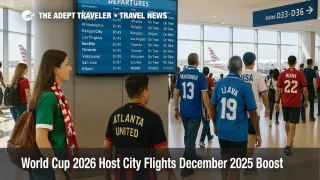
World Cup 2026 host city flights are getting a major boost ahead of the tournament, as American Airlines plans to add more than 27,000 seats on 12 routes linking FIFA World Cup 26 venues across the United States, Canada, and Mexico. The Dallas based carrier will upgauge aircraft and increase frequencies between key hubs such as Boston Logan International Airport (BOS) and Dallas Fort Worth International Airport (DFW), Hartsfield Jackson Atlanta International Airport (ATL) and Miami International Airport (MIA), and Los Angeles International Airport (LAX) and Seattle Tacoma International Airport (SEA). For fans planning multi city itineraries in June and July 2026, the extra capacity creates more same day options but does not remove the need to plan carefully.
The core change is that American's added flying for World Cup 2026 host city flights will make it easier to move between the 16 host cities, while still requiring fans to book early, avoid tight self connects, and match their routing to the evolving match schedule.
Background: A Bigger Tournament Across 16 Cities
FIFA World Cup 26 will be the first edition hosted by three nations, with matches spread across 16 cities in the United States, Canada, and Mexico from June 11 to July 19, 2026. The tournament will also be the first to feature 48 teams and 104 matches, significantly increasing travel demand within the North American host region.
Host cities include Atlanta, Boston, Dallas, Houston, Kansas City, Los Angeles, Miami, New York New Jersey, Philadelphia, the San Francisco Bay Area, and Seattle in the United States, plus Toronto and Vancouver in Canada and Guadalajara, Mexico City, and Monterrey in Mexico. Many fans plan to follow their teams across multiple venues, which makes intra regional air capacity and schedule reliability as important as the long haul flights that bring them to North America in the first place.
American is already the Official North American Airline Supplier of FIFA World Cup 26 and has secured air travel rights to support tournament operations across the three host countries, in partnership with Qatar Airways as FIFA's global airline partner. The December 4, 2025 announcement folds fan travel on regular commercial services into that broader role.
Where American Is Adding Seats
According to the airline, the additional flying focuses on routes that either link major U.S. hubs to match cities or connect likely fan bases to key venues. Between June 18 and July 11, American will add flights and operate larger aircraft between Boston Logan and Dallas Fort Worth, a pairing that links New England fans to one of the central stadiums in the U.S. host cluster.
From June 16 to July 17, Atlanta to Miami gains both more frequencies and larger aircraft, reflecting Miami's role as a World Cup city and Atlanta's status as a major southeastern gateway. Philadelphia International Airport (PHL) to Toronto Pearson International Airport (YYZ) will see upgauged aircraft from June 15 to June 30, while Kansas City International Airport (MCI) to Philadelphia also receives larger equipment between June 15 and June 22, supporting early group stage travel on both sides of the border.
On the West Coast, American will operate larger aircraft between Los Angeles and Seattle from June 13 to July 8, while service between LAX and Vancouver International Airport (YVR) gets additional frequencies between June 16 and June 26. Dallas Fort Worth to San Jose Mineta International Airport (SJC) gains more flights from June 17 to June 27, which will help Bay Area based fans reach one of American's main hubs for onward connections into the wider World Cup network.
Short haul trunk routes also get temporary boosts. Atlanta to New York LaGuardia Airport (LGA) will have extra flights and larger aircraft on July 16 and July 17, while Atlanta to Philadelphia sees similar treatment from June 20 to June 21. These links give fans more options for repositioning toward matches in the Northeast corridor or connecting to transatlantic flights before and after the tournament.
Two of the most eye catching changes involve new nonstop service into Kansas City, one of the U.S. host cities. LaGuardia to Kansas City gets new nonstops on June 21 and June 22, which align with World Cup group stage play, and Atlanta to Kansas City gains new nonstops between July 8 and July 13, when the tournament moves into the quarterfinal round. For New York and Atlanta based fans, this removes the need to connect through another hub on some of the most time sensitive match days.
All of the extra frequencies and upgauged aircraft are already on sale through American's usual booking channels, including aa.com and the airline's mobile app. As always, the additional capacity can sell out quickly around high demand fixture dates, especially if specific matches feature regional favorites or heavily supported national teams.
AAdvantage Early Access For Match Tickets
The flight changes are only part of American's World Cup plan. The airline is also using its AAdvantage loyalty program to offer early access to match tickets that can be redeemed with miles, giving frequent flyers another way to secure seats inside the stadiums themselves.
On December 17, 2025, members with AAdvantage Executive Platinum status and ConciergeKey members are the first group allowed to redeem miles for World Cup match tickets through American's dedicated channels. On December 18, 2025, the window opens for members with AAdvantage Gold, Platinum, and Platinum Pro status. On December 19, 2025, redemption access expands to all AAdvantage members, subject to availability and whatever match inventory remains.
American has said it will notify members of their eligibility and timing via push notifications in the airline's mobile app, so anyone hoping to use miles for match tickets should ensure they have the app installed, login details current, and notifications enabled well before the December windows open. While exact mileage prices and seat categories can vary, early anecdotal reports from the first phase of ticket redemptions suggest that fans should compare the value of using miles for tickets against future premium cabin flight redemptions, especially if their mileage balances are limited.
Beyond direct ticket redemptions, AAdvantage members can participate in year long sweepstakes through the World Cup 26 Perks site, with prizes ranging from opening match tickets to opportunities to watch a match with a FIFA legend. These contests do not replace the need to plan travel, but they can add extra value for fans who already fly American frequently or engage with its partners.
How Fans Should Plan Around The New Flights
For most travelers, the biggest practical benefit of American's plan is a thicker web of same day options between host cities, especially on days that sit between group matches or just ahead of key knockout rounds. Fans following one team may want to base themselves in a single region, such as the Texas cluster or the Pacific Northwest, and use the extra flights only for one or two critical repositioning legs. Others might design a wider tournament road trip, stringing together multiple host cities by air.
In both cases, the core risk management rules still apply. Same day hops between host cities should not rely on minimum connection times, particularly in summer afternoon periods that are prone to thunderstorms in the central and eastern United States. Leaving three or more hours between flights is a safer baseline when a missed connection could mean missing a once in a lifetime knockout match.
Travelers who are not bound to a specific team can use the schedule to their advantage. Booking early morning or late evening flights between cities such as Dallas, Miami, Atlanta, Kansas City, Los Angeles, Seattle, Toronto, and Vancouver is more likely to avoid peak heat and peak congestion, and it also leaves some recovery time if an inbound long haul flight runs late. Where possible, pairing one carrier and one ticket for the entire World Cup itinerary simplifies rebooking if something goes wrong, since American will be responsible for fixing misconnects on its own tickets.
Fans outside North America should also consider how American's added flying fits into their long haul plans. Some will connect from partner airlines into these host city routes, while others may build itineraries entirely on American metal. In either case, matching match tickets to realistic travel windows, building in overnight buffers where money and time allow, and keeping an eye on the tournament draw outcomes in December 2025 will reduce surprises once the schedule is final.
Finally, anyone eyeing AAdvantage redemptions for match tickets should audit their mileage balances now, decide which matches would be "must attend" versus "nice to have," and consider whether to prioritize ticket redemptions or future premium cabin flights for those miles. Once the December 17 to 19 windows open, the best inventory is likely to move quickly, especially for opening matches, local host nations, and the later knockout rounds.
Sources
- American Airlines expands its playbook with added flights and exclusive access to tickets for all FIFA World Cup 26 matches
- FIFA World Cup 2026, host cities and stadiums
- 2026 FIFA World Cup overview
- American Airlines joins as Official North American Airline Supplier of FIFA World Cup 26
- American Airlines World Cup 26 flights and ticket access explainer
- FIFA World Cup 26 Perks, AAdvantage sweepstakes site