

Storm Byron Floods Greece, Disrupts Travel
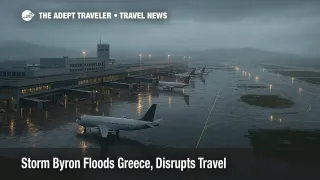
Storm Byron Greece travel disruption is now a countrywide problem as the powerful winter storm floods Athens and other regions from December 4 to 6, 2025, under a rare Red Code alert. Heavy rain, overflowing rivers, and landslides are cutting roads, closing schools, and knocking out power across Attica, Thessaly, the Peloponnese, Central Greece, Crete, and the Aegean islands. Authorities are asking residents and visitors to avoid non essential movements, stay away from basements and low lying areas, and follow 112 alerts until conditions improve.
In practical terms, Storm Byron Greece travel disruption means that for several days many trips by road, rail, ferry, and air will be unreliable or unsafe, so most travelers should delay major moves until late Saturday or Sunday, then work with airlines, ferries, and hotels to rebook once the storm has clearly passed.
Where Storm Byron Is Hitting Hardest
Greek and international briefings agree that Byron has been affecting Greece since 4 December, bringing heavy rainfall and strong winds that now cover more than half of the country. The National Meteorological Service (EMY) and Civil Protection have activated a Red Code weather emergency from Wednesday December 3 through Saturday December 6, placing nine regions on maximum alert, including Attica, Central Macedonia, Thessaly, Central Greece, the Peloponnese, the Ionian Islands, the North and South Aegean, and Crete.
In Attica, flooding in suburbs such as Mandra, Megara, Nea Peramos, and coastal districts along the Athens Riviera has turned streets into torrents, forcing the temporary closure of sections of the Athens-Corinth highway and multiple urban arteries. Western and northern Attica are recording some of the highest rainfall totals, with local gauges reporting more than 200 millimeters over roughly 24 hours. Civil protection officials say the Fire Department has handled more than 580 calls for water pumping, tree removal, and rescues from stranded vehicles as Byron has moved across the country.
Outside the capital, severe flooding, landslides, and overflowing rivers are reported in parts of Thessaly, the southern and eastern Peloponnese, Zakynthos, Lakonia, Rhodes, and Crete, where rivers have broken their banks near coastal settlements and tourist villages. In some areas, including sections of West Attica and the Peloponnese, local authorities have declared states of emergency to unlock extra resources for cleanup and repairs.
Airports, Flights, And Ferry Routes
For air travelers, the main pinch point is Athens International Airport Eleftherios Venizelos (ATH), where strong winds, low cloud, and heavy rain have led to delays, holding patterns, and a limited number of weather related cancellations as airlines adjust schedules. Reports from travel trade outlets say some arrivals and departures have been pushed back or rerouted when thunderstorms line up over the Athens basin.
Secondary hubs are also feeling the strain. Thessaloniki Airport Makedonia (SKG), Rhodes International Airport Diagoras (RHO), and Heraklion International Airport Nikos Kazantzakis (HER) are all within regions under red or high level warnings, and airlines are using speed restrictions and tactical delays to avoid unsafe approaches in heavy rain and crosswinds. While most flights are still operating in some form, travelers should assume that tight connections, especially those booked on separate tickets, are at high risk.
Byron is arguably hitting the ferry network harder than the skies. Strong winds, rough seas, and poor visibility have already forced suspensions or diversions on key Aegean and Ionian routes, including sailings linking the mainland with islands such as Mykonos, Paros, Santorini, Rhodes, and Crete. At least one ferry has been diverted to Sifnos to evacuate a child for medical care after aircraft could not operate safely, which underlines how seriously maritime authorities are taking the conditions.
Public transport inside Athens is also under pressure. Local media report temporary service suspensions on parts of the rail and tram network, flooded underpasses, and sections of major avenues repeatedly closed as storm drains are overwhelmed. Taxi unions have even paused planned strikes to keep vehicles available for essential journeys while the storm passes.
Official Warnings And How Long Byron May Last
Emergency alerts sent over the 112 system and Civil Protection updates are consistent on one point, residents and visitors should limit travel to absolutely necessary movements until at least midday Saturday December 6, when Byron is expected to weaken. Forecasts from EMY and independent meteorologists indicate that the most intense rain and thunderstorm bands will gradually shift east and south through Friday night, but that saturated ground means flash flooding and landslides may continue even as the radar echoes fade.
That lag matters for travelers. Even if skies brighten on Saturday, rivers, culverts, and hillsides will still be unstable in many parts of eastern and southern Greece, and some local roads may remain blocked by debris or damage. Rail lines and rural bus routes that run through ravines or along river valleys may also stay disrupted while engineers survey tracks and bridges.
What Travelers Should Do If They Are Already In Greece
If you are already on the ground in Greece, the safest baseline is to stay where you are until local authorities and transport operators confirm conditions are genuinely improving. Follow 112 alerts, local news, and municipal feeds, and resist the temptation to drive out of flood affected areas unless police and civil protection explicitly clear the route.
For flights, use airline apps or websites rather than airport departure boards as your primary source of truth. Because Storm Byron is affecting multiple regions, carriers may implement rolling waivers that allow free date changes within a limited window. International and Greek outlets already report flexible handling for many passengers who move trips by a day or two, especially those booked from December 4 to 6. If your ticket is on a separate onward airline, call the second carrier as soon as it is clear you will misconnect, and ask for a one time rebooking or credit citing the extreme weather.
For ferries, assume that ports can close at short notice when wind or visibility drops below thresholds. Keep boarding passes, SMS alerts, and any cancellation notices, since these will support refund or change claims later. Travelers with cars should never attempt to board or disembark when port staff indicate that conditions are unsafe, even if that means losing a sailing.
Accommodation is the other safety anchor. In flood prone areas such as parts of West Attica or low lying coastal villages in the Peloponnese and Crete, consider requesting a higher floor room and ask front desk staff to brief you on evacuation routes in case river levels keep rising. Many hotels are already extending stays at storm rates for guests whose onward transport has been cancelled, and travelers who book via agencies or online platforms should use in app chat to negotiate similar extensions.
Planning Trips Around Storm Byron
For travelers who have not yet departed, the simplest strategy is to avoid the peak window of December 4 to 6 altogether. If your itinerary is flexible, target arrivals into Athens or Thessaloniki from late Saturday afternoon or, better, Sunday December 7 onward, once airlines, ferries, and road crews have caught up with the backlog.
If your Greece trip includes multiple hops by air and sea, try to rebuild it with longer buffers between segments. For example, avoid planning an early morning island flight followed by a tight ferry connection in the Cyclades on the same day, or a last ferry into Piraeus that feeds a same night long haul departure. Give yourself at least one full night between critical connections until the storm clean up is clearly complete.
This episode also fits a broader pattern of European weather and infrastructure strain that travelers need to factor into 2025 and 2026 plans, alongside new border checks and rising tourist taxes covered in our separate overview of Europe travel rules and costs in 2025. For a recent example of how winter storms can disrupt aviation at scale, see our report on Nordic and Alpine airport delays earlier this week, which pairs well with the Storm Byron story when you are planning pan European itineraries.
Background, How Greece Manages Red Alerts
Greece has been hit by several severe weather systems in recent years, and the country now relies heavily on coordinated alerts from EMY, Civil Protection, and the 112 SMS system to manage risk. A Red Code alert, as issued for Byron, is reserved for the most dangerous combinations of rain, wind, and flood risk, and it allows authorities to close schools, relax work attendance rules, and restrict movements without lengthy legal processes.
The Byron response includes special guidelines that let public sector workers stay home when commuting is unsafe, and that push private employers to use telework, suspend deliveries, and provide protective gear for staff who must be outside. Tourism operators, from hotels to tour companies, are expected to treat these rules as floors, not ceilings, and to err on the side of cancelling or rescheduling activities when flood alerts are active.
For travelers, the key takeaway is that red alerts are not symbolic. If you receive a 112 message urging you to avoid travel, move to higher floors, or stay away from riverbeds and seafronts, treat it as non negotiable. Greece has painful experience with past flash flood disasters, and the system is designed to prevent a repeat.
Sources
- Tourism in Greece Faces Setbacks as Storm Byron Brings Flooding and Disruptions, Travel And Tour World
- Storm Byron batters Greece, triggering school closures and widespread flooding, eKathimerini
- Greece, Severe weather and landslide, Greek Civil Protection, ReliefWeb flash update
- Severe Weather Front Byron Batters Greece, Causing Widespread Disruption, Greek Reporter
- Storm Byron Triggers Red Code Alert Across Greece, Greek City Times
- Greece Issues Work Guidelines as Storm Byron Disrupts Travel, To Vima