

New Zealand Cabin Crew Strike Threatens December 18 Flights
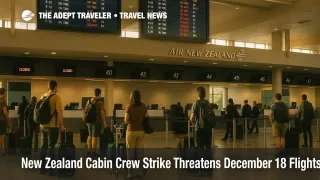
New Zealand cabin crew strike flights on Air New Zealand have shifted from a dual date threat to a single, high stakes risk centered on December 18, 2025, after the airline confirmed that previously planned industrial action on 8 December has been withdrawn. The carrier's latest travel alert says flights across its network will now operate as scheduled on Monday, easing immediate fears for domestic, Tasman, and Pacific itineraries that day. However, a separate strike notice from union E tū remains active for 18 December, forcing December travelers to refocus their contingency plans on one key pre Christmas date instead of a rolling series of walkouts.
In practical terms, the primary New Zealand cabin crew strike flights risk now lies in a potential 18 December walkout by narrowbody jet cabin crew, which would affect high frequency domestic trunk routes and short haul services across the Tasman and into the South Pacific, even as regional turboprop and long haul widebody networks are expected to operate normally.
How The 8 December Threat Changed
When E tū and fellow union FAANZ first issued strike notices for December 8, they covered regional turboprop, short haul jet, and long haul cabin crew in a coordinated 24 hour stoppage that could have affected 10,000 to 15,000 passengers through Auckland, Wellington, and Christchurch in a single day. Subsequent bargaining narrowed that risk as agreements in principle were reached for regional and long haul fleets, and those notices were stood down.
The latest update from Air New Zealand goes further and confirms that there will be no strike action at all on 8 December, with flights "across all of our network" to run as scheduled. For travelers already booked on Monday, that means the original advice to treat 8 December as fragile can be relaxed, though normal summer weather and congestion risks still apply. Anyone who pulled the plug early on an 8 December trip may now find that reacquiring seats in peak season is more expensive, a reminder that in live labor disputes it often pays to wait for formal airline waivers before making irreversible changes.
What The 18 December Notice Still Covers
E tū has kept one remaining strike notice in place for Thursday, 18 December, targeting narrowbody jet cabin crew, the group that staffs Airbus A320 and similar aircraft on domestic trunk routes, Tasman services, and many Pacific island flights. The union frames this as part of a broader campaign for pay and conditions covering roughly 1,200 cabin crew across Air New Zealand's fleets, but with regional and long haul agreements now largely parked, the leverage and disruption would be concentrated in the short haul network.
Air New Zealand's travel alert mirrors that structure. It states that, if the 18 December action goes ahead, regional and long haul services are expected to operate as scheduled, while the remaining uncertainty sits with domestic jet, Tasman, and Pacific flights that rely on narrowbody crew. At the same time, the airline emphasizes that there is currently no change to timetables on that date and that its focus is on reaching a deal that avoids disruption entirely.
Routes And Airports Most Exposed
If short haul cabin crew do walk out on 18 December, the most exposed itineraries will be those that rely on narrowbody jets routing through Auckland Airport (AKL), Wellington International Airport (WLG), and Christchurch Airport (CHC). That includes dense domestic trunk routes such as Auckland to Wellington and Auckland to Christchurch, feeder flights into long haul departures, and short haul international sectors across the Tasman to cities like Sydney, Melbourne, and Brisbane, plus Pacific islands.
Pacific holiday routes are particularly sensitive. Flights from Auckland to Rarotonga International Airport (RAR) and other island gateways already run with limited weekly frequencies, so a single day of cancellations or heavy retiming can strand travelers for 24 hours or more unless backup capacity is available. Travelers who have stitched together self built connections, for example a separate ticket from North America into Auckland, then a same day Auckland to Rarotonga sector on Air New Zealand on 18 December, carry the greatest risk of misconnection if any strike related delays appear.
What Air New Zealand Says It Will Do If The Strike Proceeds
For now, Air New Zealand stresses that there is "currently no impact" on schedules for 18 December and that its priority remains reaching an agreement that prevents any strike from going ahead. However, the same travel alert sets out the support customers can expect if industrial action does occur, including rebooking onto alternative flights, providing meals and refreshments at the airport, and arranging accommodation and ground transport when overnight stays become unavoidable.
Separate customer service and disruption guidance explain that when delays or cancellations are due to reasons within the airline's control, such as its own industrial action, affected passengers can generally choose between rebooking, credit, or a refund of the unused portion of their ticket, sometimes even on fares that are normally non refundable. The same policies outline timelines for rebooking on partner airlines, holding credits, and reimbursing reasonable out of pocket expenses for hotels and meals when passengers are forced to overnight away from home.
In earlier bargaining coverage, the airline indicated that it aims to give customers at least about five days warning before cancelling or significantly retiming flights due to strike action, which makes the window around 13 December a logical point at which any major schedule changes for the 18th would start to appear. Travelers should treat that date as a decision marker for whether to hold their nerve or actively move bookings.
Planning Strategies For December 18 Trips
For domestic travelers within New Zealand, the simplest hedge is to shift nonessential trips away from 18 December, either to earlier in the week or to the weekend that follows, particularly on trunk routes where alternative departure times are plentiful on neighboring days. Where dates are fixed, moving to earlier departures on the same day, ideally in the morning, gives more recovery options if the first wave of flights experiences disruptions while the airline is still repositioning aircraft and crews.
International and Pacific itineraries need a wider buffer. If you are traveling from North America or Europe into Auckland to connect onward to the Cook Islands, Fiji, Samoa, or Tonga, a one night stopover before any December 18 flight sharply reduces the risk that a delayed inbound long haul leg will cause you to miss a once per day island service that is itself at risk from strike action. The same logic applies in reverse for travelers leaving the islands and connecting to long haul flights home through Auckland, Wellington, or Christchurch.
Travelers with cruises, escorted tours, or weddings tied to specific dates should treat any 18 December Air New Zealand segment as a potential weak link. Booking fully flexible hotel and tour rates where possible, and confirming how far you can move flights under any eventual strike waiver before change fees or fare differences apply, is the best way to avoid panic decisions if a deal is not reached.
How This Update Fits With Earlier Adept Traveler Coverage
This article should be read as an update to earlier Adept Traveler reporting on Air New Zealand's December industrial action, including New Zealand Cabin Crew Strike Risk December 18 Flights and New Zealand Short Haul Strike December 18, 2025 Flights, which mapped the original dual date strike scenario and offered first pass route planning guidance. The new information is the clear split outcome, with 8 December now confirmed as a normal operating day while the remaining uncertainty has been pushed onto a single, later date that sits in the heart of the Southern Hemisphere holiday rush.
For travelers, the practical takeaway is to recalibrate risk by date and route. Monday, 8 December should now be treated as any other busy summer day, with normal allowances for weather and congestion, while Thursday, 18 December remains a live strike risk where narrowbody jet flights, particularly those feeding or leaving New Zealand gateways for Pacific islands, deserve specific backup planning.
Sources
- Air New Zealand travel alerts, cabin crew bargaining and potential industrial action
- E tū, 8 December strike notices withdrawn and new strike notice for short haul issued
- Air NZ cabin crews may strike in week before Christmas, RNZ
- Air New Zealand customer service and tarmac delay plan
- Domestic Flight Disruptions And Your Rights, Air New Zealand
- New Zealand Cabin Crew Strike Risk December 18 Flights, The Adept Traveler
- New Zealand Short Haul Strike December 18, 2025 Flights, The Adept Traveler