

New Zealand Cabin Crew Strike Risk December 18 Flights
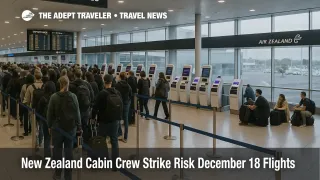
Air New Zealand's cabin crew dispute has shifted from an immediate threat of a full network shutdown on December 8, 2025 to a narrower but still serious strike risk for December 18 just as storms, staffing shortages, and an Airbus A320 recall have already hammered flights across Australia and New Zealand. The result is a December pattern where even minor weather or staffing shocks are translating into large clusters of cancellations and delays at key hubs. Travelers moving through the region now need to treat both the potential 18 December strike and the wider operational strain as active planning problems, not background noise.
In practical terms, the Air New Zealand strike December 18 flights risk now sits on short haul cabin crew who staff domestic jets and many Tasman and Pacific routes, layered on top of repeated late November and early December disruption waves that have already shown how fragile the regional aviation network has become.
How The Air New Zealand Strike Notices Have Changed
New Zealand union E tū has confirmed that all strike notices previously covering Air New Zealand widebody long haul, short haul, and turboprop cabin crew for December 8 have been withdrawn after what it calls "constructive progress" in bargaining. The union says those advances were enough to send new offers on widebody and turboprop agreements out to members for a vote and that crew have successfully pushed back against most contract clawbacks and secured at least a living wage floor on those deals.
At the same time, E tū has issued a fresh strike notice for short haul cabin crew that explicitly targets December 18, 2025, covering inter city New Zealand flights, trans Tasman links to Australia, and Pacific services. Union leaders say they withdrew the earlier 8 December notice for short haul as a gesture of good faith to allow bargaining to continue, but warn that if no fair settlement is reached before December 18, the new strike will proceed.
Air New Zealand's own travel alerts confirm that the 8 December industrial action has been called off and that the airline is now focused on resolving the remaining short haul dispute, while telling customers that it will provide updates and flexible options if a strike on December 18 becomes likely. For travelers, the headline shift is clear. December 8 has moved from red alert to mostly normal operations, but December 18 has become the new high risk date for anyone relying on Air New Zealand jets within the region.
Storms, Staffing, And Recalls Already Straining The Network
The strike story is landing on top of a network that is already under visible stress. On 25 November 2025, VisaHQ reports that a "perfect storm" of severe weather, crew shortages, and disrupted aircraft rotations led airlines to cancel more than 90 flights and delay over 600 across Australia and New Zealand in a single day, with Brisbane and Sydney logging some of the highest numbers of delayed movements.
Those issues did not resolve overnight. By November 30, separate analysis from Travel And Tour World showed that Air New Zealand, Qantas, Virgin Australia, Jetstar, and regional affiliate QantasLink had together recorded more than 70 cancellations and 336 delays across key hubs including Auckland Airport (AKL), Wellington International Airport (WLG), Christchurch Airport (CHC), Sydney Kingsford Smith Airport (SYD), Melbourne Airport (MEL), and Brisbane Airport (BNE), again driven by a mix of weather and operational constraints.
On November 29, a global Airbus A320 software recall added another layer of pressure, with Jetstar cancelling around 90 domestic and international flights across Australia in one day, and Air New Zealand warning of roughly 20 cancellations while it updated its narrowbody fleet. Although airlines now say the software fixes are largely complete, and most A320 family jets are back in service, residual backlog and aircraft repositioning continue to ripple through schedules.
The early December statistics underline that this is not just an old story. On December 3, 2025, Travel And Tour World counted more than 52 cancellations and 177 delays in a single day across Australia and New Zealand, affecting passengers at Christchurch, Wellington, Auckland, Brisbane, Melbourne, and Sydney as multiple carriers struggled with rolling disruptions. Taken together, late November and early December show a region where high demand, thin staffing margins, and weather prone routes are already producing repeated days of heavy disruption without any strike at all.
Where December 18 Risk Is Highest
If the new strike proceeds, the main risk is concentrated on Air New Zealand short haul jets that tie the network together. These aircraft operate high frequency domestic trunk routes, for example between Auckland, Wellington, and Christchurch, as well as many Tasman services to Sydney, Melbourne, and Brisbane, and selected South Pacific flights.
Because long haul and turboprop cabin crew are covered by preliminary agreements, long distance flights to North America or Asia and smaller regional routes beyond the main hubs are now less likely to see direct strike cancellations. The exposure instead falls on the connecting legs that feed and distribute that traffic, both within New Zealand and across the Tasman.
For example, a traveler flying from North America into Auckland on an overnight widebody Air New Zealand flight, then connecting to Wellington or Queenstown on a narrowbody jet on December 18, could find the domestic segment delayed or cancelled if short haul cabin crew walk off the job. Similarly, passengers booked on Tasman flights between New Zealand and cities like Sydney, Melbourne, or Brisbane on December 18 could see targeted cancellations or schedule reshuffles even if their onward long haul flights are unaffected.
The December disruption data also suggests that even if a strike is averted at the last minute, the combination of seasonal storms and ongoing staffing tightness at airlines and air traffic services can quickly produce 30 to 60 minute average delays at these hubs when conditions deteriorate. In other words, the strike risk is a peak on top of an already noisy baseline, not a standalone event.
How To Plan Itineraries Through Key Hubs
Given this backdrop, travelers should plan Oceania itineraries in December as if the system were operating with very little slack. That means minimizing exposure to the highest risk combinations rather than assuming everything will be fine.
For Air New Zealand tickets touching December 18, the first step is to check whether each leg is operated by short haul jets that fall under the remaining strike notice. If you have flexibility, moving purely discretionary travel to December 17 or December 19 is the simplest way to cut risk. Where trips cannot move, shifting to earlier departures on the same day, ideally in the morning when airlines have more recovery options, gives you more room to absorb disruption.
Connections deserve particular attention. Wherever possible, avoid separate tickets that require you to reclaim and recheck bags between airlines, because these are the first to fail when delays mount. Instead, try to keep long haul and regional legs on a single booking, add at least three hours between inbound and outbound flights at Auckland, Wellington, Christchurch, Sydney Kingsford Smith Airport, Melbourne Airport, and Brisbane Airport, and be ready to overnight if a critical connection is missed.
Travelers heading to cruises, escorted tours, or once per week long haul departures should also reconsider same day arrivals. Arriving one calendar day early into gateway cities like Auckland or Sydney, even at the cost of an extra hotel night, is a far lower risk than betting everything on a December 18 connection amid strike and weather uncertainty.
Booking, Waivers, And Backup Options
Air New Zealand's disruption guidance explains that in many irregular operations, affected customers can choose between date changes, credits, or refunds, including in some cases on non refundable fares, depending on the cause and timing of the disruption. If a formal strike waiver is announced for December 18, it will likely specify travel dates, fare classes, and how far you can move your flights at no extra cost, so reading the fine print and acting early is critical.
In the meantime, travelers should keep an eye on Air New Zealand's travel alerts page and ensure contact details in bookings are up to date so that schedule changes and rebooking options do not get lost in spam filters. It can also be worth pricing out alternative routings on carriers not directly involved in the dispute, especially for essential trips, while remembering that those airlines are facing the same weather and air traffic control constraints that have already produced large delay spikes across the region.
Finally, December's pattern is a reminder that travel insurance and a clear understanding of consumer rights in both Australia and New Zealand are not optional extras when booking complex itineraries. Local regulators and consumer agencies publish plain language guides on what airlines owe you in the event of cancellations or long delays, and these can be just as important as reading the fare rules on your ticket.
How This Fits With Earlier Adept Traveler Coverage
This update builds on our previous pieces, including Air New Zealand Strike Risk Narrows December 8, which examined how earlier agreements in principle reduced the scope of the original 8 December action, and Australia New Zealand Flight Delays From Weather, which documented November's recurring storm and staffing related disruptions. For a broader toolkit on preparing for airline industrial action, waivers, and rebooking, you can also refer to our evergreen guide, Guide To Airline Strikes, Waivers, And Rebooking Options.
Sources
- Air NZ cabin crew, 8 December strike notices withdrawn, new strike notice for short haul issued, E tū
- Air NZ cabin crew to strike for 24 hours on 8 December, E tū
- Union warns of further strike by Air New Zealand flight attendants, RNZ
- Air New Zealand travel alerts and disruption guidance
- 'Perfect storm' causes 90 flight cancellations and 672 delays across Australia and New Zealand, VisaHQ
- Severe weather and staffing shortages wipe out 16 flights, delay 100 plus at Sydney and Melbourne, VisaHQ
- Australia and New Zealand face travel chaos as Air New Zealand, Qantas, Virgin Australia, and Jetstar report over 70 flight cancellations and 336 delays, Travel And Tour World
- Travel chaos hits Australia and New Zealand as airlines face over 52 cancellations and 177 delays, Travel And Tour World
- Jetstar cancels 90 domestic flights across Australia after global Airbus A320 recall, The Guardian
- Jetstar Airbus A320 jets resume flying, some Air NZ jets still grounded, RNZ
- 2025 Airbus A320 software update, Wikipedia