

Flight Delays And Airport Impacts: December 7, 2025
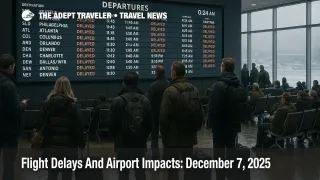
Ground stops at Chicago O Hare International Airport (ORD) and Hartsfield Jackson Atlanta International Airport (ATL) are driving US airport delays December 7, 2025, as snow and fog slow the first bank of flights. Passengers connecting through these hubs, and on regional routes that feed them, are seeing more cancellations and diversions than usual while morning schedules compress. Travelers with tight same day connections should build in extra buffer, be ready to rebook, or move departures to later in the day where possible.
The bottom line is that winter weather in Chicago, low visibility in Atlanta, and a thinner nationwide schedule are combining to keep US airport delays December 7 concentrated at a few large hubs while the rest of the network absorbs smaller knock on disruptions.
Where delays are building this morning
By midmorning on December 7, FlightAware was reporting 11,849 total delays and 383 cancellations worldwide, with 2,479 delays and 188 cancellations within, into, or out of the United States. That is a busy but not extreme day by holiday season standards, although the distribution of problems matters more than the headline totals.
In Chicago, a fast moving winter system is dropping snow at up to one inch per hour and has triggered a Winter Weather Advisory for most of the metro area through 900 a.m. CT. Local meteorologists report slick roads and reduced visibility across the region, and the Federal Aviation Administration (FAA) has issued a ground stop for Chicago O Hare until 915 a.m. CT, which forces inbound flights to hold at origin until conditions improve.
As of around 7:00 a.m. CT, that combination of snow and ground controls had already produced a little over 100 cancellations and nearly 200 delays at O Hare, while Chicago Midway International Airport (MDW) was seeing about 18 delays and no cancellations. Travelers using Chicago as a hub, especially those on morning bank departures, should expect longer taxi times, deicing queues, and higher odds of rolling delays cascading into the afternoon.
The Chicago forecast for the rest of the day keeps temperatures near freezing, with snow tapering to flurries and mostly cloudy skies. That should gradually reduce weather related restrictions, but cold air and intermittent lake effect snow showers can still slow operations, particularly on regional jets and short haul routes that turn quickly.
In Atlanta, a separate set of problems is playing out. FAA officials have ordered that all inbound flights to Hartsfield Jackson be held at their departure airports until 9:45 a.m. ET because of dense fog over the field, a classic recipe for reduced arrival rates and knock on delays across the Southeast. Some flights already en route are continuing into Atlanta, while others are diverting to nearby airports until visibility improves.
By 9:00 a.m. ET, FlightAware data cited by local media showed eight cancellations and 216 delays into and out of Atlanta, along with 25 diversions, underscoring how quickly fog can disrupt the world's busiest passenger hub. Even once the formal ground stop expires, it often takes several hours for the arrival and departure banks at Atlanta to normalize, so travelers on midday departures should still plan for residual congestion.
Outside Chicago and Atlanta, delays are more scattered. With no tropical systems in the Atlantic and only routine winter weather across most of the country, many airports are operating near normal, but individual pockets of low cloud and gusty winds can still trigger temporary arrival rate cuts. As always, the FAA's Daily Air Traffic Report frames these impacts as a planning guide rather than a precise prediction of every delay, and as of this morning the public report still reflected December 5 conditions, even though the same winter and visibility themes continue to shape operations.
Background: a thinner schedule leaves less slack
Since early November, airlines have also been flying a slightly reduced schedule at some of the nation's busiest airports. The FAA directed carriers to cut about 4 percent of flights at 40 high traffic airports starting in the first week of November, ramping the reduction to roughly 10 percent by mid month to cope with controller staffing shortfalls and the knock on effects of a protracted government shutdown.
Those cuts are spread across a long list of hubs, including New York area airports, Chicago, and other major cities, and they are designed to prevent systemic gridlock when staffing, weather, or runway works collide. For travelers, the practical effect is that there are slightly fewer seats on some routes and fewer spare aircraft and crews available when a disruption hits. On a day like December 7, when Chicago and Atlanta are both under constraints, that reduced slack can make it harder to find same day alternatives, particularly on popular trunk routes.
Travelers who follow these patterns day to day can compare today's map with the December 6 snapshot, when storm impacts and capacity limits were focused on a different mix of hubs, in our previous alert, "Flight Delays And Airport Impacts: December 6, 2025." That archive provides a useful baseline for how rolling winter systems and structural cuts interact over several days in a row.
For a deeper explainer on how air traffic control delays and ground stops work in the United States, and why seemingly mild weather can still produce long lines at security and packed gate areas, see our evergreen "Guide To U.S. Airport And Air Traffic Control Delays," which breaks down the main tools FAA uses to manage the National Airspace System.
How today's pattern affects different travelers
If you are connecting through Chicago O Hare today, the highest risk window is the morning and early afternoon, when deicing, runway clearing, and recovery from the ground stop all compete for limited capacity. Long haul arrivals from Europe or the West Coast scheduled to reach Chicago around this time may face holding, diversions, or lengthy waits for gates. Short haul and regional flights, which often turn around quickly using the same crew and aircraft, are especially vulnerable to rolling delays when the first arrival leg is late.
At Hartsfield Jackson, the immediate threat comes from low visibility and fog, which reduce arrival rates and can trigger a string of diversions that then need to be refueled and repositioned later in the day. Passengers bound for Caribbean or Latin American connections through Atlanta should be particularly cautious, since those flights often have less frequent service and may not have another departure later in the day. Domestic travelers using Atlanta as a connecting hub may find that the worst impacts are on morning and midday banks, with a gradual improvement into the evening as fog lifts and aircraft reposition.
For travelers starting or ending their trips in Chicago or Atlanta, the weather also complicates the ground side of the journey. Snow and slick roads around Chicago can slow highway traffic to and from both O Hare and Midway, while fog in Atlanta can force slower speeds and sudden congestion on access roads near the airport. That means the risk of missing a flight is as much about the drive to the terminal as the air traffic control situation itself, especially at peak times.
Planning connections and next steps
On December 7, the safest strategy for connections through Chicago or Atlanta is to avoid minimum layovers whenever possible. For a through ticket, aim for at least two hours on domestic to domestic connections and three hours or more when an international leg is involved, especially if it relies on a single daily flight. For separate tickets, treat the connection as if you were changing airlines in a different city, and consider leaving half a day if one of your flights uses Chicago or Atlanta in the morning.
Travelers who have not yet left home should check their airline app or the carrier's website before heading to the airport, even if their flight is still listed as on time. If you see a ground stop or flow control program listed for your destination, ask whether free same day changes or travel waivers are available that would allow you to shift to a later departure once conditions improve. During periods of heavy use of ground delay programs and ground stops, gate agents and call centers are often authorized to rebook affected passengers without extra fees.
If your flight is already significantly delayed, keep an eye on crew duty time limits and curfews at your destination. When winter weather drags into the evening, there is a risk that a delayed aircraft cannot legally depart because the crew times out, or that a late arrival would violate night noise rules at certain airports. In those cases, airlines may preemptively cancel or reroute flights, making it even more important to claim an available seat on the next workable option as soon as possible.
Finally, remember that both these weather events and the ongoing schedule reductions are part of a longer seasonal pattern rather than a one day anomaly. Comparing your plans with recent daily snapshots, including our December 6 report, can help you decide whether to keep a risky itinerary, add a hotel overnight, or shift travel to a calmer day.
Sources
- FAA Daily Air Traffic Report overview
- FlightAware live flight delay and cancellation statistics
- Atlanta News First, ground stop for inbound flights into Hartsfield Jackson due to fog
- Fox 32 Chicago, snow and ground stop at O Hare
- Reuters, FAA orders flight cuts at 40 high traffic airports
- OPB, travelers face cancellations as FAA orders flight cuts