

Vilnius Airport Balloon Closures Hit Baltic Flights
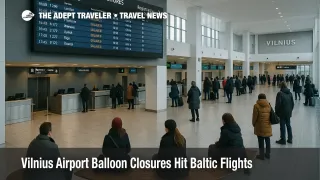
Repeated Vilnius airport balloon closures are now one of the most unusual and disruptive aviation risks in Europe, and they are hitting Baltic winter flight plans with little warning. Since early October 2025, Lithuania's air navigation authorities have repeatedly shut airspace above Vilnius Airport (VNO) when clusters of suspected cigarette smuggling balloons launched from Belarus drift into controlled zones, sometimes for minutes and sometimes for most of a night.
Lithuanian Airports, which runs Vilnius, Kaunas, and Palanga, now estimates that roughly 320 flights and more than 45,000 passengers have been affected by balloon related closures in recent months, about 5 percent of all travelers moving through Vilnius over that period. The operator puts direct financial losses above €750,000 (about $810,000 USD), and that figure does not capture extra hotel costs, missed connections, and disrupted tours borne by passengers and airlines. For travelers planning Baltic trips, this is no longer a one off oddity, it is a live operational pattern.
In practical terms, the Vilnius airport balloon closures mean that any flight using the Lithuanian capital as origin, destination, or hub can be frozen if radar detects balloons in critical flight paths. Inbound aircraft are sometimes placed in holds, but more often they divert to Kaunas Airport (KUN), Riga International Airport (RIX), or occasionally Warsaw, while departures sit on the ground waiting for airspace to reopen. That ripple then runs down the rest of the day's rotations.
The most dramatic recent closure came between late November 30 and the morning of December 1, when Lithuanian officials reported about 60 balloons entering restricted zones and kept Vilnius shut for roughly 11 hours. A separate incident in late October saw seven hours of disruption and triggered the temporary closure of Lithuania's last two open border crossings with Belarus after radar detected 66 balloons in a single night. These long closures stranded thousands of passengers, with some travelers being bussed between cities in the middle of the night.
The pattern has continued into December. Vilnius has already seen several brief night closures this week alone, including a shutdown on December 6 that suspended operations for about an hour and a half, affected roughly 1,000 passengers, and forced nine flights to cancel or divert. Lithuanian media reported that four flights were redirected to Kaunas and at least one aircraft diverted as far as Riga before later returning to Vilnius when restrictions were lifted.
Officials say closures have hit Vilnius more than ten times since early October, while Kaunas has also faced at least one shutdown linked to balloons. Lithuanian authorities describe the balloons as part of a hybrid attack, blending criminal cigarette smuggling with deliberate pressure on an EU and NATO state, and they blame Belarusian authorities for allowing launches from just across the border. Belarus denies orchestrating the incursions.
In response, Lithuania has already gone beyond airspace closures. The government briefly shut key border crossings with Belarus in October, deployed military units to help neutralize balloons, and is now considering further EU sanctions over what officials call a cynical hybrid operation. Lithuanian Airports says it is investing more than €1 million in countermeasures, including AI assisted detection and interception tools, and new legal penalties for smugglers.
Those countermeasures could themselves shape airline schedules. One proposal under active discussion is shifting most night flights from Vilnius to Kaunas to reduce exposure, especially during the 1100 p.m. to 500 a.m. window when winds often carry balloons across the border. Some carriers are already tweaking timetables; local reports say Finnair has dropped one evening Vilnius frequency because of balloon related uncertainty, and more schedule fine tuning is likely if closures keep recurring through the winter season.
For travelers, the problem is not that Vilnius is unsafe, but that your flight may suddenly be unable to land or depart, even under clear skies. When airspace closes, passengers on inbound aircraft are often bused back from Kaunas after diversions, and connecting travelers can find their onward flights long gone by the time they reach the capital. Travelers departing Vilnius can face long queues when the airport reopens and multiple waves of delayed flights try to leave at once.
Background: How Balloon Closures Work
Air traffic control, ATC, has to assume that any unidentified object near arrivals or departures paths is a risk, especially if it is metal framed or large enough to damage engines or windscreens. When radar picks up balloon like objects near critical corridors, controllers suspend departures and arrivals until they are confident the objects have moved or been neutralized. Unlike a thunderstorm, this kind of hazard is hard to see out the window, and it can appear in clusters, which is why closures sometimes last for many hours.
Because Vilnius sits only about 30 kilometers from the Belarusian border, balloons need only a modest tailwind to drift into controlled airspace. Lithuania's location on the eastern edge of the European Union and close to Russia's Kaliningrad region makes airspace integrity politically sensitive, so authorities err on the side of caution and may keep airspace closed longer than pure safety calculations would dictate.
Which Itineraries Are Most Exposed
The greatest operational risk sits with late evening and overnight flights into and out of Vilnius, especially during the shoulder and winter seasons when winds aloft favor cross border balloon drift. Flights that are first in the rotation for an aircraft the next morning are also vulnerable, since a long diversion to Riga or Warsaw can leave the plane and crew out of position for the next day's departures.
Travelers connecting through Vilnius on low cost or separate tickets to other Baltic cities, Scandinavia, or Western Europe are at particular risk of misconnects. During earlier multi hour closures, dozens of flights were diverted or cancelled in a single night and tens of thousands of passengers were delayed, so even a short planned layover may evaporate once the system restarts.
By contrast, daytime non stop trips with no onward connection, especially those arriving and departing in midmorning or early afternoon, face less balloon related exposure, although normal winter weather issues still apply. Kaunas and Riga can absorb some diversions, but they are not designed as full time alternates for Lithuania's main hub, so accommodation and ground transport can be tight when several aircraft arrive unexpectedly at night.
Practical Strategies For Baltic Travelers
For winter 2025 and early 2026 travel that touches Vilnius, treat balloon related closures as a real variable rather than a curiosity. Build at least three hours of connection time for Schengen to Schengen links through Vilnius and at least four hours for trips involving passport control, especially if you are self connecting between different tickets. Avoid planning last flight of the day arrivals into Vilnius when you have a cruise departure, tour start, or rail connection early the next morning.
If you have flexibility, favor itineraries that use Riga as the main hub and Vilnius as an end point reached by train or regional hop, or consider Kaunas for late night arrivals when schedules allow. For itineraries that must use Vilnius as a connection point, choose airlines that can rebook you on alternative routings through other hubs if Vilnius goes down for several hours.
Travelers should also update their monitoring habits. Install airline apps, allow push notifications, and check flight status the evening before and morning of travel, because airspace restrictions may be announced with very little lead time. Lithuanian Airports maintains incident updates on its website and through local media when closures occur, and flight tracking tools like Flightradar24 have been highlighting Vilnius disruptions in real time as balloons appear on radar.
Finally, budget for contingencies. When booking winter trips through Vilnius, consider refundable hotel rates or properties with late arrival flexibility, especially if you might end up in Kaunas or Riga overnight. Keep a small overnight kit in your carry on, and plan for the possibility of coach transfers between airports in the middle of the night if closures drag on.
For deeper structural context on European airspace security and how smuggling and hybrid attacks can spill into travel disruption, Adept Traveler's wider coverage of drone incursions and airspace violations across the continent can help frame this Baltic story within a larger pattern.
Sources
- Lithuanian Airports estimate 320 flights and 45,000 passengers hit by smuggling balloons
- Contraband balloons trigger chaos at Lithuanian airports
- Belarus weather balloons force repeated closures of Lithuania's main airport
- Vilnius airport resumes operations after overnight halts, delays possible
- Vilnius airport halts flights for third time this week after balloon sightings
- Why Vilnius Airport keeps closing
- Lithuania shuts airports and Belarus border after weather balloon incursion