

Red Sea Piracy And Slow Suez Return Keep Cruises Wary
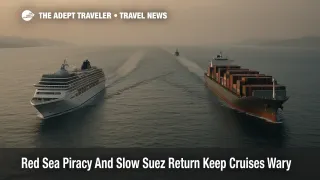
Red Sea piracy cruise itineraries are in flux after a suspected attack on a bulk carrier near the Bab el Mandeb Strait on December 5, 2025, and the long delayed release of mariners from the Eternity C attack earlier in the year. The incidents come just as shipping companies, insurers, and cruise lines are testing how far a Gaza ceasefire and a pause in Houthi missile strikes actually reduce risk along the corridor between the Gulf of Aden and the Suez Canal. For travelers, this mix of easing state backed attacks and reemerging piracy makes it more likely that cruise itineraries will keep avoiding the Red Sea, or will only return with heavy escorts, long detours, and conservative scheduling.
In practical terms, the Red Sea piracy cruise itineraries that once linked Asia, the Indian Ocean, and the Mediterranean are now one of the most uncertain bets in long haul cruising, even as 2026 world cruises and repositioning voyages are being locked in.
New Incidents Signal A Shift Back Toward Piracy
On December 5, 2025, a ship transiting the Bab el Mandeb Strait reported being chased and fired upon by small boats, with armed security guards on board returning fire and keeping the attackers at bay. The United Kingdom Maritime Trade Operations center described the vessel as a bulk carrier, and security firm Diaplous Group said the ship came under attack twice, although no injuries or damage were reported and the ship continued its voyage.
This kind of small boat attack looks more like classic piracy than the drone and missile strikes associated with Yemen's Houthi movement, which had dominated Red Sea headlines since late 2023. Maritime risk advisories have warned that as naval patrols, air defenses, and political negotiations push Houthi attacks into a pause, opportunistic pirate groups in the Gulf of Aden and around the Horn of Africa could see a chance to return.
At the same time, the human cost of earlier Houthi attacks is only now moving toward closure. In July 2025, the Liberian flagged bulk carrier Eternity C was struck multiple times in the Red Sea, reportedly by sea drones and rocket propelled grenades, killing at least four crew members and eventually sinking the vessel. While most of the crew were rescued at sea, Houthi forces detained a group of surviving mariners for months. In early December, officials in Oman and the Philippines confirmed that 10 to 11 mariners had finally been released and flown to Muscat, though there is still ambiguity in public reporting about the exact headcount.
For cruise planners, these incidents reinforce that while missile and drone strikes may be paused, the corridor remains volatile, with a mix of political, criminal, and military actors able to threaten shipping.
Ceasefire And Pause In Houthi Attacks Do Not End Risk
Following a fragile ceasefire between Israel and Hamas in October 2025, Yemen's Houthi authorities announced on November 11 that they would suspend maritime attacks and lift their self declared blockade on Israeli linked shipping. Marine insurers and protection and indemnity clubs have welcomed the pause but continue to label the southern Red Sea, Bab el Mandeb, and parts of the Gulf of Aden as high risk areas subject to special war risk premiums and routing advice.
Recent reporting also underscores that the wider region remains unstable. In mid November, Iranian forces seized the Marshall Islands flagged tanker Talara in the Strait of Hormuz, showing that other actors beyond the Houthis are ready to test shipping routes and insurance limits. For cruise passengers, the immediate threat is not a direct strike on a cruise ship, since no cruise vessels have been targeted so far, but the constant possibility that security conditions, insurance terms, or naval assessments will force last minute route changes.
Container Lines Show How Slowly Suez Will Come Back
When container line executives talk about their own Red Sea plans, they highlight caution rather than a rush back to Suez. Hapag Lloyd chief executive Rolf Habben Jansen told customers in early December that the shipping industry's return to the Suez Canal will be gradual, with no firm resumption date and a transition period of 60 to 90 days once security is judged acceptable, in order to avoid new bottlenecks at ports and along the canal.
Since late 2023, Hapag Lloyd, Maersk, and other major carriers have routed most Asia to Europe and East Coast North America cargo around the Cape of Good Hope, accepting extra transit times of roughly 10 to 14 days and higher fuel costs as a tradeoff for safety and predictability. Even with a ceasefire on the books, these companies are signaling that they will only reintroduce Red Sea and Suez transits slowly, ship by ship, and that a full normalization could stretch well into 2026.
Cruise lines, which are more exposed to passenger perception, tourism demand, and strict safety expectations, are unlikely to move faster than the container shipping sector.
World Cruises For 2026 Shift Away From The Red Sea
Cruise itineraries already reflect this caution. MSC Cruises has confirmed that its 2026 world cruise on MSC Magnifica will avoid the Red Sea and Suez Canal altogether, rerouting around Africa instead. The revised itinerary adds roughly 12 days, introduces ports such as the Seychelles, Mauritius, Réunion, South Africa, Namibia, and Cape Verde, and drops calls in Sri Lanka, the United Arab Emirates, Oman, Jordan, Egypt, and Greece.
Holland America Line has reworked its 2026 Grand World Voyage on Volendam to bypass the Red Sea as well, turning the trip into a 133 day route that emphasizes East and Southeast Asia, Central America, and a Panama Canal transit instead of a Suez crossing.
Princess Cruises has taken a similar approach, cancelling or repurposing announced 2026 world cruises into "Circle Pacific" voyages that remain in the Pacific basin and use the Panama Canal rather than the Suez Canal to connect with the Atlantic, after already routing earlier world cruises away from the Middle East.
Looking across these decisions, a pattern emerges. Multi month world cruises that once reliably included Red Sea ports and Suez Canal transits are increasingly being redesigned as Africa circumnavigations or Pacific circle routes through at least 2026, which implies that even an extended lull in attacks will not bring an immediate return of classic Red Sea cruise itineraries.
What This Means For Individual Cruises
The highest exposure sits with long repositioning voyages and world cruises that would normally link Southeast Asia, the Indian Ocean, and the Mediterranean through the Red Sea, or connect Gulf hubs such as Dubai and Abu Dhabi with European ports. Itineraries that still advertise Suez Canal transits or calls in Red Sea ports like Aqaba in Jordan, Safaga in Egypt, or Jeddah in Saudi Arabia need to be read with a critical eye, because even if the line hopes to operate them, security conditions or insurance decisions could still force a last minute reroute around Africa.
By contrast, cruises that never come near the Red Sea, for example Pacific circle routes, South America and Antarctica loops, or Atlantic and Caribbean itineraries, face indirect effects such as ship redeployments and pricing shifts but are not directly exposed to Bab el Mandeb or Suez.
So far, major lines emphasize that passenger and crew safety is the first priority, and they have rerouted ships proactively rather than sail into areas their security teams consider unstable. For travelers, the main risk is not physical harm, it is lost ports, longer sea days, and disrupted onward flights if a voyage is stretched or rerouted.
For more background on diversions through the Cape of Good Hope and how they affect cruise schedules and pricing, Adept Traveler's deeper explainer on the Red Sea shipping crisis and its impact on cruise routes, and our guide to choosing safer cruise itineraries near conflict zones, outline the structural issues behind these itinerary changes and how to interpret evolving advisories.
How To Read Advisories And Choose Less Exposed Itineraries
When evaluating a 2025 or 2026 cruise that mentions Suez or Red Sea ports, travelers should first read the fine print in the itinerary and any security or "operational flexibility" language in the brochure or website listing. Lines that clearly reserve the right to reroute around Africa, change embarkation or disembarkation ports, or adjust dates are signaling that they see meaningful residual risk.
Next, it is worth comparing the advertised route against current government travel advisories and maritime security warnings for the Red Sea corridor, including guidance from your home foreign ministry and from specialized shipping insurers that continue to classify parts of the region as high risk. If official channels describe a persistent threat of attacks, piracy, or seizures, you should assume that itineraries may change even after final payment.
It is also prudent to consider how a sudden switch from Suez to the Cape of Good Hope would affect your own plans. Detouring around Africa can add one to two weeks to a voyage, potentially changing your arrival city and date. Travelers who book nonrefundable flights, complex rail connections, or pre and post cruise hotel stays should leave more slack, use refundable or changeable rates where possible, and work with a travel advisor who can help rebook if the route adjusts.
Finally, insurance needs to match the risk. Some standard travel insurance products exclude war, terrorism, or piracy related disruptions, or treat itinerary changes without a port closure as non covered events. Policies that specifically mention coverage for common carrier interruptions caused by security events, or cancel for any reason upgrades, can give more protection in a fluid environment, but they come with cost and timing conditions that need to be understood before purchase.
Background: Why Bab El Mandeb And Suez Matter
The Bab el Mandeb Strait and the Suez Canal together form one of the world's most important maritime chokepoints, linking the Indian Ocean and the Mediterranean through the Red Sea. Research on global shipping networks has shown that a significant share of container traffic, oil shipments, and general cargo moves through a small number of such narrow passages, making disruptions here disproportionately important for trade, freight prices, and cruise routing.
Even when attacks do not directly hit cruise ships, the combination of security alerts, insurance costs, naval deployments, and political pressure can shift the entire flow of shipping away from a region. For the Red Sea, that has already meant a sharp increase in traffic around the Cape of Good Hope, longer voyage times, and a growing tendency for cruise lines to design itineraries that either avoid the corridor altogether or treat it as an exception requiring special planning and escort.
Unless there is a long period of proven stability, clear de escalation, and a corresponding drop in war risk surcharges and security alerts, travelers should assume that classic Suez and Red Sea cruise itineraries will come back slowly, if at all, through at least the 2026 season.
Sources
- Ship in Bab el Mandeb Strait attacked by suspected pirates
- Houthis release mariners held since July attack on ship in Red Sea
- Houthis release crew of Greek operated cargo ship struck in Red Sea
- Updated threats to shipping in the Red Sea
- Red Sea and Gulf of Aden, Security threat to shipping
- Shipping industry's return to Suez will be gradual, Hapag Lloyd CEO says
- MSC reroutes 2026 world cruise to avoid Red Sea
- Princess Cruises, Coral Princess world cruise to skip Red Sea, focus on Pacific
- Holland America Line's 2026 Grand World Voyage refreshed to avoid Red Sea
- Systemic impacts of disruptions at maritime chokepoints